Sunday


I had no energy left today. Needed to recharge, so I stayed at home.


My unit flooded with all the rain, so the carpet in the spare room is ruined and I need to get someone to fix everything on Monday. My best friend was coming to stay for a few months and now he has had to find a bed elsewhere until I can get it all fixed. I had to keep mopping the floor under the carpet on Friday and Saturday and today it started raining again, so I had to keep shutting the doors and windows I had opened to let some of the moisture out of the house.

I’ve been putting up with the leak issue for a long while now because the builder had to diagnose the source of the leak, but the torrential downpour last Friday made everything much worse than ever.

Friends had asked me out and I also should have visited various family members who are still mourning my brother’s death, but I would not have been good company today. I just had to stop and do bugger-all.

Hopefully the new week will bring a better attitude and more energy.

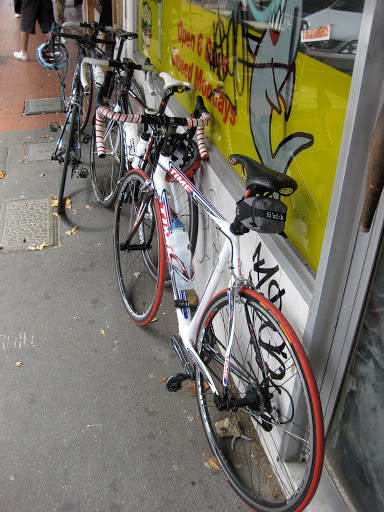
Oh and the image is unrelated. Just a heap of bikes I perved at in Elwood earlier this year.

Vivid & Sydney Film Festival 2010

I hope you all stayed up late waiting for this. It was a late night. And I must say that tonight Rage is playing the worst music I’ve heard in ages (apart from the stuff after 5.30 am). Terrible guest programming.
So tonight I went out to two flicks at the 2010 Sydney Film Festival. Firstly there was the Australian premier of The Tree at the State Theatre. It is a decent film about loss, grief, imagination, families and country Queensland. As I’ve recently lost my brother in an accident it was all a bit close to the bone for me. Everyone is going to say it is beautiful, poetic and lyrical, but I’m not so sure. There was a lot I liked, but overall, I don’t think it grabbed me or convinced me. Sorry.
After that we walked down Macquarie Street to look at all the Vivid lights and then entered the Sydney Opera House for Nosferatu with Darth Vargus. The band and score were excellent as were the sound effects by Miss Death. Jamie Leonarder’s introduction just went on for too long. And for me the film is just pretty corny. It may well be historically significant, but I’m glad we didn’t have to sit through it without the amusing live soundtrack. Even so I fell asleep a number of times.
I have to add that the seats in both venues were excellent and I had heaps of leg room. You cannot say that about all film venues in Sydney, especially some old cinemas in Oxford St.

Librarians, active content creation & going beyond what is expected

In early May 2010 I gave a talk at the State Library of NSW to a meeting of reference librarians. Ostensibly it was to talk to a series of images that I took while making a curatorial visit to Iraq for the Australian War Memorial in late 2008, but I thought that I’d put that trip in context by discussing why I think getting curators, archivists and librarians out “into the field” is important. So here is the gist of my talk. The embedded slideshow above should be viewed with this outline of my thoughts.


I wonder whether we are too passive?

I also wonder whether we are we too obsessed with how technology works (and not really using it to its potential)? Everywhere we talk about data mash-ups, catalogue improvements, better discovery & search tools, mobile platforms, cloud computing and digitising content. All of these things are worthy of our attention but surely there is more we can do aside from using technology better and there are other more fundamental tasks to focus on as well. Also, as far as technology goes, is the tail wagging the dog? Have we already lost control?

I’m sure most of our users and patrons all not be satisfied by cultural institutions that simply present and ever increasing echo chamber or a means of reflecting user-generated data. I think they want and expect more from us than that.

We can create and we must also be more proactive in collecting and developing our collections to reflect contemporary content, not just what has been collected by those who came before us. It isn’t sufficient to rely only on subscription services and commercial publishers.

My inspiration for these thoughts comes from other things that I see and hear about. Generally it comes from those who do create and perform, for example, the Australian Chamber Orchestra. Recently they again dazzled audiences around Australia by mixing pieces from more recent composers (Shostakovich, Shoenberg and Pärt) within Bach’s Missa Brevis in G Minor. It worked for me and I think it provided another way to interpret and enjoy Bach’s older work. The performance seemed to breathe new life into this work. The ACO constantly push boundaries and collaborate with cartoonists, writers, actors, and modern singers in order to keep their audiences both surprised and delighted.


Surely we can take a leaf out of their book and do what is not expected of us nor taught to us. Something more. Something beyond the rules. Not more of the same. We need to get beyond our traditional boundaries.

We need to create and to facilitate or encourage the creative talents of our patrons by modelling that behaviour ourselves, not just by providing the technological tools and spaces, nor by just digitising what was collected by those who came before us. We also need to get out there and collect contemporary content now from each of our “communities” whether they be an institution, region, small town, state or nation.

It will be good for us: being fun & playful; being a rich new experience; uncovering hidden talents; and by making our profession more interesting, stimulating and attractive. It should also delight our patrons. We must play out instruments and ride our bikes, not just leave them aside, locked up in a safe place.


So what are some of the options are available to us now?

  • curating exhibitions;
  • writing & story-telling – online and traditionally;
  • actively collecting (not just contracting it out);
  • facilitating online open access publication (particularly for academic libraries);
  • hosting digital repositories;
  • running film and short-story festivals, poetry slams, readings & other competitions;
  • facilitating community cultural projects like co-curation projects;
  • producing, directing and finding sponsors for artist/geek/writer/gamer/musician/visionary-in-residence programs;
  • producing and editing online magazines;
  • creating local content for our library collections (film, audio, music, games, animations, photo collections, even artists’ books) – and this can be done with what makes your community different or unique, just as the AWM’s focus is on Australian experience of war, yours might be an industry, local pioneers or veterans, immigrant families, famous families, a factory, an institution, craft, a crop, farms, etc.;
  • producing photo essays;
  • hosting travelling exhibitions; and
  • exhibiting (not just displaying) our special collections.

So, now to talk about my collecting visit in Iraq and the in 2008.


It may not sound relevant to reference and information service librarians in all kinds of libraries, but it is all about asking for what you want (to do), grasping your chances when they come and creating content yourself.

We (i.e. my senior curatorial colleagues in our museum) had been asking to send curators and archivists to the field for years, so when the opportunity presented itself, I had very little time to prepare for it and there was no time to stop and think about whether it was wise, safe, advisable, practical, the right thing to do, in my duty statement, feasible, etc. I just went.

There were no rules or guide books. Other than some general telling me to “do as you’re told!”.

The Australian War Memorial obviously has a strong focus on its own community and works very hard to maintain trusted and respected relationships with its key stakeholders and their representatives. It knows its core business and as a library/archive we needed to get more strongly aligned and involved with that.

We had set up and run collection groups focusing on the Australian Defence Force’s recent and ongoing operational commitments overseas. A subset of this was an official records working group looking at the challenges of ensuring a lasting record of war was being made and kept in the digital age. First, we had to identify what that records was and update our knowledge and processes from the Vietnam era! Since then all trains had changed on all platforms. This was impossible to scope from Canberra by meeting with a group of archival bureaucrats.

We had a couple of things on our side (eg. AWM’s reputation, my security clearance), but essentially I had to quickly learn how to select a “target” (no pun intended), get in someone’s face, establish trust, ask relevant questions, cover rights and permissions, grab and/or create something and then keep going.

Generally speaking, not many of us are trained to do all of that and we hardly ever practice it, but I can think of many reasons we should.

Somewhere, someone realised that the end of 2008 was probably going to be our last opportunity in Iraq and Northern Gulf waters to identify what we wanted as a record of years of Australian involvement. We didn’t know what there was nor what it looked like.

Over the course of the trip, there were many amazing opportunities that presented themselves and I just needed to take them when they were offered.

Some libraries are focusing on the creation of content (e.g. the Edge at the State Library of Queensland) and I think this is a good example of something feasible for all librarians if they can think beyond the norm and of the possibilities that are easily done now for digital story telling, taking and sharing images and small oral histories (from just local events and local people). All we need to do is get started.

A collection of thoughts


It has been raining on and off for ages in Sidknee.

I don’t like riding or running when it is wet and cold.
I bought a new red and white umbrella.
I should not complain as Sidknee weather is actually pretty mild.
There is a mystery leak in my house that is ruining the carpet in the spare bedroom.
I’ve been riding indoors watching recorded shows and DVDs.
I watch a lot of Vampire and crime flicks.
Then I walk to the light rail and catch a tram to work.
I like the light rail.
I miss having my bike in my office, but don’t know why.
I listen to music while walking and check email and Twitter on the tram.
Currently I’m enjoying the new Cloud Control and Midnight Juggernauts albums.
My walking track is so dark at night that I’m now taking a torch with me.
I think the walk in the weather is a good reminder of the benefits provided by shelter at home and at work.
I’m lucky.
My friends at work have been fantastically supportive since my brother’s death.
Friends surrounded me at a talk yesterday.
I’m very lucky.
Inclement weather seems more appropriate for grieving.
Soon I think I’ll be able to concentrate enough to read books again.
That doesn’t mean I’ll ever finish them.
I think they are getting closer to finding the source of the leak at home.
When you have a leak in your house you don’t enjoy the sound of rain as much.

30 posts in 30 days challenge


Just a quickie! Kathryn Greenhill has created a list of all the bloggers we know that are taking part in the 30 posts in 30 days challenge. She is way clever.

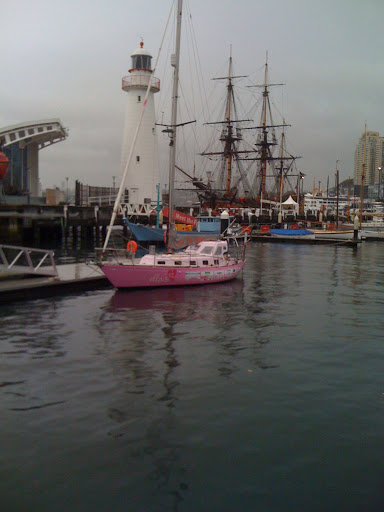
(The image to the right is Jessica Watson’s tiny boat at the Australian National Maritime Museum on a rainy day last week.)

Oh, and just in case you’ve not yet seen it, here is Kate Bunker’s Netvibes page of widgets for all the blogs participating in this challenge. Even Kathryn thinks Kate is clever.

Knit In @ UTS Library


Yesterday we had our first Knit In at our Library. It was very well attended and enjoyed by all participants.

Why did we do it?
Well it resulted from our Earth Hour competition. The winner, Ben Schuman, suggested that we could turn down our heating by asking people to wear their outside gear inside the library. (And you can see Ben knitting towards the rear of the image, just to the right of centre.)
So what?
It is a small step, but it signals more “greening” of our Library and our intent for the future. It also brought new people to the Library and we welcomed them well enough that some asked for us to make this a more regular venue for knitters at UTS.
Part II
So when we did this, some of the knitting participants suggested that the Library was a better place to do this than their usual venue (a traffic island in Harris St). I indicated to them my tentative support, given my well known belief that knitters in conferences are just terrorists in disguise. And then I went even further than this suggesting that we could certainly allocate them a space of approximately 1.37 sq m on a regular basis as long as we account for the following simple risk factors and corporate governance requirements:
  • development of a full risk register (accounting for all OHS hazards – needle injuries, woolen trip wires, people knitting disguises for terrorists, sheep dogs, excess knitting noise, etc.);
  • development & printing of new permissions forms (Entry to Library with Needles; Permission to Knit; Intellectual Property; Public Liability; No Fault Disclosure; Damage to Third Party; Personal Insurance Declaration; etc.);
  • appointment of a fully certified Quantity Surveyor and independent auditor for the club’s budget;
  • cleaning of knitting areas (for lost needles, dye stains, stray shearers, wool, fur balls, patterns, wounded knitters, etc.);
  • a security plan for the knitting area (I believe these cost at least US$90 million); and
  • quality control & assurance (we do not want to ruin our reputation by having people wandering around in garments that do not fit well or are not stylish).

That should be easy enough.

Recovery via Belvoir, the ACO & At The Movies


I think I’m slowly starting to improve in spirit and mind after the unexpected death of my brother Murray in early May. For a while it was all surreal, unsettling and confusing. I could not really concentrate on much at all. I could not read or even watch movies. One night I left a live concert at the Enmore Theatre (see image left) in a complete state of confused anxiety.


The support from my friends and family has been amazing and really helpful in aiding my own recovery. I’m now beginning to see some things more clearly again, but I find my emotions are still in over-drive.

So, I think I’ll try and post something each day on this blog as part of my recovery and in line with the #blogeverydayofjune hashtag on Twitter. Maybe someone will notice whether the posts become more or less coherent over the month. This first post is probably going to be a bit of a mess but I did warn you that my emotions are still in over-drive. Mind the step . . .


I saw The Power of Yes by Company B at Belvoir St Theatre on Friday night and really enjoyed it. I tweeted after it that it was “Brilliant, funny, but sadly all too true” and I stand by that comment. Maybe it is the lapsed economist in me? I also saw the ACO’s Romantic Symphony concert that mixed music by Schubert, Brahms and Johnny Greenwood (the lead guitarist from Radiohead) on Saturday night. There was a lot of energy apparent on both stages. What both Company B and the ACO do is really challenging because they must keep their products or output fresh and entertaining and up to the demands of very critical audiences with high expectations of satisfaction. Maybe they are measured by paying bums on seats, but I think the performers also know themselves when they are doing self-satisfying and fulfilling work.

I don’t think the kind of management theory that emanates from Harvard Business School that, along with a culture of sheer greed, gambling and competition, has almost destroyed the finance industry can be applied neatly to rescue or to keep afloat libraries and other cultural institutions. This is especially the case given the kind of second rate management “experts” (who didn’t make it to the finance industry) who tend to regard it so highly in such institutions. We don’t simply have clients and stakeholders and we don’t need to worry about bottom lines and shareholder returns in exactly the the same way as a merchant bank does. Our outputs are different and we should be able to focus on more specific qualitative indicators that are much harder to measure.


Obviously, just focusing on ticks in corporate governance boxes (designed by finance managers) does not work either. We are services providers, but not in the same way as a retail store or a call centre. What we do is less tangible, but not less important. I think we have more to learn from successful artists and maybe from the Artistic Directors and General Managers of successful arts organisations like the ACO than we do from sundry second rate management consultants, accountants or auditors. That lot should not be steering our course.

On a happier note, On Sunday afternoon I caught up with At The Movies on ABC TV. I’ve been a fan for years, even though I don’t always agree with David’s or Margaret’s ratings. David was reporting from the 2010 Cannes Film Festival and I really liked what the actor Melanie Thierry had to say about her Director Bertrand Tavernier (not to the bishop!) in the film The Princess of Montpensier. I think it is what we have been trying to do at UTS and what distinguishes us from many other workplaces. (Maybe I’m just a bit silly about this kind of thing in my present state, but it is how I like to work when I’m happier.)

Bertrand’s directing consists mostly in the confidence and freedom he gave us. He never imposes anything. He hates marks on the ground. He just can’t stand them. He’s so cheerful when he’s shooting, so happy. His obsession is that energy flows, that every moment, every second is fresh. He communicates so well. He is so positive, so cheerful. He jumps around all day long, getting excited about every scene, rubbing his hands and muttering, “This is fantastic! I love my actors! I’m crazy about them.” And just that gives you so much confidence that you’ll do anything. And that’s an important aspect of directing.

What a fantastic way to direct.

Murray Stuart Booth, 1963-2010


I want to thank all those who came to my brother’s funeral on Monday 10 May to farewell him and also to those who came to support his family who will miss him so much. In particular, I would like to thank those like Nick Osborne from the London, UK who travelled so far to be with us on Monday. I would also like to thank our dear family friend Jeanne Lange who sang the Irish Blessing for us during a period for reflection after the eulogies and Richard Westmoreland from Randwick Botany Cycling Club who delivered a very touching eulogy. Murray (Muz to us) was a very modest man who never liked a fuss made of himself and I think he would have been quite shocked by the turn out, but I can assure everyone that his whole family has already drawn much strength from all the support shown and kind words said on the day.

These words are based on the eulogy that I struggled to deliver on Monday. I have not been able to tell everyone I know about his death because the day I spent informing my whole family about his death on 2 May was too difficult to believe and not something anyone should ever have to do.

Muz was born in Sydney, but really he grew up in Melbourne as a boy and young man. Most of his high school years were spent at a selective boys school in inner Melbourne and there he played water polo and did well at subjects like Mathematics.

He gained a university entry score, but decided not to continue with formal education, starting work with the AMP in Melbourne after matriculating. He soon started to pursue some of his passions: cars, his dog Tim and bikes. Murray bought a Mini Cooper and started enjoying driving with his close friend Richard. (We were not able to contact Richard before the funeral.) They made some long trips away together in that car including one to deepest Queensland. Soon he acquired a wonderful Newfoundland dog that he called Tim. People say that dogs resemble their owners and I think Tim was a reflection of Murray’s personality. Tim was always puppy-like and one enormous dog who could stand with his paws on my shoulders and lick me fair in the face. He was gentle like Muz but his slobber had all the qualities of Tarzan’s Grip and it made interesting sounds when it hit the walls of the house as he shook it off his snout. They were wonderful to see together and Tim would do anything Muz asked of him. Dad had retired by then, so Tim amused his house colleague while Muz was away at work by eating all of Dad’s pot plants, some of his trees and then made a decent start on the terra-cotta pots. Tim thought he was a person, so soon became Muz’s driving companion in the Mini Cooper. He always sat in the front passenger seat and if I was ever lucky enough to be taken for a drive, I had to squeeze into the small back bench seat around Tim who also got himself in first. Tim became accomplished at rallying on country roads and whilst he never quite made it as a navigator, he did once make it into the driver’s seat indicating to Muz, that he thought it was about his turn to drive.

It was in Melbourne that Muz began his passion for bicycles. He rode with the hard vets of the eastern suburbs in the days of leather soled shoes and road bikes with toe clips. There he learned his road bike skills and eventually saved enough for his first serious bike, having it made by Cecil Walker in Melbourne city. He still loved that bike and it hangs with pride of place in the fleet that fills his garage at home. (I conducted several guided tours of his bike collection during the wake for various family members who did not understand the depth of his passion for bikes.)

I guess what our family also remembers about Muz in Melbourne was his love of the Goodies and the latter Monty Python productions, particularly The Life of Brian and Fawlty Towers. He had a very funny sense of the ridiculous that his sister Mez and I always found very amusing. We will miss his cheeky grin and dimples terribly.

After a while Muz and Tim took a transfer to Tasmania to work in Hobart. He bought himself a home and seemed to enjoy life there for several years. Muz eventually sold up and moved back to the mainland, but Tim would not have handled another shift of climate and he retired to a farm in Tassie.

Muz worked for a time in the AMP in Sydney, but he really hated it and decided to chuck it all in and go to university to study to become an accountant. He enrolled in a Commerce degree at the University of Wollongong and it was there that he met and started dating his wife Jenny. That was over 17 years ago. Over his time in Sydney he continued his passion for cars and first acquired an awful looking Holden HSV Walkinshaw that Mum and Mez called the Spearmint Machine or Ralph because of the sound it made when it roared away. That was eventually replaced by an older Brock HSV The Black Beauty which he still owns. I think Jenny used to call it the brothel car and did not like to be taken anywhere in it. We have a lot in common! He raced both HSVs in club races on tracks around the Sydney region.

About 13 years ago, he married Jenny and I was honored to be their best man at the wedding. I remember the day well because I had never seen my brother so happy. I think that day would only have been matched by the birth of his son Ben and his daughter Alexis. He was completely devoted to his family as a husband and as a father. His family was really his number one passion in life. My sister Mez loved to watch Muz with his kids: their little hands in his big hands was such a sight to behold. Sometimes he just loved to sit and watch them play. I think his wife and children completed him as a person.

I now want to illustrate several of Muz’s traits and characteristics that I’ve not yet mentioned.

Most people who knew him would acknowledge his generosity, with his support and assistance for others and also with his empathy for others. He enjoyed helping many of his friends to purchase the right bike and gear for their needs, often referring to himself as “muz.con” because “.com” was taken. He had helped both his sister Mez and I with moving house several times, providing both heavy lifting and many silly observations to keep us all entertained during those long hard days. Recently, he and Mum helped me unpack a whole house after my move to Sydney in early 2009. He was really glad to see his sister happy (after marrying Phil recently) and me back in Sydney where we could do much more together.

He was gregarious, though he’d not have said that of himself. Whenever we were in bike shops anywhere, someone would say hello to him. And he could work a crowd socially, not as the centre of attention, but because of his genuine openness and warmth. It was his suggestion to buy a dog for Mum and Dad over 11 years ago despite my reservations at the time. It was probably the best gift we ever gave them at Xmas time. Of course, I later claimed all of the credit, but Mum knew all along it was Muz’s idea.

Muz was a very decent man and I think he admired those qualities in our father. He was forgiving, not judgmental, considerate and respectful of others, particularly his Dad, his father-in-law, and many of his friends from cycling. He had long admired two friends from school who became Olympians: John Fox in water polo and Shaun Panayi in diving.

Later in his life he remained passionate about his cars and bikes. He loved Top Gear and would often message or call me while watching the show. He had tickets to take his son Ben to the live show in Sydney. I think he enjoyed everything about cycling: the drama; the sound of a pack spinning together; the colour and scenery; the degree of difficulty; the devotion of the participants; the traditions and legends; the machinery; and the artistry of the bikes. He had learned much from the veterans of the road in Melbourne and in Sydney he rode and raced with the Randwick Botany Cycling Club. He followed that passion most recently by setting up his own business in bike insurance assessment. I think he relished the opportunity to work on something he enjoyed so much. I greatly admired his initiative and his independence.

Muz was my wise counsel for just about everything in life: jobs, houses, superannuation, bikes, and cars. I asked him before making decisions on all of these matters. For the last 10 years or so I think he rated me somewhere between a four year old child and a helpless village idiot. It was a family joke that he would never trust me with important tasks like our BBQs even though he hated doing it himself. 25 years ago I decided to do my first Ironman and it was very very early in the sport’s history in Australia. I sought his advice about getting a proper bike to race it on and he arranged for me to get one built to his specifications by Gordon Hill at Hillman in Melbourne. A year earlier, Gordon had built the frames for the Australian Olympic team in L.A. so when I found that out I really felt unworthy to ride it well enough. Only the best was good enough for his brother. I had given him the old bike after he helped unpack my house in 2009, but I will now restore that bike myself. He sourced or approved all of my racing bikes. I can even remember phoning Muz from a bike store in Honolulu in late 2008 before I purchased a new pair of bike shoes. Recently, he and I converted the bike I last raced in Hawaii into a single-speed bike for inner Sydney streets at Deus in Camperdown. He realised what that bike meant to me and again had to approve all of the changes. It got to the stage where Pierro at Deus would suggest something to me and before I could say anything he would tell me to just ask my brother about it and then get back to him the next day.

Muz was always there for me when I needed him as a friend and a brother. I loved him and I will miss him more than anyone can imagine.

UTS on future academic libraries

On 9 February 2010 Dr Belinda Tiffen, Sophie McDonald and me from the UTS Library presented some ideas for our future Library to a national library conference in Melbourne (VALA2010).

As part of the UTS City Campus Master Plan, we have begun the early stages of planning for a new library building or “learning commons” on Broadway that will set new standards for online and physical services to our clients (students, researchers, academics and staff), green culture and operations, and our own work environment. About 60% of our current collection will be buried in a robotically-served retrieval system under Alumni Green (adjacent to the new library building), freeing up the library space for things other than book storage. That facility will be designed and built in the near future.

Our ideas for the future library were presented in three short but entertaining video clips outlining scenarios for: