
Category: Libraries
Sketch-notes – social media in public libraries
 |
| Kathleen Smeaton’s study ALIA Information Online 2013 |
Sketch-notes – NBN and libraries
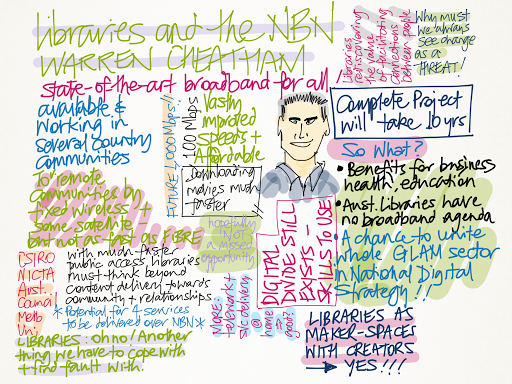 |
| Warren Cheatham ALIA Information Online 2013 |
This was an interactive awareness-raising session led by Warren Cheatham from Townsville. It showed us the librarian as advocate for government programs and how to assist in understanding. He encouraged debate about many of the differing perceptions of something many of us simply do not fully understand and I think he also got us to think about its potential for libraries (if it isn’t killed with a stick by a different governing party). Thanks Warren.
One thing Warren and I discussed was the potential of the NBN to provide a catalyst that unites the whole Galleries, Libraries, Archives and Museums (GLAM) sector on a new path towards cultural digital collaboration. This is an area in which Australia is sadly lacking and perhaps the power of the NBN could bring our sector together.
Sketch-notes – Charles Leadbeater
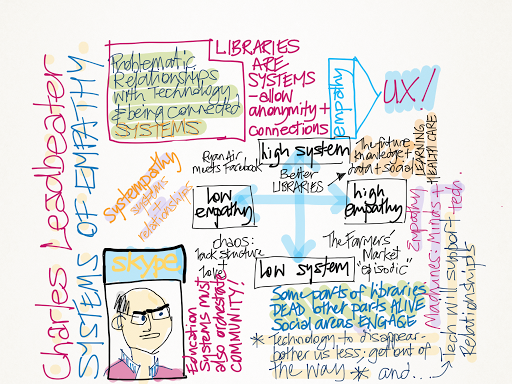 |
| Charles Leadbeater’s keynote ALIA Information Online 2013 |
Charles Leadbeater is described as a leading thinker on the future of learning and his Skype presentation really lived up to its promise. Again we were reminded that solutions cannot be found by looking only or primarily at technology or systems. He encouraged us to empathise with our clients and to facilitate connections and develop and facilitate meangingful relationships. He said that eventually technology would bother us less and simply help support those social relationships. His keynote was one of the main highlights for me.
Sketch-notes – Sue Gardner, Wikimedia
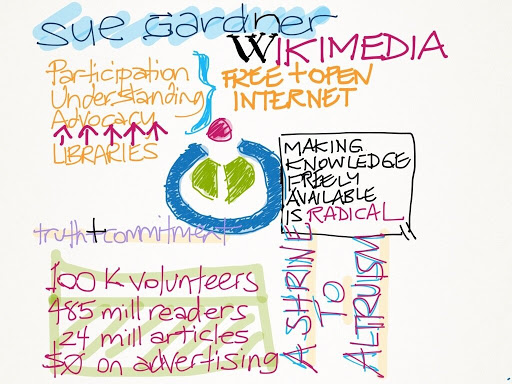 |
| Sue Gardner’s keynote at ALIA Information Online 2013 |
Sue Gardner from Wikimedia left us with some very important reminders about the importance of a free and open internet and how libraries must participate in that as advocates and by helping others to understand more about it. She encouraged us to do what we can to make knowledge freely available, just as Wikipedia does.
Sketch-notes – Open Linked Data
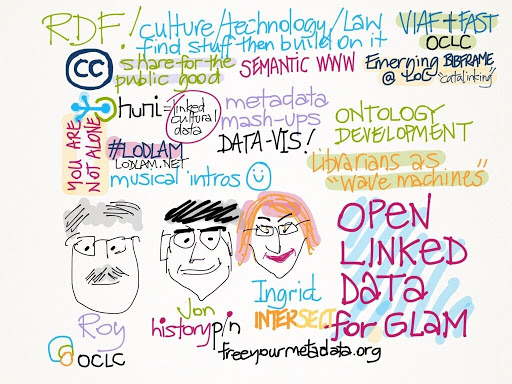 |
| Roy Tennant, Jon Voss and Ingrid Mason Keynote for ALIA Information Online 2013 |
This was one presentation that I felt I should attend, but I was also fearing because it is a serios and technical subject that might be hard to present in an entertaining and lively manner. Well that certainly was not the case with these three presenters. They grabbed our attention after lunch with well selected personal musical introductions for each.Then they managed to pass on some key messages about the benefits of open linked data along with some powerful examples of what data can do when it is shared, open and then linked. A very memorable presentation!
Sketch-notes – Sarah Drummond
 |
| Sarah Drummond’s keynote ALIA Online 2013 |
Sarah Drummond provided a great deal of inspiration at ALIA Online, particularly for younger librarians who could identify with her in so many ways. She really engaged by participating in the New Librarians Seminar the weekend before the conference itself and then by running a one day workshop on design, that emphasised the importance of understanding and mapping your customers’ journeys, after the conference. She was one of several keynoters who urged us to start with people and not technology and she was brave enough to tell us that we hold too much fear and that results in our attachment to too much command and control. We need to let go more.
Sketch-notes – Designing Better Library Experiences
 |
| Zaana Howard’s session at ALIA Online 2013 |
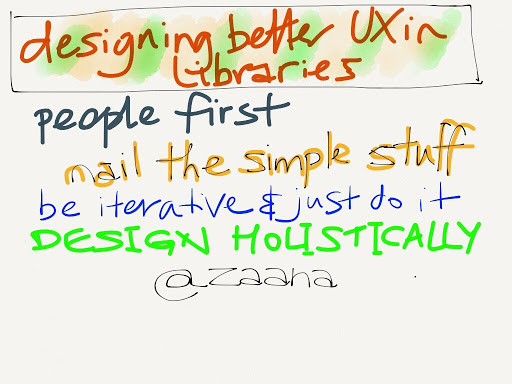
Zaana gave a very short session on designing better user experiences in libraries. Her key messages (above) were few and short, but memorable and wise. I think they were timely reminders and her research is evidence based. She had a verysignificant influence on the under current of service design in this conference and I thank her for her input on that.
Sketch-notes – Business Model Innovation
 |
| Tim Kastelle Keynote at ALIA Information Online 2013 |
This is the first of a series of sketch notes from the ALIA Information Online conference held in Brisbane during February 2013. I have to declare that I was on the Program Committee for the conference, so maybe you’ll read some bias into my comments here. I’m trying to be objective.
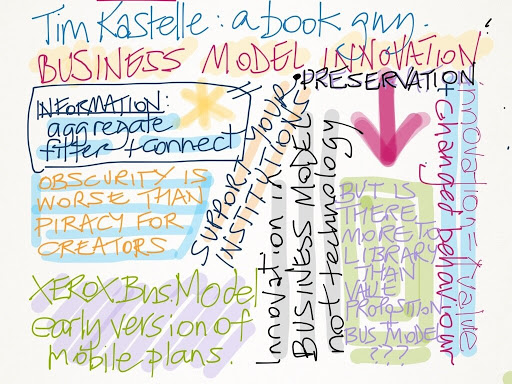
The sketch notes above are from one of the first keynotes by Tim Kastelle from the University of Queensland Business School. I think one of his best messages for libraries (which you can see above) was to aggregate, filter and connect. I also liked his suggestion that obscurity was worse than piracy for content creators. He urged us to consider innovation in our business model (i.e. behavioural change), not simply in or through technology.
I think that keynote neatly set us off on what the Program Committee hoped would be a series of rather different messages and themes for the conference. These included:
- Designing new services for people.
- Finding and providing more meaning in what we do as cultural institutions.
- Finding our voice and becoming better advocates for the public good (e.g. Open Access, Copyright reform and a sustainable future).
- Putting people before technology.
- The importance of empathy and user experience research.
- Reassurance of the value in play, fail, learn as a strategy.
I’m still learning about the use of sketch-notes. They do force you to think more deeply about the messages you are hearing and how to represent them visually. I’m being mentored in this by one of my colleagues @thelibrarykim so I thank her for all of her tips and assistance. Her sketch-notes are always grand!
Ebooks, the future of research & cultural preservation by libraries

I read this post from O’Reilly TOC this morning and I was glad that someone finally raised these issues that have been bothering me for some time. I almost posted about the same issues a few weeks ago, but was distracted. The post raises some real concerns about the preservation of knowledge for future research. For me it is wider than that and goes to cultural preservation for our communities. Is it right that for our e-content we should just rely on someone else to have a copy (like Apple or Amazon as the article suggests)?
I had been worried about this, because like many other libraries we have been e-preferred for some time now. Is it also right that cultural material we collected and provided for our own communities could be unavailable for them in the future because the e-content is no longer available via our library? I don’t think it is and I don’t think we should simply hope for the best, divest ourselves of this responsibility and rely on others doing it for us, like say the National or State Libraries and certainly not the publishers because it isn’t really their role and it really never has been. Don’t we have an obligation along these lines (i.e. cultural preservation) for those in our communities? I think the rush to e-preferred has possibly led us to a focus on the now, the most convenient, the most efficient, and the least expensive alternatives, but quite probably at the expense of our obligation to preserve knowledge and culture for future generations.
I had been running around asking everyone who was involved with ebooks a lot of questions about what happens when the providers go bust, when we cease subscribing, or in the case of other inconvenient but worrying events (like hacking, file corruption, etc.). I am told that it varies with different ebook providers. Some regard it as a lease of those ebooks, others allow you to download the content in their proprietary format or in xml, but this ultimately isn’t a solution. Encrypted formats offer a whole other dilemma. Many contemporary publications are in danger of disappearing, becoming untrustworthy or inaccessible in the future if we don’t seriously consider this issue now. My own view is that there is actually more to cultural preservation of publications than simply preserving the xml. Books have always had other features, like covers, layout, typography, illustration, decoration, way finding assistance, etc., that add to the reader’s experience. In our relentless hunt for efficiency and convenience I think we’ve progressively discounted the value of these features for our readers.
Perhaps this will be addressed by those talking about ebooks at the 2013 ALIA Information Online conference in Brisvegas next week.
This was originally posted here:
http://informationonline2013.wordpress.com/2013/02/07/ebooks-the-future-of-research-cultural-preservation-by-libraries/
What did I say, think and write in 2012?

Just in case you missed it, and let’s face it you probably did, here is a listing.
With colleagues from UTS Library (S Schofield, B Tiffen) I co-authored the article “Change and Our Future at UTS Library: It’s Not Just about Technology.” Australian Academic & Research Libraries 43 (1) , 32- 45.
I contributed the essay “Design as a Catalyst for UTS Library” for J. Schweitzer & J. Jakovich (eds.) Crowd-Share Innovation: Intensive Creative Collaborations, Freerange Press ( 2012) , Ch. 2: 114- 119.
For the ALIA Biennial Conference Sydney 2012 (http://conferences.alia.org.au/alia2012/), again with UTS colleagues (B Tiffen, J Vawdrey), I co-presented on Discovery for Academic Libraries.
Chapter/essay (about the future library) for forthcoming book on the 25th Anniversary of UTS edited by Paul Ashton & Debra Adelaide. (Publication title not known yet.)
Various conference, interviews, blog posts and seminar presentations including:
- Design and our Future Library: more than just spaces and technology, a practitioner’s view, by invitation, for UTS:CMOS Workshop on Organisational Spaces. http://www.slideshare.net/malbooth/uts-future-library-more-than-spaces-technology A similar presentation was also given earlier that week to Australian University IT Directors & CIOs.
- Supporting researchers and research publication: impact measured by more than just metrics, for the seminar Measuring and Improving Library Value, 2012. http://www.slideshare.net/malbooth/supporting-researchers
- Creativity and (academic) libraries, for Library 2.012, an online conference run by the School of Library and Information Science at San Jose State University. http://www.slideshare.net/malbooth/creativity-academic-libraries
- Short talk on creativity and innovation in our Library at a Talk it up! Forum with Hael Kobyashi and Chris Gaul. http://hdl.handle.net/2100/1314
- Design as Catalyst at UTS Library, a masterclass for UTS:CI Labs 2012. http://www.slideshare.net/malbooth/design-catalyst-ci-lab-notes
- Making Researchers Famous With Social Media, for UTS Research Week 2012 http://www.slideshare.net/malbooth/making-researchers-famous-with-social-media
- From Search to Discovery in our Future Library (with Josh Vawdrey) for the ITD Divisional staff meeting (similar to the presentation given for the ALIA Biennial, but no pdf available, sorry).
- Short talk (as a panel member) for ALIA Sydney event on the Future of Reading: Books Are Not Dead. http://www.frommelbin.blogspot.com.au/2012/08/books-are-not-dead.html and an earlier talk for the same group UTS Library and Sustainability http://www.slideshare.net/malbooth/uts-library-sustainability
- Interview on UTS:Newsroom: From Triathlons to Tomes http://www.newsroom.uts.edu.au/news/2012/09/tomes-to-triathlons?
- Interview with CIO Summer 2012, 58-60: “Going Underground“ (with UTS CIO, Chrissy Burns) http://www.cio.com.au/article/444300/uts_library_goes_underground_robotics/
- Various blog posts for ALIA Information Online 2013: see http://informationonline2013.wordpress.com/ (including two long posts about the implications of recent changes in online learning for libraries). Those posts and most of the items listed here can also be found on this blog.
- Interview for UTS Engage about our future library at UTS, with Ryan Diefenbach (film-maker, producer): http://youtu.be/V1n0rgyQ4YQ
- Presentations (several) for CSU students, UTS Information and KNowledge Management students, and TAFE Librarians (from both Victoria and NSW) on the Future Library.
- Presentation for QUT’s Information Studies Group (online): Becoming Extraordinary. http://www.slideshare.net/malbooth/becoming-extraordinary
 FromMelbin