
Category: Education
Highlights from Educause 2013 #1: Ken Robinson’s opening keynote

I was lucky enough to attend Educause 2013 in Anaheim, California in October. I had one arm in a sling after a fall that dislocated my left shoulder, but I took handwritten notes in a notebook and on looking back, some of the sessions I attended had some interesting and stimulating content, so I might do a few posts about the best sessions. This first post is about the keynote that opened the conference by Ken Robinson, the English author, speaker and adviser on education.
He started quoting lots of famous people like Asquith, Churchill and even Dorothy Parker. All very amusing and entertaining. My favourite (as a lapsed economist) was the J.K. Galbraith quote: The only function of economic forecasting is to make astrology look respectable. Then he focussed on the way we are as a species and the all pervasive effects of cultural norms on our behaviour. He said that some technologies, like TV for example can change that.
I liked his reminder that when Apple first introduced the iPhone in 2007(?) it had something like 800 apps. Now it has over 800,000 and that is well beyond what Apple would have designed themselves or even imagined/anticipated. It is a great example of people appropriating a brilliant idea and then seeing what they can do with it.
He then moved on to talk about imagination, creativity and innovation. He described Imagination as giving us the power of Creativity, which is a process in which you do something or make something. Innovation is putting good ideas into practice. I think there is a lot in this for future libraries: stimulating and inspiring imagination, then providing spaces, technologies, services that allow people to make things (not just write about them) and also assisting in bringing people together to put those great ideas into practice.
Ken said we are constantly evolving and modern technology enabled us to do things now that were not even possible before it was introduced. Sometimes it also allows us to imagine possibilities well beyond what we can now do. He warned that even though there has been so much technological innovation in the last 10 years, IT in education seems to have blockaded against it. (Unfortunately, this was further illustrated by many sessions in the conference that concentrated on controlling ICT from within and defending against all boarders or potenial collaborators from outside our institutions.) He went on to say that technology isn’t over now, it is never over and that the future will involve even more profound changes than we have already seen. He then postulated about the rights of robots in the future.
I think he mentioned that now you don’t even need to go to the library to access information, so it has to develop another role and embrace the technologies that gives it new purpose.
His next topic was the lack of a sustainable rate for consumption (by humanity). The planet will survive and so too will bacteria, but humanity is now at risk. We need to challenge what we now take for granted. For example a university degree no longer assures you of a job for life. For humans, life is not so linear or manufactured and we must think differently about ourselves to become more organic and creative. Creative education depends on different kinds of questions in which there is no correct answer. I doubt that the current obsession with big data collection and analysis will help us much in this quest. Currently we think in terms of improving old policies rather than looking at new systems.
Don’t even take for granted that we know what the question is. To sum up, I was reminded of two further J.K. Galbraith quotes:
The conventional view serves to protect us from the painful job of thinking.
James B. Hunt Jr. Library, NCSU


Hunt Library, NCSU, a set on Flickr.
Via Flickr:
Here is a large set of images from the new James B. Hunt Jr Library at North Carolina State University (NCSU).
I was fortunate enough to attend the second Designing Libraries Conference that was held this year in the Hunt Library. It was massively over-subscribed by librarians from all over North America and various parts of the rest of the world, such is its reputation already.
There are some duplicates in this set (high & low res versions) because I had uploaded many in low res format whilst travelling. I’ve tried to add some explanatory text to the most significant images as well as titles and tags. If you’re confused or really interested in something just leave a comment in Flickr.
Please have a decent look as I think they’ve really done a brilliant job.
The library is a credit to the vision of Susan K. Nutter (Vice Provost and Director) and her staff, the architects Snøhetta & Clark Nexsen and the design team.
And for those of you too lazy to look through all those images on Flickr, here is a slide show set to the Cillo remix of Bon Iver’s Calgary:
A comment on my work blog asked for information about how spaces in the Hunt Library (or our own future library) relate to teaching, learning and research strategies. Rather than just reply directly I thought I would put some additional information in this blog post along those lines. Thanks to my colleagues Belinda, Sally and Beth who provided comment and suggestions on all of this. So here it is, mind the step …
One of the most impressive aspects of the Hunt Library is how it has been planned with the broader university mission in mind, and encapsulates the aspirations of NCSU. As a research-intensive, technology University, NCSU’s mission and goal statement is not so different to ours at UTS:
As a research-extensive land-grant university, North Carolina State University is dedicated to excellent teaching, the creation and application of knowledge, and engagement with public and private partners. By uniting our strength in science and technology with a commitment to excellence in a comprehensive range of disciplines, NC State promotes an integrated approach to problem solving that transforms lives and provides leadership for social, economic, and technological development across North Carolina and around the world.
Its aspirational vision statement is also similar to ours:
NC State University will emerge as a preeminent technological research university recognized around the globe for its innovative education and research addressing the grand challenges of society.
As the gateway to knowledge for NCSU and its partners, the NCSU’s libraries play an important role in achieving this vision.
Hunt Library is one of two main libraries on campus, and is described as the face of NCSU in the 21st century, a space that expands the frontiers of learning and research. To enhance innovative learning and teaching practices, Hunt provides a place for students to connect to peers, faculty and researchers across disciplines, work with tools that erase distance and promote collaboration, access world-class research collections, showcase their work in digital and physical displays, and explore new technologies that encourage and enable the creation of games, films and music, and working with “big data”, 3D models or prototypes. It is also a space designed to inspire and elevate; encouraging creativity, curiosity and the pursuit of new knowledge through the quality of the building’s design and finish, the ubiquity of accessible technology, the thoughtful inclusion of collections, scholarly reading rooms and exhibition spaces throughout the building, and a program of cultural events and displays.
For other members of the NCSU community, including faculty, researchers and industry partners, purpose-designed, technology-enriched spaces enhance their teaching, research and scholarly activities in line with the NCSU vision to be a leading technological research university and an innovation centre for their region driving economic and social benefits.
These are achievements we think our future library should aspire to in order to support our own strategies for learning and research.
Fortunately we have a strong basis to build a library that furthers the UTS vision to be a world-leading university of technology and provides a competitive advantage for UTS. Like Hunt Library, our Library Retrieval System (LRS), will free library space from housing our entire collection of print material, enabling expanded spaces for a full range of scholarly activities, while keeping the collection easily accessible. Looking to the successful example of Hunt, the types of spaces we will provide should include:
- a variety of individual and group study spaces from quiet individual study to group study spaces that account for different learning needs and individual preferences;
- ample power, data and wifi to cater for current and future technology;
- incubator spaces for exploring new technologies;
- digital media editing and production facilities;
- sophisticated areas for creating simulations and virtual environments;
- gaming spaces for the scholarly study of games;
- panoramic (digital) displays to showcase academic and student work;
- makerspaces for model making; and
- spaces for special collections and exhibitions that provide exposure to culture and inspiration.
Importantly and in addition to the spaces and technologies in their libraries, both NCSU and UTS libraries provide services that enable the success of their students and support researchers including:
- improved information discovery through online catalogue search and discovery tools;
- online reference, interlibrary loan, access to 7.2 million shared books available on request through Bonus+;
- open and closed reserve services for all required textbooks and 24 hour access to electronic reserves;
- online guides to library resources for all faculties;
- lending services for technologies such as laptops, tablets and e-readers;
- Copyright and eScholarship services, collaborating with scholars on digital publications, our digital repository, IP/Copyright issues and our Open Access press – UTS ePress;
- extensive data support services providing advice (via training sessions and consultations) on data management planning, discovery, description, sharing and preservation;
- research support services from specialist librarians who have experience in searching for resources in particular fields;
- training and instructional support, from literature review to navigating subject specific databases and also advice on how to find, use and attribute unrestricted resources such as images, film and media; and
- tailored information literacy programs from orienting new students to expert researchers, – including workshops, video tutorials or games such as treasure or scavenger hunts.
We see that a future library like Hunt can create a new heart for our redeveloped campus that helps form a hub of creative collaboration between students, academic staff, researchers and industry partners. Just as Hunt Library has done, our future library could become the University’s intellectual, cultural and social centre. The future library should promote learning and knowledge creation, enable experimentation, support innovative projects and partnerships and showcase UTS research and scholarship, providing inspiration for our current and future students. It should complement other campus redevelopment projects that breathe life into the aspirations of our University.
Design Thinking and UTS Library
I gave this presentation to a Victorian audience of mostly librarians on 28 August 2013. It outlines our journey with Design Thinking. The text is embedded against each slide below. (It is downloadable.)
Collection Visualisation

This post is just a collection of examples that relate to the visualisation of collections. It saves me sending a number of tweets back to two colleagues in the US who started a conversation about this over the weekend: @sjwilder100 (from UNC Charlotte Library) & @lorcanD (from OCLC)
Several researchers are doing some interesting work in this space and I think it is pretty important. Adding some kind of visual layer to catalogues, search or discovery tools provides us with a capabilty that is largely missing in the cultural sector at present. Most searches focus solely on text-based initiators or they provide text-based lists of search results. Open data, the encouragement to collaborate in coding and the need to either search visually or to visualise search results is leading towards much improved collection discovery. This makes the collections we provide more easily found, used, explored, enjoyed, linked and shared. So here are a few examples that I’m aware of, in no particular order, mind the step:
Marian Dörk is a postdoc researcher at Newcastle University. You can see several examples of his visualisations here http://mariandoerk.de/ I like the PivotPaths and you can even demonstrate them for yourself on his site http://mariandoerk.de/pivotpaths/
Mitchell Whitelaw does some fascinating research relating to collection visualisation and has worked with archival, photographic and art collections. You can see an example relating the the exploration of Australian Prints here (a research project with Ben Ennis Butler) http://mtchl.net/explore-australian-prints-printmaking/ What I like about Mitchell’s work is that he crafts in some great design that entices the user to explore because the interfaces are both generous and beautiful.
Tim Wray is still undertaking his PhD at Wollongong, but he has already done some interesting work with art collections that provides navigable pathways for collection exploration: http://timwray.net/2012/12/create-pathways-at-your-fingertips/
Mr Chris Gaul was UTS Library’s first Artist-in-Residence in 2012 and you can see some of his conceptual ideas for collection discovery here: http://www.chrisgaul.net/utslibrary/ His Library Spectogram is shown in the image above and was the inspiration for our colourful collection ribbon that allows you to browse our monograph collection or see your search results presented visually http://find.lib.uts.edu.au/
Paul Hagon is a friend and former colleague who is the Web Developer at the National Library of Australia. He has done some interesting experiments relating to colour and search results in visual collections. Here is a search by colour experiment: http://ll04.nla.gov.au/ and here is a concept that visualises the colours of tags used in Flickr http://www.paulhagon.com/2010/05/14/colours-of-a-tag/
Over the last few days Serendip-o-matic was released. It is a collaborative project by a team of twelve people from academia, libraries and museums and I know of researchers here aut UTS who have already found it very intriguing. What is really great about this is the serendipity it provides. So go on, give it a whirl!
I know that I’ll have left out some other great examples from people working in this space including Georgina Hibberd, a researcher at UTS who has some really wonderful ideas about visualisation and the discovery of library collections. So, if you know of someone worthwhile, just let me know and I’ll add them to this little collection.
Postscript additions:
Since I first posted this Marian Dork has reminded me of the very beautiful and playful interfaces created at the University of Calgary in their Bohemian Bookshelf http://www.alicethudt.de/BohemianBookshelf/ My apologies for forgetting to add them to the list above earlier.
Libraries and the digital future
This is the presentation I gave to a City of Sydney Libraries seminar on 27 June 2013. It was only a short presentation so it isn’t comprehensive. Presenter’s notes are included in the pdf file.
Aaron Swartz, by me

Via Flickr:
“Be curious. Read widely. Try new things. I think a lot of what people call intelligence boils down to curiosity.” Aaron Swartz, 1986-2013
Praxis Makes Perfect


Praxis Makes Perfect, a set on Flickr.
Via Flickr:
This is a set of images from one of the 2013 Vivid Sydney Light installations in Walsh Bay.
I loved it and watched the whole sequence one night snapping as many images as I could. The animations and graphics are brilliant and they are my favourite for 2013 of the whole Light festival, big and small.
I thought this before I found out anything about the work itself and a couple of days later I was amazed to see that the whole piece has been put together by 2nd year animation students from the UTS Faculty of Design, Architecture and Building.
The work was full of content and a fantastic demonstration of visual story-telling. It explores the 12 principles that underpin animation and features the historical figure Mary Reibey, a former convict who went on to become a successful businesswoman in early colonial Sydney.
The beautiful musical piece accompanying this animation was played by Peter Hollo using a cello in some different ways. You can hear it on his blog.
I found out from Damian Gascoigne (who with Deborah Szapiro lectures on this course), that once given the go ahead after pitching a proposal to Vivid, the students had only eight weeks to get it all done.
It was wonderful to see the great work of UTS students and academics being showcased so publicly.
#THETA13 Search to Discovery (Part 2)


#THETA13 David Jensen on Sir Douglas Mawson
THETA13 kicked off for me with a great illustrated talk about Sir Douglas Mawson and the restoration of his huts in the Antarctic by David Jensen. I was inspired to try to draw the huts (under snow) from a photo I found online. We should all know more about him.

#THETA13 Marnie Hughes-Warrington: navigating to the edge
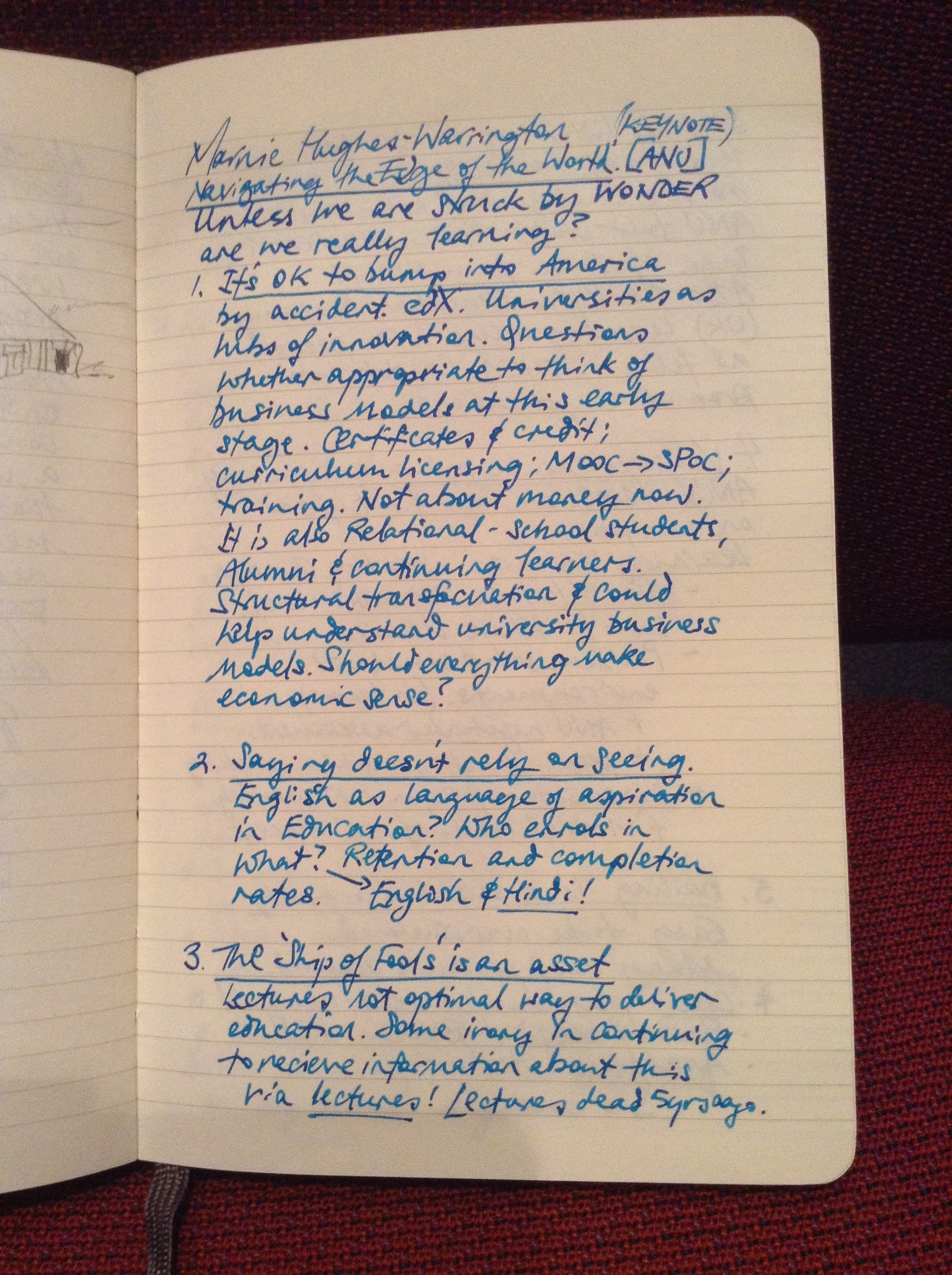


 FromMelbin