
Category: Culture
11-808 & Conversations : Artist-in-Residence, 2014

Elisa Lee and Adam Hinshaw partnered as the UTS Library Artist-in-Residence for 2014. Works from this Residency are now prominently displayed in the UTS Blake Library in Haymarket, Sydney.
Their brief was to provide an artistic interpretation of the UTS Library Retrieval System (LRS). Their resulting major work 11-808 is a live data visualisation that interprets the use of the LRS in real time. The purpose of the entirely underground system needed to be communicated to a wide audience, illustrating how the system was being used and demonstrating its value to the UTS community. The brief was extremely challenging, with a tight budget and deadline, but Elisa and Adam’s work has exceeded expectations.
The result is an elegant and poetic display of data that shows how this system is being used and, via the catalogue of library metadata, the dynamic movement of collections around the Library ecosystem. Through their artists’ perspective, beauty and the interaction of colour, Elisa and Adam have conveyed meaning and understanding to an extent that I think Joseph Albers* would have approved.
They also provided a playful sound installation, Conversations, that explores the random nature of the ways books are stored within the 11,808 steel bins of the LRS, arranged only by spine height. Here they have provided audible “conversations” between the books in selected bins.
Their work is artistically beautiful, superbly designed and technically very clever. Both works are eloquent in conveying meaning as well as exploring and highlighting the nature of this system. In doing so they have provided attractive and engaging works that appeal to the curiosity of Library users and that speak to them in very contemporary language.
* See also https://www.lib.uts.edu.au/news/304412/colour-on-concrete-exhibition
My picks (I guess) for Sydney Film Festival 2015

Yes, it is that time of year again. As Jack Thomson nearly said last year: “In the dark, we share our germs.”
Well, these are the films I’ve bought tickets for anyway. There were a couple that I’d like to see but couldn’t because they sold out or clashed with something else I had on. I did want to see Holding The Man, but I figure it’ll get a general release soon. It sold out as I was making our bookings. As my program was pretty long I decided not to try to see The Secret River as we will get to see it soon on TV.
I try to organise a big group of people and we bulk purchase tickets to get a good price. It is a bit like herding cats, but worth it in the end. Sometimes I am going with friends, sometimes alone. I generally take a few days off to enjoy the festival too, so whilst it looks a little ambitious, I’ll be on leave for much of it. So here we go with this year’s schedule:
We Are Still Here. Who doesn’t like a decent chiller? And this session is conveniently in Newtown.
Slow West. A western. With Michael Fassbender and Ben Mendelsohn. It won an award at Sundance. And Kodi Smit-McPhee is supposed to be the next big thing.
Results. Because Guy Pearce.
Mr. Holmes. I love Sherlock and a good mystery. Also, Ian McKellen is coming along nicely as an actor.
Vincent. I love many French films and I’m also a fan of the supernatural in film. So mixing the two could be magic. Or it might be a disaster.
99 Homes. A thriller. Even if it is no good, we still get to look at Andrew Garfield for 112 minutes. Although, he does seem to be sporting a silly beard …
600 Miles. Another thriller. I think Tim Roth is always good and a little under-rated as an actor. My kind of story, so it should be enjoyable.
The Tribe. Sex scenes! And violence. No, really I buy it for the articles. Well it has won heaps of awards and there is no dialogue.
Spring. A romantic drama with some mayhem. Who could resist that? Also, it is being screened in Newtown.
Victoria. A thriller set in Berlin. We have one spare ticket and I love Berlin, so I may go to this.
Phoenix. A post-WW2 mystery: another genre that I love.
54 (Director’s Cut). The unsanitised homoerotic version. It is being shown in Newtown.
The Invitation. Because Horror. And its being shown in Newtown.
A Second Chance. Yet another thriller, from Denmark. Stars the Kingslayer (aka Nikolaj Coster-Waldau).
“German Angst” (a trio of films: Final Girl, Make a Wish & Alraune). Because sex, death & supernatural forces.
I usually try to write up short reviews, especially if I think the film was worth seeing (or not).

My place in time – photo project

So I ran across this project via the twitter and decided to give it a go: https://blackcurrantphotography.wordpress.com/the-my-place-in-time-photo-project/ Currently I’m posting my images to Tumblr via Flickr (as I didn’t want to re-caption the Flickr originals). In order to keep track on my progress, I’ll progressively add links to the content I’ve uploaded against Kell’s list below: The list.
- The price of fuel/petrol.
- A mode of transportation.
- Teenage wasteland – use your common sense when photographing kids that aren’t yours.
- A small business.
- A view you pass on your way to work. And here too.
- Construction And here too.
- Destruction
- Something that was here 10 years ago.
- The corner shop or deli – basically anywhere you run to if you need something late at night.
- Where I go to relax.
- I can’t believe the news today.
- My favourite restaurant.
- What arrived in the post.
- A local service – think delivery/post/bin collection/ranger.
- People playing sport.
- An outing with friends (with the background in shot).
- Somewhere I used to visit as a kid.
- A handwritten note from someone I love.
- Something that was here 20 years ago.
- The end of the day. And here too.
- What I can see from my window. And here too.
- A river view.
- The price of a cup of coffee.
- Something I’ve never seen before – this can include a place.
- How we communicate.
- A view with train/rail lines in it.
- My favourite thing to drink – make sure the label is in shot.
- The receipt for something I bought today.
- Three O’Clock in the afternoon.
- How I tell the time – I know most of us use our phones these days. Be creative!
- Graffiti – If you can see the artist’s name please credit them. And here too.
- A sculpture.
- Nothing but trees.
- This sign makes me laugh.
- The view from somewhere high up.
- One kilometre from my house.
- The view from the end of my street.
- I’m in a supermarket.
- A ticket.
- A trip to the movies/cinema.
- What’s showing at the movies.
- This week’s music chart.
- Something old.
- A busy intersection – Do not take this whilst driving!
- Authority – Police, security, someone in a position of power. Be respectful and don’t get in the way.
- On my way to work/school.
- I wish this place had never changed.
- Ten dollars in my currency – this will be more interesting if you use change.
- I had to stop the car and take a photo.
- Somewhere I used to live.
- Someone outside your family/group of friends that you would miss if they were gone.
- This place has been here for my whole life.
- If I had kids I would want to take them here.
- Somewhere I visited with my first love.
- Out on a date – if you are single then photograph a date with friends or family.
- Power / electricity.
- A neon or electric sign.
- A concert or show poster.
- Somewhere I visit every day – not the toilet!!!
- A postcard – why not buy it and send it to a friend?
- Postage stamps from my country.
- Postage stamps from another country.
- I wish I didn’t have to pay this bill!
- A car I would love to own. And here too.
- The car I do own (or bike/scooter etc). And here too.
- Where all the cool kids go.
- It’s show time – interpret as you wish.
- Somebody’s special day.
- A photo from the coast.
- To market, to market.
- Fresh produce.
- A local playground – Again, use your common sense. Photograph your kids or a friends or wait til nobody is there. Don’t be creepy.
- Education.
- If I had a permanent marker, I would correct this sign.
- Road work.
- Somewhere I belong.
- Somewhere I don’t belong.
- My local library.
- Waiting for a bus.
- This week’s trashy magazines.
- I bought a Lottery ticket.
- An old painted sign on the side of a building.
- The view from the passenger’s seat. And here too.
- Some groceries I bought this week.
- Where I was at 11:11 am.
- Where I was at 11.11pm.
- A car numberplate.
- A shop that’s no longer open.
- This place is for sale.
- Coca-Cola. – It’s been around for most of our lives. Let’s see how it looks around the world.
- The price of a Big Mac at McDonald’s.
- On the way to the airport.
- Out on a bushwalk / hike. And here too
- Only in my country.
- Absolute junk.
- Street lights.
- Friday afternoon.
- How I spend Sunday morning.
- Someone I’ve just met.
- My place in time – any photo at any time of the day that describes how you feel with life.
Are libraries Blockbuster in a Netflix world?
I read this earlier today via Zite, over breakfast at a cafe near our library:
It talks about the demise of Blockbuster and the rise of Netflix. Blockbuster made some dumb business decisions and ignored some possible ways to stay afloat, but the author Greg Satell talks about the importance of networks in Netflix’s rise. Blockbuster’s failure to understand the importance of networks also determined their fate. He says that those networks are very difficult to quantify or define, but that we’ve not really tried to understand their importance.
Even though we may work in a much smaller ecosystem (e.g. our library serves a University community), I really believe that our own future strongly depends on what we do within, and how we encourage and contribute to, our own networks. That is why I keep stressing the critical nature of engagement and the fact that everything we do is somehow connected to something else we do. Virtually nothing we do in libraries can actually be sustainably successful if we do it in isolation. I think the chase for efficiency in libraries has actually encouraged silos to develop and this works against those connections we must have within libraries. So far I think we* actually understand this and we actively seek to connect within and to those outside the library pretty well, but it is something we cannot ignore and that we must continue to invest in. The networks we participate in, encourage and contribute to have a positive effect on the development and relevance of our library and we should make them major considerations in all we do. To quote from Greg Satell @digitaltonto :
… we really haven’t scratched the surface on the networks we encounter in real life: The networks of consumers that make up our brands and industries as well as the organizational networks that determine how things get done—or don’t get done—in our enterprises.
And it’s imperative that we start thinking about them more seriously. We need to stop acting as if there is a recipe for business—like a cake or a casserole—and start thinking in terms of how factors are connected.
I am now going to take this analogy a little further… I think the focus of libraries should already be moving from being all about the collections we develop and provide access to, measured mostly in size of collections and numbers of visitors, to the unique collections (of both knowledge and culture) that we help to create and then share with our networks. That, as Greg said, is something that is harder to define and measure. Of course the other key advantage that all libraries have, even in universities, is that they are cultural institutions. Culture provides context for all knowledge, but flourishes within libraries only when it is kept alive.
* UTS Library
Calvary – Review
I know that it is a big call this early in the Sydney Film Festival, but Calvary by writer-director John Michael McDonagh has made the whole festival worthwhile for me. I think it is faultless and a model for other film makers in terms of story-telling, entertainment, brilliant script writing and character development. It deals with the role of the Catholic church in child abuse in Ireland (and many other places), but the writer-director very skilfully weaves the tale together through the life of a good priest played by the amazing Brendon Gleeson as he tends to his village flock under the threat of death from a victim of child abuse.
I also enjoyed the writer-director’s previous film The Guard, but I think this is even better as it deals with such a terrible aspect of church history, whilst reminding us of the good that is done by individuals within the church itself.
The script writing doesn’t avoid or trivialise any of the serious matters the film covers, but very effectively manages to recognise them and then pepper the story-telling with some wonderful conversational humour. It is a black comedy, but there are enough laughs to keep it truly entertaining and it is not so black a story that we are left without hope. I must also confess to loving the Irish accent of the brilliant cast as they seem to enjoy demonstrating John Michael McDonagh’s obvious love of language. One of the best lines for me was when Brendan Gleeson’s lead character drunkenly abuses his colleague (Father Leary, played by David Wilmot), saying that he lacks integrity and should be an accountant in an insurance firm. The is also an hilarious dialogue about those who join armies in peace time and whether a desire to murder someone should be seen to be as useful as an engineering degree.
In addition to all of this, the camera treats us to some stunning visuals of the Irish coast and Benbulbin to give us a true sense of place, and the musical score adds a further important dimension and mood to the film.
Film makers like John Michael McDonagh keep us coming back to the cinema. I stayed for his Q&A and two things he said stayed with me. Firstly he said that as a film maker he was committed to entertaining his audience. I think some other film-makers in this Festival could benefit from his advice. He writes to entertain and his method of story-telling leaves most others in the dust. Secondly, in response to a question he stated that it is foolish to refer to actors being “brave” in taking certain film roles, or for writers to take a “brave” perspective in dealing with subjects like child abuse. He said that was simply rubbish and that brave people are those who run into burning buildings to rescue others.
My score: 5/5, I really could find no faults at all.
Leaked NYT Report on Innovation
Twitter and other social media yesterday was crazy about a leaked 91 page report from the New York Times on innovation in the mobile and digital age (use the Google or contact me if you cannot find it). It primarily addresses their environment of rapidly changing media platforms, but there is a lot in it that also applies to us in library-land. In particular, our own web strategy at UTS Library, which is very informal, and where we are going with our Open Access press UTSePress.
Initially I thought I’d just send it to the managers responsible for those areas, but after quickly reading the lot I found more and more general ideas that I liked, so I sent it to all of our managers and we will all meet to discuss it at a later date. If you can still find it, you’ll see that it isn’t a marvellous copy, but it is mostly readable and I think very valuable, even if it seems mostly to affirm some of our existing directions.
- web publication trends (we’ve been closely following these of late)
- audience reach and why it is important (agreed)
- reader experience (acknowledging it and doing something about it and we must do more in this area)
- having a web strategy – do we want one that is more obvious, a little more formal and that evolves?
- disruption and what it means for us (too)
- content aggregators – what are they, how they impact on us and how we make best use of them
- the importance of discovery – new tools & getting the basics right, like tagging and structure (we’ve been focussing a lot on this for the last couple of years)
- experimentation – how it works, why it is needed (agreed and we do try to encourage this)
- personalisation (see above re discovery as we’re trying to do something like a recommendation engine that our users can opt into)
- using data layers or adding them in (I’m not exactly sure how this applies to us and need to think more about it, but I’m pretty sure we should be doing more in this area)
- user generated content – is that relevant to us? (we are essentially doing that in the physical space now with curations of student works and could extend that to our online presence, perhaps using social media more – we’ve experimented with this a little already)
- events (this is a big area for us and they always have a planned and strong online dimension)
- going “digital first” or digital equally? (I think the latter is more relevant for us – we should not concentrate simply on either digital or physical programs)
- boosting analytics (this is why I desperately want to get some professional UX people into the library)
- employee movement between departments – to boost collaboration & understanding (I think we could really do more here)
- failing, learning, & sharing results (I think we’ve already started on this path)
- making more creative roles not just (passive or responsive) service roles: makers, entrepreneurs, advocates, observers (agreed)
Academic libraries, design and creative futures
This is a presentation (slides and speaker’s notes) from a presentation that I gave last week. It was a public talk at a UTS Shapeshifters event on Creative Futures. I was humbled to be on stage with Paola Antonelli from MoMA and Professor Anthony Burke and Hael Kobyashi from UTS. Read more here:
http://newsroom.uts.edu.au/events/2013/12/shapeshifters-creative-futures
I should explain more about the 3rd slide. The things listed on that slide are often forgotten or discounted in the blind pursuit of efficiency or traditional KPIs. For libraries, these things (i.e. delight, surprise, engagement, serendipity and curiosity) are at least as important and should not be forgotten, dismissed or left until later.
The video of this talk is also now available:
Highlights from Educause 2013 #3: Jane McGonigal
Jane McGonigal, the game designer and author of the best-seller Reality is Broken: Why Games Make Us Better and How They Can Change the World gave a wonderful keynote called Higher Education is a Massively Multiplayer Game.
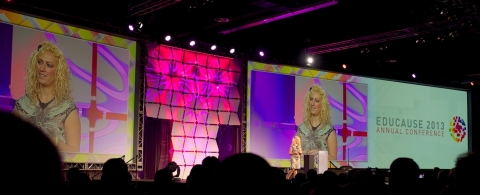
She sees and advocates the incorporation of gaming as possible future for higher education, saying that over one billion people now play games for at least an hour per day. Some people are so committed that they play games like it is their job. Apparently games bring us 10 positive emotions: joy, relief, love, surprise, pride, curiosity, excitement, awe/wonder, contentment and creativity. Games also provide an environment in which it is safe to fail and easy to learn from one’s mistakes.
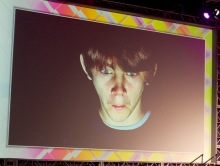
She said that games also develop a 3:1 (positive to negative emotions) resilience that makes people more productive and successful. She showed some images of resilient gamers on stage like these two:

She also showed some neurological research scans of brains from Stanford that showed the difference between active and passive brains. They were most active when engaged in a game. She said that Play was not the opposite of work, it was the opposite of Depression. Apparently, gaming activates the same part of the brain as a cocaine addiction. It encourages: the mastery of a skill, solving puzzles, driving personal ambition, motivation, the anticipation of rewards, practicing habits, determination and further skill development.
She urged educators to super empower learners about their own ability to succeed in learning by using things like points to complete missions, badges for development of new skills – anything that gives learners a meaningful goal and recognises their achievement. What could be done with a billion gamers on connected devices? What could they do together?
She then spoke of Joi Ito’s belief that students should now be creating knowledge and insight as part of their education, not just learning what is already there. More from Joi Ito (who is Director of MIT’s Media Lab) :
I don’t think education is about centralized instruction anymore. Rather it is the process of establishing oneself as a node in a broad network of distributed creativity.
And those thoughts beautifully flowed on from the sentiments expressed earlier by both Ken Robinson and Mimi Ito.
Jane then illustrated three projects that bring together the concepts of play and acting as a node in a broad network:
- Foldit, from the University of Washington teaches protein folding, building on the fact that manipulation by participants in the virtual space was better than that of super computers because gamers were more skillful and possessed of better spatial intelligence. They knew not to apply brute force. Soon after an invitation to join the project was published in Nature, gamers solved in three weeks a problem with HIV/AIDS that had baffled scientists for over 10 years.
- Evoke (based on Grand Theft Auto?) is a project that helps solve social problems with young people becoming super heroes for the rest of the world. It focussed on youth at university age in Sub-Saharan Africa as a source of solutions not just problems. The aim is to solve real-world problems by making the best use of youth skills and with their collaborators and allies. Blogs, photos and videos were uploaded to prove progress. The World Bank Institute (WBI) provided Social Innovator badges and it resulted in 20,000 students being enrolled from 130 countries. They accidentally ran a MOOC! 50 new social enterprises were funded by the WBI like Libraries Across Africa (now Librii) : a franchise model that is up and running in Ghana now.
- Find the Future is a game that Jane helped to create for the New York Public Library (NYPL) Centennial in 2011. It kicked off with an overnight event that offered 500 places for players (18 and over) to explore the NYPL’s collections for clues locked away in 100 objects that changed history. They had 10,000 applicants. Together the participants put together a collection of stories over night for the NYPL’s rare book collection.
Jane believes the future of education is in a blended environment of gaming, something like MOOCs and live events that allow learners new ways of learning through creative practice anytime, anywhere and in collaboration with others.
Highlights from Educause 2013 #2: Mimi Ito, UC Irvine
Session: Open Networks for Social and Connected Learning
Professor Mimi Ito from UC Irvine is a Cultural Anthropologist. This was a great follow-up to Ken Robinson’s keynote.
She talked about adapting educational technology in the 21st century to platforms that can connect classrooms to a wider world of learning. For middle school kids those technologies centre around games like Minecraft and media sources like YouTube.
Education lags behind changes outside the classroom. It needs to move towards open networks that: increase the amount of information that is available; are production oriented; solve problems; include civic engagement; and are inquiry based. We are not there yet.
To tap the potential we need to forge stronger connections between classrooms and the world at large. Education needs to be seamless with life itself. Technology can be a powerful ally for this agenda.
Younger people are more avid readers – in all forms. And they average 7.5 hrs per day in media consumption (it is saturated).
Gaming is the entertainment media of our time – at all levels of society.
Abundance (of options, availability, continual connection, etc.), however, can also be too much of a good thing.
An example from her research. She worked with teams of ethnographers from 2005-08 and found:
- There is a generation gap in the perceived value of online activity – younger people see it as a life line and older people see it as a waste of time (even though they use it themselves)
- What do they do & learn? Heaps! Baseline technical literacy and to be a social being. Uploading photos, managing web pages, managing profiles, interacting, judging, etc. Some online tools really allow people to do amazing things, such as uploading to YouTube channels for civic causes. Some users are really out there, but they are a minority. At the other end of the spectrum there are the bullies. She quoted GIbson: the future is already here, just not evenly distributed.
She then went on to distinguish between Friendship-driven & Interest-driven participation. This started with MySpace and Instant Messaging and is now based around Facebook and Texting (or other fast ephemeral services like Snapchat and Kik). Dorks and geeks can connect with others who have shared interests and share knowledge and expertise – so that is very different to a friendship group. She used the example of Facebook being used to connect with those you went to school with and Tumblr (or Instagram) being used for those you wish you went to school with. So FB is more about friendship (with kids seeing adults there as just creepy) and Tumblr (& the like) is more about interests. It is now easy to find and connect to an online community that is very different to the one in which you live: communities of producers with like interests. It allows and facilitates the development of potential for those resourceful enough to take/absorb/use from their peers and interest groups and then apply it in an academic community. She warned though that only a few do this.
Mimi said the academic bubble now has to reach out and facilitate those connections. To overcome the cultural gaps they face young people still need and look for adult support and guidance.
She warned that some tools can also become “weapons of mass distraction”. Attention cannot be controlled the ways we used to. We need to more creatively deal with a culture or environment of media abundance. And we don’t want to go back to an environment of scarcity.
Quoting Howard Rheingold in NetSmart she says we need strategies to cope with abundance and distractions such as: crap detection; attention management; collaboration; participation; net know-how; etc.
Referring to Open Education Resources (and MOOCs?) she said that the build-it-and-they-will-come attitude tends to re-advantage those already advantaged and only serves to widen the gap. Access is not enough.
Some guiding principles:
- leverage local relationships – peer cultures; the warm body effect is important; community based learning labs in libraries (e.g. MOOCs with local guides)
- everyone can be a teacher – (not just the traditional experts) so peer-to-peer university; everybody can help (e.g. PHONAR); use aggregators; Jim Groom’s and DS106 – digital storytelling – it lets the internet do it
- meet learners where they are – in interests; peer cultures (e.g. the Walking Dead MOOC)
- recognise learning in the wild – credentialing such as coders and gamers being recognised in LinkedIn; open badging infrastructure; learning to be more visible and under learner control
She used a three-circle diagram to show that Connected Learning happens at the intersection of three communities: Interests; peer culture; and the academy. She described communities on Google+ as connected learning.
BUT: beware of putting a pop-culture veneer on something that not so pleasant, which she described as “chocolate coating broccoli”. Actually, I don’t mind broccoli; I am sure she meant to say cauliflower.
Finishing up, she reminded us that the major challenge in all of this was in getting faculty/teachers/academics on board, not so much the students.
Highlights from Educause 2013 #1: Ken Robinson’s opening keynote

I was lucky enough to attend Educause 2013 in Anaheim, California in October. I had one arm in a sling after a fall that dislocated my left shoulder, but I took handwritten notes in a notebook and on looking back, some of the sessions I attended had some interesting and stimulating content, so I might do a few posts about the best sessions. This first post is about the keynote that opened the conference by Ken Robinson, the English author, speaker and adviser on education.
He started quoting lots of famous people like Asquith, Churchill and even Dorothy Parker. All very amusing and entertaining. My favourite (as a lapsed economist) was the J.K. Galbraith quote: The only function of economic forecasting is to make astrology look respectable. Then he focussed on the way we are as a species and the all pervasive effects of cultural norms on our behaviour. He said that some technologies, like TV for example can change that.
I liked his reminder that when Apple first introduced the iPhone in 2007(?) it had something like 800 apps. Now it has over 800,000 and that is well beyond what Apple would have designed themselves or even imagined/anticipated. It is a great example of people appropriating a brilliant idea and then seeing what they can do with it.
He then moved on to talk about imagination, creativity and innovation. He described Imagination as giving us the power of Creativity, which is a process in which you do something or make something. Innovation is putting good ideas into practice. I think there is a lot in this for future libraries: stimulating and inspiring imagination, then providing spaces, technologies, services that allow people to make things (not just write about them) and also assisting in bringing people together to put those great ideas into practice.
Ken said we are constantly evolving and modern technology enabled us to do things now that were not even possible before it was introduced. Sometimes it also allows us to imagine possibilities well beyond what we can now do. He warned that even though there has been so much technological innovation in the last 10 years, IT in education seems to have blockaded against it. (Unfortunately, this was further illustrated by many sessions in the conference that concentrated on controlling ICT from within and defending against all boarders or potenial collaborators from outside our institutions.) He went on to say that technology isn’t over now, it is never over and that the future will involve even more profound changes than we have already seen. He then postulated about the rights of robots in the future.
I think he mentioned that now you don’t even need to go to the library to access information, so it has to develop another role and embrace the technologies that gives it new purpose.
His next topic was the lack of a sustainable rate for consumption (by humanity). The planet will survive and so too will bacteria, but humanity is now at risk. We need to challenge what we now take for granted. For example a university degree no longer assures you of a job for life. For humans, life is not so linear or manufactured and we must think differently about ourselves to become more organic and creative. Creative education depends on different kinds of questions in which there is no correct answer. I doubt that the current obsession with big data collection and analysis will help us much in this quest. Currently we think in terms of improving old policies rather than looking at new systems.
Don’t even take for granted that we know what the question is. To sum up, I was reminded of two further J.K. Galbraith quotes:
The conventional view serves to protect us from the painful job of thinking.
 FromMelbin