
Tagged: Second World War
For ANZAC Day 2025 (some tenuous links)
Over the Easter break, I started watching The Narrow Road to the Deep North miniseries and I ordered Richard Flanagan’s 2014 Booker Prize winning novel that inspired it for my Kindle. I usually feel a bit of a connection to this kind of thing as I am named after my father’s older brother Malcolm who died as a PoW of the Japanese. He had been captured during the fall of Singapore and had served time in Changi and then on the infamous Burma-Thailand Railway, before being repatriated to Japan as slave labour on the Japanese cargo ship Rakuyō Maru. It was torpedoed in September 1944 by a US submarine in the South China Sea and my uncle lost his life along with 1,158 other Australian and British PoWs from that “hellship”.
On Easter Monday I normally try to catch the famous Stawell Gift handicapped pro footrace and after watching that I started to think about what to post for ANZAC Day, something I usually do for the people I swim with regularly in Sydney. After a great deal of thinking and a quick skim of Dr Peter Pedersen’s excellent book The Anzacs: Gallipoli to the Western Front I thought that maybe I could try to come up with a post linking Gallipoli (Day 1), the Stawell Gift (or at least Stawell, the city), PoWs of the Japanese and my family at war. So here we go, mind the step …
It all starts with Captain Joseph Peter “Puss-in-Boots” Lalor who landed at Gallipoli with the 12th Battalion in the second wave on 25 April 1915. A grandson of Peter Lalor of Eureka Stockade fame he had also served in the Royal Navy, the French Foreign Legion and had helped out in a South American revolution before joining the Australian Military. After wading ashore with the family sword, he and his men had dug in just short of the Nek. The 12th Battalion was in reserve.
Elements of the 11th and 12th Battalions had been sent to occupy Baby 700, consolidating there until resuming the advance, but under Lt. Col Mustafa Kemal the Turks who had initially fled the Anzac landing assault, reorganised and started counter-attacking. Baby 700 was regarded as strategically important by both sides and the Australians and then some New Zealand troops made several charges against it during the day, forced back by the Turks each time.
Captain Lalor eventually sent some exhausted troops to the rear and led the remaining 12th Battalion troops forward for the Nek. He came across Captain Leslie Morshead with a platoon of the 2nd Battalion and asked them to join him. Leading a charge, Captain Lalor stood up and was sniped. Captain Morshead survived the first day at Gallipoli and months later he fought at Lone Pine as a Major.

Leslie Morshead is pictured above standing on the right, in a captured Lone Pine trench after the battle in August 1915 with Private James Brown (Jim) Bryant of the 8th Battalion (also standing, facing the camera). Private Bryant from Stawell, Victoria would be awarded the Military Medal in 1918 as a Company Quartermaster Sergeant in the 60th Battalion for “conspicuous gallantry and devotion to duty”. There is another photo of Private Bryant here, on 26 April 1915, also taken with his own camera, by an unknown mate. He re-enlisted as a Lieutenant the 2nd AIF in 1941 and would then survive three years as a PoW in Changi Prison after being captured. He provides a rather tenuous link to the Stawell Gift and also to prisoners of the Japanese. Over 22,000 Australians became prisoners of the Japanese during the Second World War, including Jim Bryant and my uncle Malcolm.
After the Gallipoli campaign, Leslie Morshead was promoted to Lieutenant Colonel and commanded the 33rd Battalion in France from November 1916. He led the battalion successfully through Messines and the Passchendaele campaign of late-1917, was awarded the Distinguished Service Order, and continued to command through the battles at Villers-Bretonneux and Amiens in 1918. His service also continued in the Second World War, initially as a Major General commanding the 9th Australian Division (photo below) during the seige of Tobruk (April-November 1941) and again, as a Lieutenant General (commanding the 2nd AIF and the 9th Division) during both battles of El Alamein in 1942. He was known to his troops at “Ming the Merciless”. Later in the war he would command the Australian I and II Corps in the South West Pacific.

Leslie Morshead and veterans of the 9th Division that he commanded at Tobruk and El Alamein provide the final tenuous link to my family, this time with regard to my father … Robert John Booth (aka Dad) enlisted in the RAAF in early 1944 and served as a Flight Sergeant Navigator in the Pacific at the ripe old age of 19. He would not say much about his war service, but on the odd occasion when he did I remember him telling us of at least one of his pilots being a 9th Division veteran. This man had seen enough of the army during his service at Tobruk and El Alamein, so on return to Australia he transferred to the RAAF and retrained as a pilot. Dad said he was both fearless and as mad as a cut snake. As a young boy I remember Dad taking me to visit a couple of friends and distant relatives for whom he had enormous respect. They were Rats of Tobruk.
Our Anzac Day Swim Set
On Anzac Day (or thereabouts) I usually use an Anzac theme and tell some stories between the sets. This year I used a selection of those who served as patrons of each set, so here it is, mind the step:
5*600s on Anzac Day
1. PO Ron Middleton, VC RAAF: 150fs /10R + 3*50 as fs, bk, fs /5R + 150 drill-DPS-bk /2:45 + 3*50 as fs, bk, build /60
2. Lt Col Vivian Statham (nee Bullwinkel), AO MBE AANS: 4*(2*50 (25fly+25fs)/60 + 50bk/70)
3. Ord Seaman Teddy Sheean, VC RAN: 3*(100IM/2:00 + 2*50 as Build & FE /60)
4. Capt Reg Saunders, MBE 3RAR: 4*(50 sprint/70 + 100 aerobic fs/1:45)
5. Cpl Cameron Baird, VC MG 2 Cdo Regt: 4*100s/2:00 as 75fs+25bk; 4*50s/50, 55, 60, n/t
You may not understand the swimming short-hand, but it is more important to understand the service of the patrons, so here are my notes foreach of them:

PO Ron Middleton, VC RAAF. He was awarded the VC while piloting a Stirling bomber over Turin, Italy in 1942. His aircraft was hit by heavy anti-aircraft fire over the target and he lost consciousness briefly with numerous serious wounds to his limbs, body and face. After dropping their bombs he was determined to return his crew home to England but they suffered more flak damage over France. He ordered his crew to bail out on reaching the English coast and five did so successfully. He turned back over the Channel and ordered his front gunner and flight engineer to bail out, but they did not survive in the water overnight. He soon crashed into the Channel and his body was washed ashore in Feb 1943.

Lt Col Vivian Bullwinkel, AO MBE AANS. Served as a nurse with the 2/13th AGH, Singapore, until defence of the island ended and she escaped on the SS Vyner Brooke. The ship was sunk by Japanese aircraft on 14 Feb 1941 and she made it ashore to Bangka Island with 21 other nurses, soon surrendering with others to the Japanese who killed the men and ordered the nurses to wade into the sea (probably after being sexually assaulted) before machine gunning them from behind. She was hit and feigned death until the Japanese soldiers left. She hid for 12 days with a British soldier who was also wounded (and later died of his wounds), before being captured and then spending 3.5 years in captivity as a PoW of the Japanese.
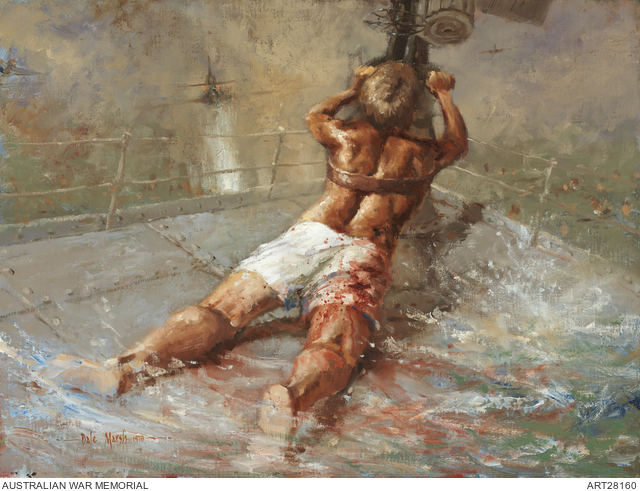
Ordinary Seaman Teddy Sheean, VC RAN. He served on the corvette HMAS Armidale, carrying out escort duties off the Australian and PNG coasts. On 1 December 1942 in waters off Timor the Armidale came under severe attack from Japanese aircraft with torpedoes hitting its port side and engineering spaces. After a bomb hit aft, the order was given to abandon ship. Survivors leapt into the sea and were machine gunned by Japanese aircraft. 18 year old Teddy helped to free a life raft then scrambled back to his Oerlikon anti-aircraft gun on the sinking ship. Although wounded in the chest and back he strapped himself to his gun and shot down one bomber and kept others away from his comrades, still firing as the Armidale sank. Only 49 of 149in the ship’s crew survived the sinking. He was awarded only a MID and had a Collins Class sub named for him in 1999, but in 2020 after a sustained campaign to have his bravery and sacrifice recognised, an expert panel recommended he be considered for a VC, which was posthumously awarded in December. This was a first for the RAN.

Capt Reg Saunders, MBE 3RAR. Reg was the first Aboriginal Australian to be made a commissioned officer in the Army. He enlisted in 1940 and served in North Africa and then the ill-fated Greek and Crete campaigns, eventually evading capture on Crete for 11 months. He was evacuated to Australia in 1942 and re-joined his battalion, fighting in the 6th Division in New Guinea as a Sergeant until recommended for officer training in mid-1944. He served in NG as a platoon commander in the Aitape-Weiwak campaign. He left the Army in October 1945, but when the Korean War started he returned to the Army serving initially as a Lt with 3RAR and later as a Captain Company Commander in the ferocious Kapyong battle (in which 3 RAR was awarded a US Presidential Citation). Reg was recommended for a decoration but turned it down. He was a much-respected soldier and leader and awarded the MBE for his community work in 1971.

Cpl Cameron Baird, VC MG 2 CDO. Originally from Tasmania, Cameron joined the Army in January 2000, serving with 4 Battalion (Commando), later 2 CDO Regt in Timor-Leste and Iraq (twice) until 2004. He re-enlisted in 2006, also with 4 Bn (Cdo). From 2007 he had four deployments to Afghanistan until 2013. He was awarded the Medal of Gallantry (MG) for a search and clearance operation on a Taliban stronghold under heavy fire and with close quarter fighting in 2007 as a LCPL. He was KIA in operations in 2013 and awarded a VC in 2014 for his bravery and self-sacrifice. After a helicopter insertion, Cameron Baird led the silencing of a number of enemy positions under heavy fire. He then assisted another team whose commander had been seriously wounded. With selfless disregard for his own safety, he drew fire from an enemy machine-gun position and his team regained the initiative. Inside the enemy compound he charged their positions three times, drawing fire away from his team, again under heavy fire. His third attempt cost him his life.
Remembrance Day 2020: Tattersall’s Club, Sydney
By observing one minute’s silence on 11 November 2020, we pay tribute to the men and women who have served and are still serving in our defence forces and remember those who have died or suffered in conflicts, wars and peacekeeping operations.
A number of Tattersall’s members and members of their families have served with distinction, some paying the ultimate sacrifice, particularly in the First and Second World Wars. I cannot mention all of them here, but it is worthwhile highlighting the service of some of them.
Several members served in both wars. Lieutenant Colonel Blair Anderson Wark VC DSO MID is perhaps the most famous. Blair won a VC for bravery in operations against the Hindenburg Line at Bellicourt in 1918. He re-enlisted in the militia during the Second World War, but died suddenly on a training exercise whilst commanding the 1st Battalion at Puckapanyal in 1941.
Another well known member who served in both wars was Bob Concannon. A peak at his service record puts protests against COVID restrictions into perspective. He served with the 7th Light Horse Regiment,1915-1919 including service on Gallipoli and at Romani. In 1941 Bob re-enlisted to serve as a Captain with HQ 8 Division in Malaya. He was captured by the Japanese and then interned as a POW in Thailand from 1941-1945. Two other members, George Kiernan and Ward Booth were interned with Bob.
The family of member John O’Riordan also saw remarkable service over both wars. John’s brother Captain (Dr) Sydney O’Riordan MC served with the Australian Army Medical Corps in both wars, winning his MC for his gallantry and devotion to duty whilst dealing with casualties in an aid post in France in 1918. He served again from 1941-1942, but died in 1944. Another brother, Flying Officer Clifford O’Riordan, was an air gunner with the famous 460 Squadron, RAAF. He was killed in a flying battle over Germany in 1943. One of John’s sons, Sgt John O’Riordan served with the 1st Papuan Infantry Battalion and he too was killed in action in New Guinea in 1943. Another son, James O’Riordan, survived the war, having served with both the Australian Army and the RAAF between 1942-1945.
Perhaps the most tragic family is that of member Henry Stevenson and his three sons: Frank, Joseph and Charles. Flight Sergeant Frank Stevenson served as a pilot with 450 Squadron, RAAF and was killed in a flying battle over Italy in 1944. Joseph the oldest son, was also a Flight Sergeant, serving as an air gunner with 24 Squadron, RAAF. He was killed in a flying battle over the Timor Sea in 1945. Henry’s middle son Charles served as a Gunner with the 2/5th Australian Field Regiment, RAA. His date of death is recorded as November 1947 in DVA’s Nominal Roll for the Second World War, but we could not determine a cause of death.
You can share who you are remembering on social media using the hashtag #WeRememberThem
The Cost of War: Three Sons
After writing my last post about the Remarkable O’Riordans I came across another tragic story of loss during the Second World War. I saw the photo below in the Tattersall’s Club Magazine of August 1945.
The three sons of Tattersall’s Club member Mr Henry Stevenson are noted: Frank, Joseph and Charles. I had to find out what happened to the three brothers.
421094 Flight Sgt. Frank Stevenson was born on 11 January 1923. He had been a labourer and storeman before the war and was married to Hildrey. Frank enlisted in December 1941 and served as a pilot with No. 450 Squadron, RAAF. He was killed in a flying battle over Italy on 29 May 1944. He is commemorated at Minturno War Cemetery, Lazio, Italy and his name is recorded on panel 105 of the Roll of Honour at the Australian War Memorial, Canberra. Frank’s name will be projected onto the exterior of the Hall of Memory on 31 May 2020 at 7:21pm and on 17 August 2020 at 7:49pm.
425068 Flight Sgt. Joseph Arthur William Stevenson was born on 26 July 1914. He had been a timber cutter and diesel engineer and was married to Valmai. Valmai and Joseph had two sons. Joseph enlisted in December 1941 and, as a noted marksman, served as an air gunner with No. 24 Squadron, RAAF. He was killed in a flying battle over the Timor Sea on 23 January 1945. He is commemorated at the Northern Territory Memorial, Adelaide River, NT and his name is recorded on panel 102 of the Roll of Honour at the Australian War Memorial, Canberra. Joseph’s name will be projected onto the exterior of the Hall of Memory on 15 May 2020 at 6:50pm and on 4 August 2020 at 9:41pm.
NX38002 Gunner Charles Walter Stevenson was born on 16 May 1919, enlisted in July 1941 and served until November 1945. He was serving with 2/5 Australian Field Regiment, RAA on discharge. His date of death is recorded as 8 November 1947 in the DVA Nominal Roll for World War Two. I was not able to determine the cause of his death.
“not unremembered by those who know and admire them”
The Remarkable O’Riordans
For a couple of months now I’ve been digitising the magazines of Tattersall’s Club, Sydney (I’m a member). They let me take the scanner and a lot of magazines home during the Covid19 lockdown.
Recently, I’ve been working my way through the Second World War issues and on Friday 24 April 2020 I came across the February 1944 magazine that had a short article about the remarkable O’Riordan family from Sydney, two of whom were Tattersall’s Club members. I dug these details of their service mostly out of various online databases and archives from the Australian War Memorial.
Four members of the O’Riordan family served in both the First and Second World Wars. All are related to Tattersall’s Club member John O’Riordan :
John’s brother Dr Sydney Michael O’Riordan, MC served as a Captain and then Major with the Australian Army Medical Corps (AAMC) in the First World War. He was awarded his MC in 1918 for:
conspicuous gallantry and devotion to duty. During then later stages of an advance, when the infantry were under heavy fire, he established his aid post in an advanced position, and dealt very rapidly with the casualties. His initiative and coolness under heavy fire were an inspiration to all who came in contact with him.
He was serving as a Captain attached to the 13th Infantry Battalion in France. He again served as a Major with the AAMC in the Second World War between July 1941 and February 1942, attached to the 3rd Infantry Battalion. He died at Redfern in 1944.
Another brother of John, 403397 Flying Offr. Clifford Timothy O’Riordan was an Air Gunner with No 460 Squadron*, RAAF was killed in a flying battle over Germany on 30 July 1943. He is commemorated in the Becklingen War Cemetery, Luneburg, Germany and his name can be found on panel 108 of the Roll of Honour at the Australia War Memorial (AWM), Canberra. His name will be projected onto the exterior of the Hall of Memory on 12 May 2020 at 2:41am and on 3 August 2020 at 2:55am. He was a Tattersall’s Club member and had been admitted to the NSW Bar before enlisting in 1941. His own war diaries are held by the AWM and they’ve now been digitised. You can read a description of those diaries and also view or download them via this link: https://www.awm.gov.au/collection/C89812
One of John’s sons, NX113095 Sgt. John Michael O’Riordan served with the 1st Papuan Infantry Battalion, Australian Army. He was killed in action in New Guinea on 25 November 1943. John’s name is located on panel 76 of the Roll of Honour at the AWM. His name will be projected onto the exterior of the Hall of Memory on 2 June 2020 at 12:42am and on 2 August 2020 at 2:34am.
Another son was NX87133 Gunner James Clifford O’Riordan who served in the Army from February 1942 until December 1943, after which he transferred to the RAAF where he served as a 443862 Flight Sgt J.C. O’Riordan until October 1945.
I reckon that is very sad but also truly remarkable for the one family.
* Some hours after initially posting this I realised that 460 Squadron, RAAF was familiar to me. It was first formed as a heavy bomber unit in 1941 and is commemorated at the Australian War Memorial by the famous Avro Lancaster bomber “G for George”. 460 Squadron flew as part of RAF Bomber Command and was a multi-national unit with most of its personnel being Australian. It flew the most sorties of any Australian bomber squadron in the RAF bombing campaign against Germany and Italy, but lost 188 aircraft and suffered 1,018 combat deaths, 588 of whom were Australian. RAF Bomber Command represented only two percent of total Australian enlistments during the Second World War, but accounted for 4,136 fatalities (3,486 killed in action and 650 in training accidents of approximately 10,000 RAAF personnel who served with Bomber Command). RAF Bomber Command sustained Australia’s highest casualty rates in the Second World War.
 FromMelbin