
Tagged: history
For ANZAC Day 2025 (some tenuous links)
Over the Easter break, I started watching The Narrow Road to the Deep North miniseries and I ordered Richard Flanagan’s 2014 Booker Prize winning novel that inspired it for my Kindle. I usually feel a bit of a connection to this kind of thing as I am named after my father’s older brother Malcolm who died as a PoW of the Japanese. He had been captured during the fall of Singapore and had served time in Changi and then on the infamous Burma-Thailand Railway, before being repatriated to Japan as slave labour on the Japanese cargo ship Rakuyō Maru. It was torpedoed in September 1944 by a US submarine in the South China Sea and my uncle lost his life along with 1,158 other Australian and British PoWs from that “hellship”.
On Easter Monday I normally try to catch the famous Stawell Gift handicapped pro footrace and after watching that I started to think about what to post for ANZAC Day, something I usually do for the people I swim with regularly in Sydney. After a great deal of thinking and a quick skim of Dr Peter Pedersen’s excellent book The Anzacs: Gallipoli to the Western Front I thought that maybe I could try to come up with a post linking Gallipoli (Day 1), the Stawell Gift (or at least Stawell, the city), PoWs of the Japanese and my family at war. So here we go, mind the step …
It all starts with Captain Joseph Peter “Puss-in-Boots” Lalor who landed at Gallipoli with the 12th Battalion in the second wave on 25 April 1915. A grandson of Peter Lalor of Eureka Stockade fame he had also served in the Royal Navy, the French Foreign Legion and had helped out in a South American revolution before joining the Australian Military. After wading ashore with the family sword, he and his men had dug in just short of the Nek. The 12th Battalion was in reserve.
Elements of the 11th and 12th Battalions had been sent to occupy Baby 700, consolidating there until resuming the advance, but under Lt. Col Mustafa Kemal the Turks who had initially fled the Anzac landing assault, reorganised and started counter-attacking. Baby 700 was regarded as strategically important by both sides and the Australians and then some New Zealand troops made several charges against it during the day, forced back by the Turks each time.
Captain Lalor eventually sent some exhausted troops to the rear and led the remaining 12th Battalion troops forward for the Nek. He came across Captain Leslie Morshead with a platoon of the 2nd Battalion and asked them to join him. Leading a charge, Captain Lalor stood up and was sniped. Captain Morshead survived the first day at Gallipoli and months later he fought at Lone Pine as a Major.

Leslie Morshead is pictured above standing on the right, in a captured Lone Pine trench after the battle in August 1915 with Private James Brown (Jim) Bryant of the 8th Battalion (also standing, facing the camera). Private Bryant from Stawell, Victoria would be awarded the Military Medal in 1918 as a Company Quartermaster Sergeant in the 60th Battalion for “conspicuous gallantry and devotion to duty”. There is another photo of Private Bryant here, on 26 April 1915, also taken with his own camera, by an unknown mate. He re-enlisted as a Lieutenant the 2nd AIF in 1941 and would then survive three years as a PoW in Changi Prison after being captured. He provides a rather tenuous link to the Stawell Gift and also to prisoners of the Japanese. Over 22,000 Australians became prisoners of the Japanese during the Second World War, including Jim Bryant and my uncle Malcolm.
After the Gallipoli campaign, Leslie Morshead was promoted to Lieutenant Colonel and commanded the 33rd Battalion in France from November 1916. He led the battalion successfully through Messines and the Passchendaele campaign of late-1917, was awarded the Distinguished Service Order, and continued to command through the battles at Villers-Bretonneux and Amiens in 1918. His service also continued in the Second World War, initially as a Major General commanding the 9th Australian Division (photo below) during the seige of Tobruk (April-November 1941) and again, as a Lieutenant General (commanding the 2nd AIF and the 9th Division) during both battles of El Alamein in 1942. He was known to his troops at “Ming the Merciless”. Later in the war he would command the Australian I and II Corps in the South West Pacific.

Leslie Morshead and veterans of the 9th Division that he commanded at Tobruk and El Alamein provide the final tenuous link to my family, this time with regard to my father … Robert John Booth (aka Dad) enlisted in the RAAF in early 1944 and served as a Flight Sergeant Navigator in the Pacific at the ripe old age of 19. He would not say much about his war service, but on the odd occasion when he did I remember him telling us of at least one of his pilots being a 9th Division veteran. This man had seen enough of the army during his service at Tobruk and El Alamein, so on return to Australia he transferred to the RAAF and retrained as a pilot. Dad said he was both fearless and as mad as a cut snake. As a young boy I remember Dad taking me to visit a couple of friends and distant relatives for whom he had enormous respect. They were Rats of Tobruk.
Anzac Day 2024
So for the last little while I’ve been putting together a bit of information about Anzac Day and who we commemorate for the people I swim with several times a week. Sometimes I read it out between sets on the day, but this year we are only swimming on the days before and after Anzac Day, so I distributed this as reading. I don’t know why I selected some Boy Anzacs and a Dame, it just came to me when browsing the Australian War Memorial’s website. There is also part of a famous poem by Rupert Brooke which I believe says it all, particularly regarding those Boy Anzacs.
Private James Charles Martin

James Martin was born on 3 January 1901 in Tocumwal, NSW. He was successful on his second enlistment attempt at 14 years and 3 months, departing from Melbourne in June 1915 with the 21st Infantry Battalion. Deployed with reinforcements for Gallipoli from Egypt, his transport ship was torpedoed by a German submarine and he spent several hours in the water before being rescued. He eventually landed on Gallipoli on 7 September.
Although battle casualties were slight in the time he was there, front-line work, short rations, sickness, flies, lice and mosquitoes took their toll on his unit. He contracted typhoid fever in late October and was evacuated to a hospital ship, having lost half his weight. He died of heart failure only two hours later, three months short of his 15th birthday. He was buried at sea and is commemorated on the Lone Pine Memorial on Gallipoli. He is thought to have been the youngest Australian to have died on active service in the First World War.
Private Kenneth Norman McNamee, M.M.

Private Kenneth McNamee, M.M. (4258, 14th Battalion) was born in Ballarat, Victoria. He was working as a printer with “The Sporting World” and not yet 16 years old when he enlisted in July 1915. Kenneth was awarded a Military Medal for his “daring and coolness” while running messages and maintaining communication between Company and Battalion headquarters during the battle of Mouquet Farm in August 1916. Kenneth was wounded on 11 April 1917 during the battle of Bullecourt and was last seen being bandaged by two German Red Cross men. This was reported after the war by a fellow prisoner of war, who said that Kenneth had been badly wounded by a bullet just above his heart and was unlikely to live long. Kenneth is commemorated on the Villers-Bretonneux Memorial, Villers-Bretonneux, France. He was 17 years 9 months of age.
Private Roy Henderson Robertson

Private Roy Robertson (1765, 20th Battalion) was a shop assistant from Scarborough, NSW. He enlisted in June 1915, claiming to be 18 years old. Roy was killed in action at Russell’s Top, Gallipoli, on 7 November. His name is recorded on a memorial at Walker’s Ridge Cemetery, Gallipoli.
After the war his brother, James L. Robertson, who served with the 45th Battalion, wrote that Roy was 16 years 4 months when he died.
Private Ernest Arthur Deane
Private Ernest Arthur Deane (NX52899, 2/2nd Machine Gun Battalion), from Campbelltown, NSW died on active service in Egypt on 19 August 1941 when his dugout collapsed on him. He is commemorated on the El Alamein War Cemetery in Egypt. His service record file shows his birthdate on enlistment as 26 January 1920 but subsequent letters from his family post-war show his real birth date as 26 January 1925. This was somewhat common with those who looked and sounded old enough to enlist. He would have been 16 years and six months when he was killed accidentally.
Private Thomas Arthur Jiggins

Private Thomas Arthur Jiggins (NX36926, 2/19th Infantry Battalion), from Barallan, NSW enlisted under his brother Frederick’s name, using his date of birth, 1 May 1920. He changed his name to his correct name in August 1941 in Malaya and did so by Statuary Declaration, without any mention of his correct birth date, 1 February 1925.
His service record shows him as missing believed wounded on 22 January 1942 and he was later officially presumed to be dead. (He was not recorded as a PoW.) The AWM Roll of Honour circular shows that he was only 16 years and 11 months when he died.
Dame Emma Maud McCarthy, GBE, RRC & Bar, DStJ

Dame Maud McCarthy was born in Paddington, Sydney in 1859 and saw service as a nursing sister and army matron-in-chief in the Boer War and the First World War. Known as the nurses’ general, she was one of the most highly decorated women’s leaders of the First World War.
She had moved from Australia to England by 1891 and began general nursing training at London Hospital, Whitechapel, becoming a sister in early 1894. She was selected by Princess Alexandra to go to the Boer War with five others as her own “military” nursing sisters and served with distinction from 1899-1902.
On return to England she was matron at a succession of military hospitals and became principal matron at the War Office in 1910. On the outbreak of war she served as Matron-in-Chief of the British Expeditionary Force in France and Flanders from 1914 to 1919, sailing on the first troop ship to leave England. By the time of Armistice there were over 6,000 in her charge and she had been responsible for the nursing of hundreds of thousands of casualties in the years 1914-1918. She retired in 1925 and died at home in Chelsea, London in 1949.
THE DEAD (IV) extract
Rupert Brooke, 1914

These hearts were woven of human joys and cares,
  Washed marvellously with sorrow, swift to mirth.
The years had given them kindness. Dawn was theirs,
  And sunset, and the colours of the earth.

These had seen movement, and heard music; known
  Slumber and waking; loved; gone proudly friended;
Felt the quick stir of wonder; sat alone;
  Touched furs and flowers and cheeks. All this is ended.
Sources:
https://www.naa.gov.au/explore-collection/defence-and-war-service-records
Other Men’s Flowers. An Anthology of Poetry Compiled by A. P. Wavell, 1981 reprint
My Reading in 2023


My total number of books was down a little on 2022, but some of these were either long reads or a bit difficult to get through.
I really enjoyed Mick Heron’s Slough House series of books and I believe I’ve read all of them now. They are just so well written and there is so much hilarious dialogue. I must say the TV series is also excellent and very well cast. It is as if he has written the books specifically for that cast.
I like books series a lot and when I find a good one I usually see it through. Jo Nesbo’s Harry Hole series is great and more recently I’ve been reading my way through two of Alex Gerlis’ series: Spy Masters and The Wolf Pack Spies. There are also Bill Rogers’ The National Crime Agency books.
Many of these books tend to have a continuing hero figure, which I like, or they are basically historical fiction. Apart from that lot there are only four others: one about photography as there is so much to learn (and I liked the look of the book); Erik Larson’s The Splendid and the Vile; one by another favourite author, Karin Slaughter; and one that was the subject of a streaming TV series, All The Light We Cannot See. I’ve read several of Erik Larson’s books as they are usually great stories, but I find them hard to get through. All The Light … was adapted terribly on the small screen. It is an interesting story, but I don’t think the book deserves all the rave reviews it gets.
I read all but one of these on my Kindle as that is my preference now. Only Jackie Higgins’ photography book was a paper book. That’s all!
My Reading in 2021
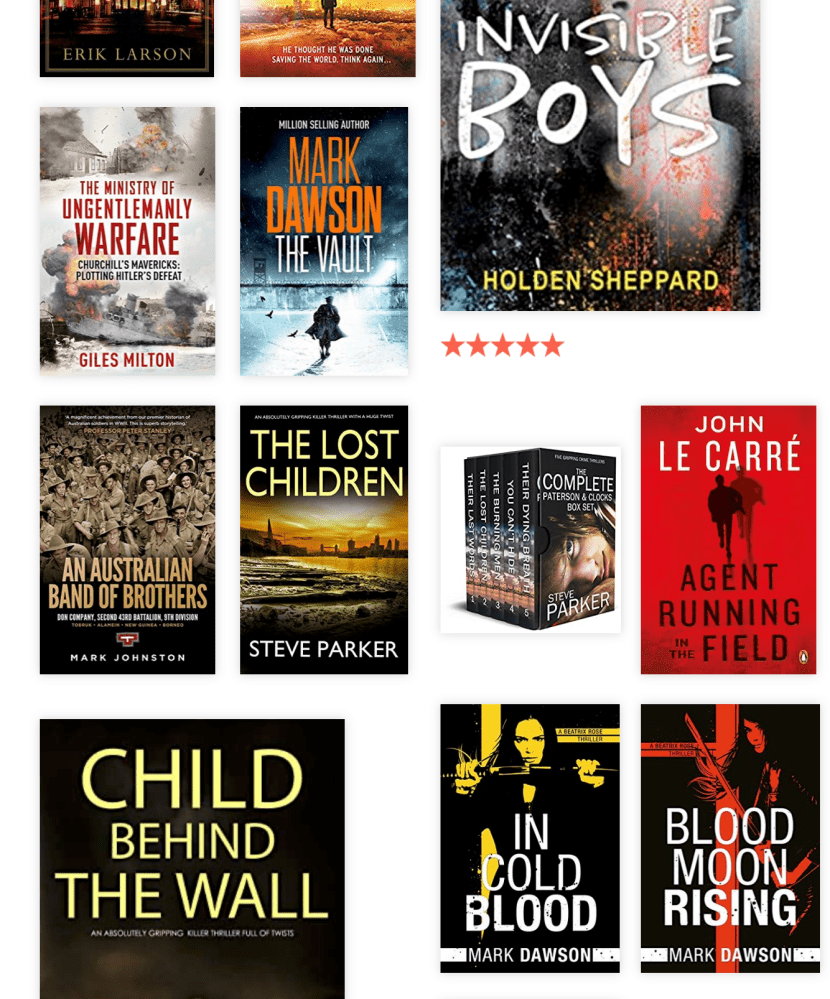
Recently, Goodreads told me that I’d read 31 books in the last year. So I decided to check that for double counting as if anyone had asked me I suppose I would have said, “I don’t know, 12-15?”. I read most books these days on my Kindle and sometimes I purchase multiple editions by one author, e.g. Steve Parker’s ‘The Complete Paterson & Clocks Box Set (1-5)’. Goodreads registers all five books when completed, but sometimes I purchase another single edition or two before finding the cheaper box set. My audit confirmed that I had completed the reading for 32 books. I reckon I have Kindle to thank for all that reading because pre-Kindle me used to buy heaps of paper books and start many of them, but rarely finish any in recent years.
What follows is my quick review of what I read in 2021. That Goodreads link above gives you a quick summary if you don’t want to TL;DR edition …
I’ll use two codes: eB for ebook and pB for paper book.

First, a confession of sorts: two books were not actual ‘reads’ Alan Fletcher’s The Art of Looking Sideways (pB, 4/5) and Bruce Weber’s Bear Pond (pB, 5/5). Both are beautiful books, but I would not classify them as reads. I recorded them as ‘read’ this year as I’ve looked through TAoLS many times over the last decade trying to find various quotes or inspiration and I just felt that I should record it as complete on Goodreads. Similarly, I’ve looked at all the beautiful photos in Bear Pond quite a lot. It is a First Edition, published in 1990 to benefit the AIDS Resource Centre in NYC. I literally lusted after this book for many years before purchasing a pre-loved edition online. It is one of my most cherished possessions.
The other 30 books were actual reads and all but one were read on my Kindle. I guess I should start with the the only other book that I rated 5/5: Holden Sheppard’s Invisible Boys (eB). I actually wrote a review for this book on Goodreads, so I won’t repeat all that here. I guess it was the one book I could really identify with and it made me feel something.

Only three of the remaining books were non-fiction. Of these, I think Mark Johnston’s An Australian Band of Brothers: Don Company, Second 43rd Battalion, 9th Division (eB) was my favourite. I would’ve given it 4.5/5 if possible. I loved Stephen E. Ambrose’s Band of Brothers and the mini-series from about 20 years ago. Mark Johnston’s Australian history compares very well and is just as horrific. It is very well researched and even after working at the Australian War Memorial for many years, I was amazed at what these men and their families endured during and after the Second World War. Erik Larson’s In the Garden of Beasts: love and terror, and an American family in Hitler’s Berlin (eB, 4/5) is a frightening story of the coming war in the years immediately before 1939 in Berlin itself. I’m obsessed with Berlin and have read a few historical and many spy novels as well as histories of this fantastic city, so I really enjoyed this book and at times you almost cannot believe what you are reading. The Ministry of Ungentlemanly Warfare: The Secret Organisation that Changed the Course of the Second World War by Giles Milton (eB, 4/5) is another wonderful history, but I think it tries to put too many extraordinary stories into one volume and some deserved more details.
We are now down to 26 books, but for these there are only six authors. We should probably start with one of my favourite authors of all time, John le Carré. His second last book was Agent Running in the Field (eB, 4/5). I think I’ve read all the books he published before this one, but I’m yet to buy his last book Silverview. ARitF isn’t his best book, but I enjoyed it nonetheless as he was a truly gifted story-teller. le Carré also points you to the genre(s?) of fiction stories that I enjoy most: espionage/mystery/thrillers.
Like le Carré, I’ve read multiple books by each of the remaining five authors. In 2021 I only read the one novel by Karin Slaughter: The Silent Wife (eB, 4/5), but this is #10 in the ‘Will Trent’ series and I’ve read all of the others. Similarly, this year I read #5 & #6 in Gregg Hurwitz‘s ‘Orphan X’ series: Into the Fire and Prodigal Son (both eB and 4/5). I do love getting to know characters like le Carré’s George Smiley, Slaughter’s Will Trent and Hurwitz’s Orphan X. I was also a huge fan of Len Deighton’s Bernard Samson back in the day. See also Jo Nesbø’s Harry Hole and Camilla Läckberg’s Patrik Hedström, but now we are way off the 2021 track.
A new author for me in 2021 was Steve Parker of ‘Paterson & Clocks‘ fame. I read #1-5 in the box set and then #6: Child Behind the Wall as soon as I saw it because I really like his use of the English language, particularly the many laugh-out-loud sayings of Detective Clocks. All were eB and 4/5.
Mark Dawson is another author who has given me some new favourite heroes: John Milton and Beatrix Rose. I was surprised to learn that this year I read #16-20 in the ‘John Milton’ series (yes, I’m addicted) and #1-3 in the Beatrix Rose series. Once again, all were eB and 4/5. I’ll eagerly read more when they’re available. I also read and enjoyed Mark Dawson’s The Vault, a stand alone espionage novel, early in 2021 (eB, 4/5).
I read seven books by the final author, Peter May. The first six were the ‘China Thrillers’ #1-6 featuring Beijing Detective Li Yan and his partner and lover, the US forensic pathologist Margaret Campbell (all eB, 4/5). These were good, but I think I enjoyed his ‘The Lewis Trilogy’ more some years ago. In early December I finished reading Peter May’s Extraordinary People (pB, 4/5), a book that I purchased some years ago. It is the first of his ‘Enzo [Macleod] Files’ and I’m already committed to continuing with that series.
That’s all for 2021. I hope I can live up to this standard in 2022!
Some podcast recommendations …
 OK, so I’ve not done much blogging for a while, but now in isolation I feel the need to share some thanks to, and recommendations for, the podcasters that are helping to keep me sane.
So before you read any further a word of warning … I walk a lot listening to podcasts and I also listen to them while in the gym or the kitchen at home. The list below is quite long and some of the podcasts are not currently “live”, but I include them because their back catalogue is well worth a listen. So here we go then, mind the step.
“Live” podcasts:
The Peter Attia Drive Great podcast for health and medical advice recommended by a doctor friend of mine. Good coverage of COVID-19, but some excellent episodes on the importance of sleep, drugs in sport, that marathon record, new running shoes and recovery.
7am Great for up-to-the-minute independent reporting and analysis of current affairs and politics.
Hunting Seasons Explores a season of TV in each episode. Quite long episodes. I only listen to them if interested in the series.
Crime Writers On … These guys started by reviewing early episodes of the famous Serial podcast (see below), but now review other (mostly) crime-related podcasts and pop culture. I never miss an episode.
The Beetoota Advocate For the best analysis of Australian politics and current affairs (and a good belly laugh).
Crime in Sports Perhaps an acquired taste and another long podcast, but these two comedians give a great analysis of what seems like an endless list of true(!) professional sports crimes. Almost unbelievable.
True Crime Obsessed Another true crime comedy podcast (yes, I’m addicted). I love these guys. Always funny.
Conversations This is Richard Fidler’s and Sarah Kanowski’s ABC radio show podcast. I listen when interested in the person they are talking to.
The Male Gayz From New Zealand. I love these guys, but again it may not be for you. I really love their theme music! Typically down-to-earth Kiwis, but both have the talent to keep you listening while they just talk about rubbish.
Health Report From the ABC with Dr Norman Swan. Almost required listening these days. I’ve been listening on and off for years.
This American Life From US National Public Radio and hosted and produced by Ira Glass who is probably the foremost expert on podcast storytelling and one of the brains behind Serial. I listen to selected episodes when they appeal to me. Each week they choose a different theme and story.
Extreme Vetting with The Chaser Great for a ROFL moment, this podcast puts selected comedians, writers and politicians through the ringer. Maybe start with the Tony Martin ep from 23 March 2020.
Nordic True Crime This one is a bit dark, but as I’m also obsessed with Scandinavia Noir TV series, movies and books, I love it. Sometimes covers truly horrific crimes, so don’t say you’ve not been warned.
The Gays Are Revolting These guys usually release their eps on a weekly basis and cover contemporary issues and events that are relevant to the queer community. The usually have guests in for interviews. They’re trying to continue while some have been stood down from their jobs
Coodabeens Footy Show Another show that I never miss, but it is only on during (AFL) footy season. Now on ABC radio and in their 40th year on the air. May be a little hard to understand unless you’ve lived in Melbourne or are a keen AFL fan. I love the songs, talk back characters, the general banter and Sam the Sub’s regular segment. Two hours well spent each week.
Kermode and Mayo’s Film Review From the BBC. I’m only a relatively recent listener and I’d probably not yet qualify as a “member of the church”, but this is another one I never miss now and I’m slowly working my way through their available back catalogue. Fantastic! They regularly review big stars of the screen(s) and they’re persevering from home while in isolation in England.
Espionage I guess this is another acquired taste, but the stories are usually well worth listening to.
... These Are Their Stories: The Law & Order Podcast Hosted by Kevin and Rebecca from Crime Writers On, each episode concentrates on reviewing one episode of the TV shows Law & Order, SVU or Criminal Intent with a special guest. Very funny!
Hawk Talk Podcast OK, I’m a Hawthorn FC fan and club member. I’m totally devoted to Nick and Tizz, two die-hard Hawks fans who produce a great weekly podcast during footy season.
Bring a Plate Well there hasn’t been a lot since April 2019, but Peter and Bec are both very funny writers and I find them great listening. But wait! There’s more. A new episode was released on 7 April!
*** LATE NEWS! They’re back!!! Roy & HG: Bludging on the Blindside Yes, Roy & HG are back on the ABC again. All is right with the world, or at least it soon will be.***
Not currently “Live” podcasts (some have completed their run):
Accused Host Amber Hunt does a simply brilliant job on this podcast. The third series just wrapped at the end of January 2020. I’ve listened to them all. One of the top three true crime investigative podcasts ever. Beautifully made and presented. Not to be missed.
74 Seconds This podcast received a Peabody Award in 2017 and tells the tragic story of the first police shooting to go on trial in Minnesota. Really well made.
Bear Brook Another great true crime podcast from the US. A really engaging presentation. and great storytelling.
Bowraville Dan Box from The Australian (newspaper) did a great job on this, exposing an unsolved killing in Bowraville, NSW. Another tragic true story.
Breakdown Now with seven seasons online, this comes from Atlanta, US and the latest season covers a police shooting of unarmed veteran Anthony Hill who was struggling with bi-polar disorder. I found it pretty interesting and very tragic.
Crimetown Currently in their second season, Marc and Zac have attracted a big following with this podcast and deservedly so. Start with Season One about Providence, Rhode Island and the corrupt public figure Buddy Cianci.
Done Disappeared A great send up of Up and Vanished, this is really hilarious, but perhaps you should try a bit of U&V first?
Hunting Warhead Well this one isn’t what the title sounds like. It is an investigative podcast about hunting down online child abusers. Pretty gruesome content.
In the Dark I found both Season 1 about young Jacob Wetterling’s abduction and Season 2 about Curtis Flower’s probable wrongful conviction riveting. Right up there with Accused and 74 Seconds, this podcast is not to be missed. Madeleine Baran, Samara Freemark and their team do an outstanding job with this podcast.
OFFSHORE They’re now working on their fourth season, but until that drops there are three great seasons online. I feel like Hawaii is almost my second home, so really enjoyed the first two seasons about a killing in Waikiki and the sacred mountain Mauna Kea. With any podcast the host is particularly important and Jessica Terrell does a wonderful job on OFFSFORE.
Open Mike This show features interviews between AFL journalist Mike Sheahan and some of the AFL greats. Some are funny and others very moving (like the recent ep with Brian Lake). I’ve not listened to them all.
Phoebe’s Fall A very good Australian investigative podcast from The Age newsroom in Melbourne about the tragic death of Phoebe Handsjuk.
Serial There have been three full seasons of this famous and game-changing podcast. Best to start with Season 1, which at the time was the podcast equivalent of Game of Thrones in terms of popular interest. It put podcasts right up there with mainstream TV series. The first season investigated the murder of Hae Min Lee, a high school senior from Baltimore. Was Adnan Syed guilty or not? In the second season host Sarah Koenig continues, but this time the story is about Bowe Bergdahl as US soldier who had been a prisoner of the Taliban for nearly five years before his release in May 2014. I really enjoyed both seasons.
SBS True Stories I subscribed for Season 3, a five-part 2015 investigation into Adelaide’s gay-hate murders by journalist Mark Whittaker. More horror and tragedy. Sorry.
The Ballad of Billy Balls This one is quite unusual. iO Tillett Wright (host & producer) presents this tale of the 1977 death of Billy Balls, whose girlfriend Rebecca is iO’s mother. It is very well presented and like nothing else you’ve ever heard.
The Eleventh Yet another great ABC podcast that recently concluded. Journalist Alex Mann delves into the sacking of the Whitlam government in 1975, interviewing several people who were involved in some way at that time.
They Came to Play Yet another AFL footy podcast presented during footy season. Nothing since their post-Grand Final ep in late September 2019, but I hope they continue when the footy starts again (gotta be optimistic!). The best thing about this show is that one of the hosts, Lehmo is a Hawks supporter. I never miss it during footy season, especially if the Hawks won and both Footscray and Richmond lost.
The Sporting Probe with Roy & HG This one finished at the end of 2018, but if you like Roy & HG’s humour you can catch up on all 88 episodes.
Tony Martin’s SIZZLETOWN I really miss this one and hope they start it up again. Absolutely hilarious. They even have merch.
Trace A great investigative podcast about the unsolved murder of a Melbourne mother in a suburban bookshop. Great work by the ABC’s Rachel Brown.
Uncivil This podcast is another Peabody winner from 2017. It presents the stories left out of the official and accepted version of the history of the US Civil War. I studied the US Civil War at undergraduate level and I learnt something new each episode. A shame it ended in late 2018.
Uncover I just finished season 6 of this Canadian investigative podcast, so there’s a great deal of listening here for you. I’ve enjoyed Season 3 on the Toronto serial homicides and other unsolved deaths and the history of the LGBTQ community in Toronto and Season 6 on the 1980s panic about Satanic cults in Martensville, SK.
Undisclosed This podcast requires a bit of commitment as it goes into so much detail. Rabia Chaudry, Colin Miller and Susan Simpson investigate wrongful convictions and the US civil justice system. There are 17 seasons! Those I’ve gotten into include the stories of Adnan Syed (of Serial fame, two seasons), Joey Watkins, Jamar Huggins, Freddie Gray, Dennis Perry and Keith Davis Jr.
Unravel This podcast has had four great seasons: 1. Blood on the Tracks about a suspicious death outside of Tamworth in 1988; 2. Barrenjoey Road about the disappearance of Trudie Adams in 1978; 3. Last Seen Katoomba on the disappearance of young Blue Mountains mother Belinda Peisley; and 4. Snowball, the amazing story of how the swindler Lezlie Manukian stole more than a million dollars from host Ollie Ward’s family in New Zealand. Gripping.
Wrong Skin This is a really illuminating and beautifully presented podcast from The Age. It is about a relationship banned under traditional (indigenous) law. Two young lovers disappear and almost a year later only one body is found. Not to be missed.
So that’s about it. Yes, there are others in my podcast library, but those above are the podcasts I’d regularly download and would recommend to others. Enjoy!
And finally, my sincere thanks to all those who have brought us the podcasts above. I love your work!
“The Battle of Coral” by Lex McAulay

The crew of No. 6 gun, 102 Field Battery, photograph by Greg Ayson: https://www.awm.gov.au/collection/P01769.010
More Anzac Day reading …
This book tells the story of the largest unit-level battle involving Australian and New Zealand soldiers in the Vietnam War. A series of actions were fought over 26 days in May-June 1968 around Fire Support Patrol Bases Coral and Balmoral, north-east of Saigon. The North Vietnamese Army actively took the fight to the 1st Australian Task Force positions and even artillery gun positions fought close-combat actions.
It is an appropriate book for the Anzac Day period because the Patrol Bases included both Australian and New Zealand Army forces (as well as US Army units and elements).
Lex gives the background to this period in Vietnam and introduces us to all of the major players and the units involved. I don’t think I read this book until about 2003 or so, but over the course of my earlier time in both the Army and within the Department of Defence I had already met many of the characters mentioned. What surprised me was that over the two decades before reading the book, none of those people had sat me down and told me about what happened at ‘Coral’ in 1968. Even after 2003 as I started researching Coral and meeting with some of the battle’s veterans, most seemed very reluctant to say a lot about what happened, particularly with respect to the major NVA assault and battle on the first night (12/13 May 1968). None were boastful of their own actions and many told me that certain individuals deserved, but disappointingly never received, major bravery awards.
So all that makes Lex’s book a pretty essential record. He tells it in a typically laconic Australian manner. Lex covers the stories of most of those Australians who were wounded or killed during the battle. One well worth reading is the saga of Gunner Mal Hundt who was hit six times during the Battle for Coral on 13 May, at least two of which came from his comrades. Even as he was being evacuated, as Lex puts it “His troubles were still not over.” Mal continued to serve in the Army as a gun sergeant later on and I am pretty sure I met him during a Coral veterans’ 50-years on reunion in Canberra in 2008. He seemed pretty well adjusted to me. I like the way Lex manages to relate the way some of the soldiers kept their dry sense of humour and their ability to make massive understatements in even the darkest of circumstances.
“Anzac to Amiens” by Dr CEW Bean
 “8th August, 1918” by Will Longstaff: https://www.awm.gov.au/collection/ART03022/
More Anzac Day reading …
This single volume narrative covers the entirety of all Australian forces and their involvement in the First World War. It is based on the 12-volume “Official History of Australia in the War of 1914-18”, of which six were written by Dr Bean himself. He observed first-hand many of the battles fought by the Australian Imperial Force (AIF) as Australia’s official war correspondent during that war and is noted by theUNSW historian Dudley McCarthy in the Foreword for his “capacity to convey the feelings and qualities of thousands of ordinary soldiers”.
Dr Bean was wounded at Gallipoli in 1915 and also mentioned in dispatches there. In 1916 he suggested the idea for a national museum to the Minister for Defence and in 1917 he urged the systematic collection of records which, with the formation of the Australian War Records Section marked the birth of the Australian War Memorial.
In the final chapter of this book Dr Bean says what caused Australians to enlist in the AIF was “the principle of protecting their homes and their freedom by sustaining a system of law and order between nations”, but he also recognises (in 1946) that this war did not end war itself. Later in that chapter, he writes that “only in conditions ensuring freedom of thought and communication can mankind progress”: words that ring true today.
“Prisoners of War: Australians Under Nippon” by Hank Nelson
More reading for Anzac Day …
This 1985 publication is based on an award winning ABC Radio series of the same name that was first broadcast in 1984. It was presented by Tim Bowden, AM (war correspondent, journalist, broadcaster, documentarian, author and oral historian) and Hank Nelson, AM (historian, author, mentor and ANU Professor). I listened to that series week-by-week, on Saturdays as I remember, because I was named after Dad’s older brother who was killed as a POW when the Japanese ship the Rakuyō Maru, transporting over 1,000 Australian and British POWs back to Japan, was torpedoed by the USS Sealion II in September 1944. My family would never tell me much about my uncle’s tragic experience as a POW when I asked and this radio series and book helped me to understand why. They simply did not know. Some earlier accounts had been published, such as Russell Braddon’s “The Naked Island”, but I think this broadcast and publication really helped us to understand the experience of those POWs because it was made at a time when so many ex-prisoners were finally more willing to talk about their incarceration. That the stories were brought to life is also not least down to the skill of both Tim and Hank.
The book is quite simply full of almost unimaginable memories of endurance, mateship, courage, compassion, humour and the most beastly brutality. It begins with the fall of Singapore in February 1942, and then covers life in Changi, the infamous Thai-Burma railway, the capture of Australian Army Nurses, the decimation of ‘Gull Force’ on Ambon, the atrocities committed on Borneo and the Sandakan death march, escape and evasion attempts, forced repatriation of some POWs to slave labour Japan, the severity of punishments handed out in Outram Rd prison in Singapore, survival and eventual freedom and the legacy of wounded minds.
Now that the 16 parts of the series are available for download, I think that it is best to take the opportunity to listen their voices and then read their words, perhaps chapter-by-chapter. Together, the program and the book bring to life the experiences of many memorable prisoners such as Stan Arneil, George Aspinall, Keith Botterill, Vivian Bullwinkel, Dr Kevin Fagan, Don Moore, Ray Parkin and Snow Peat.

A George Aspinall photograph of three “fit” workers on a camp on the Burma Thai Railway: https://www.awm.gov.au/collection/P02569.192
Nearly all ex-POWs would have passed now, but I had the opportunity to meet and talk with some while I was working at the Australian War Memorial. It always amazed me that so many went on to lead healthy, productive and reasonably long lives knowing what they endured and also what they went without for so many years as POWs. I think it would’ve been around 2004 that several ex-prisoners tracked me down at the Memorial and asked if I was related to a mate of theirs (they had enlisted, served and been captured in 1942 with my uncle). They were all in their 80s or 90s by then and I got to know them all. They marched together every Anzac Day in Sydney and had all survived the sinking of the Rakuyō Maru in 1944. They asked me if they could meet with my father and I remember getting them all together one Saturday morning in West Ryde at one of their homes. After all those years they had managed to track me down and finally my father and I knew what had happened to his brother so many years ago. For me it was just like meeting many of those who told their stories to Tim and Hank.
The Broken Years

Image source: https://www.awm.gov.au/collection/P04604.016
Dr Bill Gammage AM, FASSA is an academic historian who wrote The Broken Years based on his PhD thesis at the ANU. First published in 1974 it tells the story of Australia’s involvement in the First World War through the private records created by a thousand Australian soldiers in their diaries and letters home.
At that time Bill was still able to correspond with some veterans of the Great War and he also skilfully selected records that were mostly collected by the Australian War Memorial (AWM) in the 1920s and 1930s and ties them together to form a chronological story from 1914-1918, covering campaigns in Gallipoli (ANZAC), Egypt, Palestine and France.
I first read this book back in the late 1970s whilst training at RMC Duntroon and studying military history. It had an enormous impact on my attitude to war and made me fully aware of the awful realities, well beyond what I had heard from veterans, or seen in movies or on TV. I think the power of this book comes from the voices of those who served, who tell their own stories so powerfully. As the cover of the book notes, it is both a horrifying and emotionally moving account. What Bill Gammage does in The Broken Years is demonstrate the enormous importance and power of those archival collections at the AWM and he also highlights the vision of the historians, librarians, and archivists who created them so many years ago.
It is also worth noting that Bill Gammage is a highly respected historian and that he revived the tradition of Dr C.E.W. Bean, the official Australian historian of the First World War who focussed his story on the experiences of those who served rather than the battlefield strategies. Bean was also the founder of the AWM. Bill was later employed by Peter Weir as the military advisor for the film Gallipoli.
Bill’s book also seems to have had a not insignificant influence on at least part of my working life. I did not spend that long in the Army after graduating from Duntroon. I had a number of career changes and then somehow managed to wind up at the AWM as Head of their Research Centre (library and archive) in 2001. I was privileged to be responsible for the collections that this book was based upon and also for managing the addition of names to our Roll of Honour as we were again at war in the Middle East.
The critical thing with archival collections is that one must not just concentrate on preserving, cataloguing and exhibiting or providing access to what is already there. Those collections need to be developed as time marches on. With my curatorial colleagues at the AWM in the early 2000s, we soon realised that we faced new challenges in order to do what the AWM had done in the 1920s and 1930s to collect contemporary records of war – in the form of both official accounts (like unit war diaries) and private records in the digital age. We soon began asking to make curatorial visits to war zones to see what was being created for ourselves and to tag or collect what the AWM would need for future exhibitions and research into the conflicts that were still being waged. This started to happen from about 2007-2008. A colleague visited Iraq to mark and collect military technology and paraphernalia and then in late 2008 I was sent to Iraq (Baghdad) and out to sea with the RAN in the Northern Arabian Gulf to collect war records before our forces withdrew from Iraq. I was able to mark or tag some items such as map collections and official records, find out how people were corresponding or keeping diaries, made many photographs and recorded oral histories for the AWM collections. I left the AWM for UTS Library in 2009, but those AWM curatorial visits to war zones have continued in places such as Afghanistan ever since.
The Broken Years will be part of our featured book display at UTS Library for ANZAC Day 2017. I am not aware of any volume like this that has been written about any conflict after the First World War, so it is still unique. As a librarian, curator and collection manager I think it reminds us of the important and continuing role of archives and collecting institutions to preserve public knowledge, even as formats change.
Land of Mine – review #sydfilmfest
Land of Mine is a very grim and sobering film. Set in 1945, it tells us a little known story of the de-mining of the coast of Denmark immediately after the Second World War. After Germany’s surrender we follow a group of teenage German boys, obviously conscripted late in the war, who were sent to Denmark to remove mines from its coastline. Apparently some 2,000 German ex-soldiers were forced to de-mine these beaches and over 1,000 of them died or suffered debilitating injuries as a result.
From the very beginning this film is brutally realistic in its approach. Perhaps it is necessary if the anti-war message is ever to be widely understood. So we are introduced to the consequences of war with an abundance of violence, destruction, revenge, loss of life, waste, blame, guilt and victimisation. Very little is held back and there are many graphically realistic scenes of sheer horror.
One of the keys to the power of this film is that the cast look and act so authentically, making in even more shocking. The Danish sergeant in charge of the group of the boys, played by Roland Møller, has obviously either seen the results of German excesses during the war itself, but we are not given any details. All of the young German boys look so innocent and somewhat ashamed of their country’s role in the war. It is so effective and powerful because I think they actually are teenagers, not 24 year olds playing teenagers as is so often the case.
As the film develops, it slowly introduces and explores other emotions and the consequences of war: loss, grief, empathy, friendship, love, sympathy and perhaps forgiveness.
The film is beautifully shot, from the scenery of the Danish coastline to the close-up shots of the boys nervous hands removing detonators from the mines.
It is such a powerful film that I wonder whether it should be compulsory viewing for any politician wanting to send young people off to war or willing to spend more money on the awful industries that manufacture these horribly destructive weapons.
My Bruce McAvaney Specialness Rating*: 4/5 (Most people would think this to be special.)
 FromMelbin