End of Day #1


It was patchy, but you get that. Don’t expect as many posts from Day #2 as I am going out Wednesday night and in any case the program content is not as strong, as far as we are concerned.
I had dinner after the close with Carmel and Paulie and they basically agreed with me about the papers I heard.
One thing I did notice on my travels on foot around town is that Melbourne city is now full of public works of art. They are everywhere and wonderful!
I’ll try and take some more pics tomorrow.

International Librarianship 2.0: some international dimensions of Web 2.0 and Library 2.0

(Keynote)
Peter Johan Lor
, Secretary General, International Federation of Library Associations and Institutions and Extraordinary Professor, University of Pretoria, South Africa
Abstract:
The World-Wide Web is evolving into an interactive, multipolar social space, referred to as Web 2.0. Libraries are urged to follow suit, as implied by the term Library 2.0. A brief exploration of the evolving environment precedes a discussion of a number of trends which affect the library profession and which require attention at the international level. They include the commodification and dematerialisation of information, globalisation, and disintermediation. Their effects are diverse and affect freedom of information, equity of access, and inclusion in the information society – three themes that are addressed as part of IFLA’s international advocacy programme.
Well, as a keynote, this one didn’t measure up. The content was initially entertaining but pedestrian in its content. Sorry, but I expected more from a keynote than this and struggled to stay awake. I wasn’t expecting him to put a Reliant Robin into orbit, just some stimulating new ideas or a different perspective. Maybe there is more in his written paper.
He talked about the early days of library automation and how it has accelerated. Now we are in a “disruptive innovation phase”.
He mentioned the importance of enjoying the journey (search) & the Long Tail of obscure/esoteric trivia encountered along the way. Problems encountered with amount of information to digest and limited bandwidth. Web: interactive; collaborative; and private/personal.
He links the Web & Library 2.0 to Info Economy. He also noted the ephemeral nature of new “dematerialised” documents. How do we preserve them? The place of publication is now irrelevant/obsolete.
Virtual content must reside somewhere and he briefly entioned “trusted repositories” in this context. Maybe they make it easier to pull the plug and censor material.
See his discussion of the relationship between Commoditisation/IP and the Long Tail (- in his paper for those interested I have the pdf file).
He also talks about the issues like orphaned works (i.e governing anything produced after 1860-70!) which confront mass digitisation projects. IFLA/IPA have a joint statement on this: should conduct a diligent search and if they can’t find the owner and then go ahead and (mass) digitise, and the owner appears, there should not be a sanction against the library. [This may be relevant to the RC WW1 digitisation Project.]

Data management and the curation continuum: how the Monash experience is informing repository relationships

Andrew Treloar, Director, Australian National Data Service Establishment Project, Monash University
Cathrine Harboe-Ree, University Librarian, Monash University
Abstract:
Repositories are evolving in response to a growing understanding of institutional and research community data and object management needs. This paper (building on work already published in DLib, September, 2007) explores how one institution has responded to the need to provide management solutions that accommodate different object types, uses and users. It introduces three key concepts. The first is the curation continuum, which identifies a number of characteristics of data objects and the repositories that contain them. The second divides the overall repository environment based on these characteristics into three domains (research, collaboration and public), each with associated repository/ data store environments. The third is the curation boundary, which separates each of the three domain types.
This one was really aimed at the academic environment, but I hoped that there would be something for us to learn here too. I think it was beneficial. I have the pdf file for those more interested.
The core of Andrew’s presentation was his slide on the Data Curation continua identified so far:


Object:

Less Metadata More Metadata
More Items Fewer Items
Larger Objects Smaller Objects (different reqts)
Objects continually updated Objects static
Management:
Researcher Manages Organisation Manages
Less Preservation More Preservation
(eg. no commitment to those presentations being around forever on Slideshare)
Access:
Closed Access Open Access
Less Exposure More Exposure
(His paper also stresses the importance of going well beyond access into exposure and discoverability using a range of techniques such as OAI-PMH, RSS feeds, search engine spidering and federated search.)

How does this continua help them map out their Repository requirements? That is where their three different environs came to life.
From the paper’s conclusion (as this is of some relevance to our DAMS/Mediabin):
When the ARROW philosophy was initially conceived it was thought that a single institutional repository that was integrated, interoperable and flexible would provide the best platform to support teaching and research at Monash. The single common repository approach, while initially attractive, has been found to suffer from a range of implementation challenges and fails to provide adequate management solutions for data generated by researchers over the entire research lifecycle. These challenges can be best addressed when considered in terms of the data curation continua. The ARROW, DART and ARCHER projects have seen the evolution of this concept into a more nuanced understanding of the different types of content that would need to be managed, and the different audiences and uses for that content. This has led to an acceptance that multiple, albeit interoperable, repositories would be better. One set of decisions about what to do for each of the continua leads to three different sorts of repository domains. Monash University is calling these research (DART), collaboration (ARCHER) and public repositories (ARROW) respectively. A further management concept, the curation boundary, provides a mechanism for determining when and how objects can be moved between the domains.

We may not always need to use something like these three stages and currently we just use two – private (museum staff only) and public (web). It could be, however, that we will soon require a medium stage where we are more open to collaborative ventures and cooperative creation of our digital collections. Perhaps that also comes in via tagging of public assets?
As knowledge about institutional and data management repositories evolves over the next few years, these ideas will be further explored, by Monash and many other institutions. I guess what he was saying is why apply the one set of rules to everything if not everything is to be kept/preserved forever – perhaps as objects cross the curation boundaries, different rules can be applied by workflow? A good example would be the generation and attachment of metadata?
Andrew is now setting up the ANDS.
During questions, both Catherine and Andrew talked about developing the new people needed to take such projects forward. It is a growth area for librarians, but there are not a lot around who have the full compliment of both IT and IM skills. Data management and other curatorial skills will be required for us (for the ECM system).

Queensland Stories: community, collections and digital technology at the State Library of Queensland

Deb Stumm, Executive Manager, Heritage Collections, State Library of Queensland
Abstract:
In the vast state of Queensland, the ability to create and share stories about people, places, landscapes and ecology using digital technology and the World Wide Web bridges distance and difference. The sharing of stories is the key concept around which the Queensland Stories Program has been built. The Program strongly aligns with the State Library’s new strategic priorities and positions it as a leading institution in the field of digital technology. It promotes the State Library as a centre of creativity and learning, and provides opportunities for community engagement projects as well as the creation of user generated content for the collection.
Deb showed some images of the new SLQ building and I really, really need to see it! SLQ has many other partners that they work with. Over 1 million people visit it each year now! (I think they might be interested in a small touring version of our T.E. Lawrence collection.)
Digital story-telling started at Berkley and other examples include the VHP at the LoC. ACMI also has had a program since 2004. Builds multi-media collections (i.e development!). Queensland Stories Project does just that. This kind of model is something we could follow for recent conflicts.
The Queensland Stories website, launched in June 2005, is a rich storehouse of Queensland digital stories. Digital stories can be viewed over a dialup and broadband connection on both Apple Macintosh and PC platforms. The digital stories are available in both Real and Windows Media Player formats to enhance the viewing experience.
IP issues: layers & elements; advice given to creators accordingly (esp. re music and film – use whatever is free). Looking at Creative Commons licenses as well.
Uses local champions and trainers similar to the VHP in the US. Staff and volunteers at community libraries. Stories held on local networks?

Virtual and Physical: architect Christopher Alexander on living spaces

Dr Bonna Jones, Senior Lecturer, RMIT University
Yen Wong, Learning & Technology Librarian, State Library of Victoria

Abstract:

Christopher Alexander is a controversial architect who believes that those who build physical spaces must address the question of human feeling. When combined with some ideas on metamedia literacy, there are implications in his work for the building of social online spaces such as Inside-a-Dog, a new site being developed by the State Library of Victoria for young readers.

Many were keen to go to this presentation, but in the end it didn’t deliver. Too much theory and light on content.
Relationships between parts and whole. Emergent things.
Neglect of the importance of the human feeling and the beauty of shape.
There wasn’t much in this for us. Eventually I fell asleep.

Discussions and exhibition viewing

I missed a couple of presentations and talked at length to W.F. Pascoes re digitisation – recent trends in equipment and new software and correction techniques for OCR work (done in India!).
Caught up with Shirley Foster from Altarama. They are very grateful for all the promotional support the AWM has given them and the company is now going strongly, especially in the ACT. There was keen interest in RefTracker at the conference, including the NLA.
Discussed RFID with two providers, including 3M. They’ll ask me to go and see them for a demo in Sydney in April around the time I am giving a digitisation master-class.
Over lunch I caught up with Paulie and Carmel from NLA and they agreed that Andy Powell’s plenary address was the most stimulating thing from the morning session. The rest of the Library 2.0 stuff that I missed was useless, at least for us.

Library 2.0

Lynette Lewis from Yarra Plenty Regional Library –
Library 2.0

(a written paper was provided on CD – let me know if you want the pdf file)
She related 2.0 developments and initiatives to other physical improvements such as wifi and RFID – aiming at 100% self-serve.
Referred to Helene Blowers’ Learning 2.0 program. Self-paced and online to encourage play and exploration. 12 week program – 23 things. Exercises set out on blogs. A good model for us and ECM learning exercises.
YPRL are also using a wiki internally as a training resource for staff.
LibraryThing for Libraries is also used through their catalogue – tagging.

It was worth the trip just to hear this bloke

Repositories Through the Looking Glass
(Keynote)
Andy Powell, from Eduserv Foundation
(an educational charity based in Bath)
This presentation had a lot of useful views for us as we approach the new philosophy of our whole ECM environment.
So far (and at this conference) digital repositories seem mostly on the academic agenda in university libraries. Not much seems to be recognised regarding the challenges facing cultural institutions, so maybe we can learn something from the academic experience?
Powell has some cynical views re repositories.
He started by giving us his background with Dublin Core – he has been involved from early days, esp re web based metadata generation tool development. (The Abstract Model was discussed zzzzzzzzz.)
Then he moved on to JISC Info Environment – again aimed largely at the tertiary and further education environment. Most UK digital repositories are based in this environment. They use all the expected standards, but the environment has missed or ignored the Web and this is missing from most digital library spaces, particularly web architecture.
Eduserve has worked with the UK Science Museum and they started by modeling the infrastructure behind the repository (similar to what we have done with ECM). They have built (i.e. developed) a repository for them that they called a Web Content Management (WCM) system.
Serving stuff on the web still missing from JISC Road Maps. He was very positive about open access and what it will do to scholarly publishing – it isn’t an “if”, but a “when” – it will happen!
Repositories (to date) are mostly focussed on deposit, not servicing the web. WCMs are essential if they are to be used. Concepts such as search engine optimization are essential (not just having federated search within the environment).
He briefly touched on the “REST” architectural style – it focusses on resources and global identifiers.
Is the focus just to be on the institutional repositories or a global environment?
Web 2.0 means: the new “prosumer”, remote applications, social-ness & exposed APIs; plus diffusion (eg. blogs, etc.) and “concentration” (via Lorcan Demsey’s recent writings at OCLC) – hosting services that are global in scale, eg. Flickr, Technorati and maybe del.icio.us? He mentioned those using Amazon S3 hosting. Social networks are critical, particularly for research purposes and this needs global services.
Future – what would a web 2.0 repository look like? He said it would look like Slideshare Not many in the audience seemed to be using it. You can share, embed, tag, favourite, etc. Other attributes he suggested: a high quality web based document viewer; tagging; visible to Google; RSS; Amazon S3 (infra-structural services); social groups ability; global in scale. BUT – it doesn’t support preservation, complex workflows and doesn’t expose rich metadata – so what? Are they really needed (in this system)? How can these needs be met without destroying everything? I think that is the problem we have made for ourselves with some of our CMS – wanting them to be all things to all users and forgetting their most critical tasks.
One way forward may well be using SWAP – scholarly works application profile. Used to described eprints – scholarly works/publications held in repositories. They used FRBR – functional requirements for bibliographic records. (See also this Demsey blog post.)Simple Dublin Core (the metadata standard/protocol) doesn’t do this – it is all about relationships, not just a flat structure description. But it may all be too complex in the end. Can we just encourage users to tag, vice deep formal cataloguing that nobody ever sees and few outside the institution ever use? This has effectively distorted much of our work (in the AWM) that seems lost to any users, even on our own site. Rich cataloguing records are locked away inside some of our CMS and NEVER exposed on the web. THIS IS FUNDAMENTALLY WRONG!
We need to learn more from Web 2.0 about what works on the web as most repositories are not working (particularly re sharing on the web). They are not marrying up with the social networks that researchers actually use. Slideshare gets by with almost no formal metadata, just by using tags and links between resources.
Open access is important – making content available on the web. Policy needs to reflect this. We still focus on deposit, not putting resources on the web.
Andy’s clossing message was for us to think about resource orientation, not services – digital libraries ignore this at their peril.
Questions & further discussions:
Warwick Cathro (NLA) suggested that institutional repositories can account for needs such as preservation and richer identification (which is what we are aiming at to some extent), but Powell said that that world has not yet been built, at least not in the UK. Building the social layer is beyond that model.
Physicists seem to be sharing their knowledge and research in arXiv.org and they maintain their affiliations.
Why do we still publish as PDF – it is like still working on paper, why not XHTML – embedded links and micro-formats. It runs counter to the mainstream web. Citation is another huge area and is still at odds with how it works on the web yet even WordPress allows for this with an app.
Stuart Weibel from OCLC suggested that researchers are too lazy and won’t do what is needed re deposit and identification of resources. But Powell remains optimistic that the low cost of sharing a presentation on slideshare brings massive benefits in terms of knowledge sharing. It is intuitive and obvious and can work with little encouragement. It is a second best to say “you must do this”. Systems must be more intuitive than that! (I think this is a key message for us and the new practices and protocols we will be setting up and using within our ECM.)
Re future of scholarly publishing, Powell said that Open Access is just an inevitable change. We see it in the music industry already. Researchers can make their stuff free on the web. Yes, people will still want to buy and want to publish in journals. Maybe they’ll be different, but something will change. National funding bodies seem unable to fund global networks for researchers, so publishers are starting to step into that space, building “Facebooks” for researchers. What impact will blogging have on this – probably an increasing one.
[My apologies for this long post, but this is the one paper not yet provided to us online or via the CD we received at Rego. I had to take these rough notes during his presentation. I thought it was pretty relevant to us as we approach ECM implementation.]

SLV – podcasts


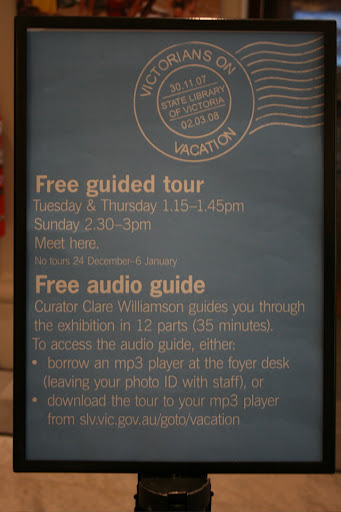
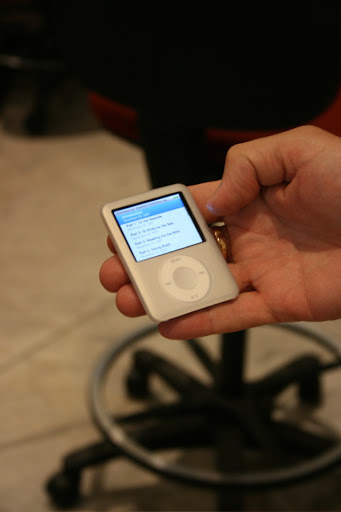
After looking over their digitisation facilities, I had a look at the Victorians on Vacation temporary exhibition. It is an interesting exhibition with some very evocative images, but I found their online audio guide to be a good model for us. There is clear signage about it as you enter the exhibition and I asked the staff about their free to hire MP3 players. They are iPod Nanos (about $199 each I think) and visitors can borrow them for a photo ID. They’ve had only one stolen and for that one no photo ID was left – just stolen credit cards. They’re pretty well used, especially on the weekends, but they only had a few to lend out. They say the use of the guides varies depending on the exhibition content, but they are expecting them to be popular for their next exhibition, The Medieval Imagination, opening in late March.

State Library of Victoria


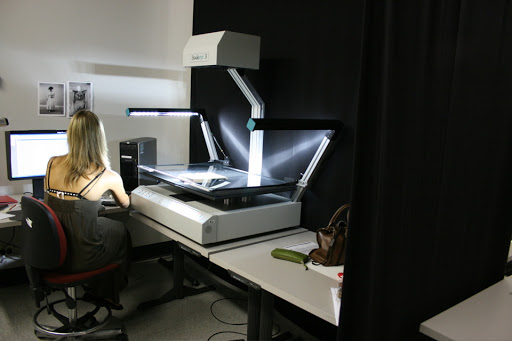
The people who visited us to look at our digitisation facilities last week returned the favour and showed me theirs this week. They have three (yes 3!) Bookeye scanners. They are not perfect for everything, but I think they are needed for many bound formats. The SLV are just scanning in grey scale for access at this stage and have not bothered with OCR for printed text.
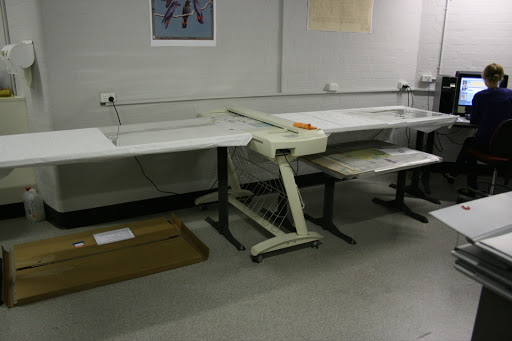
Above you can also see an image of their map scanner with decent layout tables each side of it.
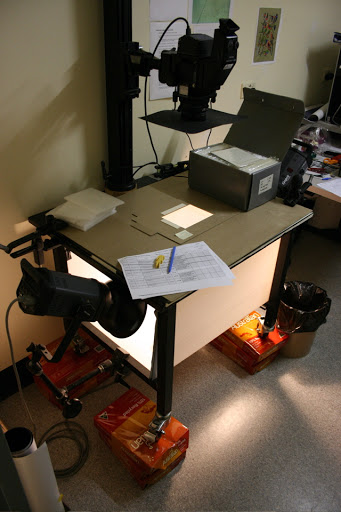
The last image is a light box that they fashioned themselves for their own glass plate negative program.