Book Spotter’s Guide to Avian Titled Literature
An installation by Zoë Sadokierski and Kate Sweetapple in UTS Library. See also cargocollective.com/

An installation by Zoë Sadokierski and Kate Sweetapple in UTS Library. See also cargocollective.com/
(Reblogged from something I posted here: http://informationonline2013.wordpress.com/2012/08/06/the-bookless-library/)
This article in The New Republic by David A. Bell is a pretty interesting read about the NYPL and its struggle for a slice of the future, albeit on a much larger and more public scale than ours: http://www.tnr.com/article/books-and-arts/magazine/david-bell-future-bookless-library?page=0,0
Much of the ground covered in the article will be familiar to those of us interested in the subject matter, i.e. us and our institutions. It is a long read, but it covers issues including the place of books, ebooks, obsolescence of core library functions, “banishing” books from the library proper (to offsite storage), nostalgia for dead-tree books, Copyright & licensing, the consolidation of library spaces, access to knowledge, the evolution of digital formats and digitisation of text, acquisition, “curation” and building design. All in a climate of constant change. Ring any bells?
I do not think that we will become glorified internet cafes, but I do agree that change is afoot and we must change with it. I enjoyed seeing a couple of things in the article, such as: libraries as communities; a nod to the library’s role in the collaborative consumption (of knowledge); and recognition that libraries are a source of crucial expertise, not least with regard to acquisition. David Bell recognises that libraries are “homes to lovingly compiled collections that amount to far more than the sum of their individual printed parts” and recognises that special collections are to be treasured. He almost starts to imagine new roles for us, but stops short of recognising those large public libraries that have already taken such steps such as the British Library (and its BIPC), The State Library of Queensland (and The Edge) and some new programs led by the NYPL itself.
Bell says, and I agree, that the digital revolution is creating the need for more spaces of physical interaction and the easy access to online academic courses will not kill off the desire to rub shoulders with fellow students and professors. He goes on to encourage more partnerships between public libraries and universities and also to advocate spaces in libraries in which readers can organise appropriate activities themselves.
What is missing? I guess some explanation and understanding of the role that librarians have in properly curating their collections as experts. By that I mean researching, acquiring, describing & arranging, promoting, exposing and encouraging the discovery of library collections, no matter what format they are. Being more active in such roles establishes a valued role for the future that cannot be eroded by the march of online services. Also I think he deals with libraries as mostly keepers of text-based, largely monograph collections and therefore he fails to recognise that knowledge and culture these days is not just contained in books and journals. Increasingly, other richer and more engaging media formats are being used for storytelling, as containers of knowledge and for the sharing of ideas. Libraries need to understand this and part of that understanding is a new more proactive research and acquisition process that comes to terms with these new creative practices. Finally, I think he might have touched on our role in encouraging public debate of pressing social issues, in part because we provide access to the knowledge that gives a deeper level of understanding, but also because we are or should be active participants in some of the themes: coping in a digital age; the democratisation of knowledge and opening access to it; and being more sustainable in our daily lives.
Thanks to Hamish Curry @hamishcurry for alerting me to this on Twitter. Let me know what you think if you get a chance.
(Reblogged from something I posted here: http://informationonline2013.wordpress.com/2012/08/14/thinking-differently-twitter-and-zite-can-help/)
Here is a rag bag of different articles that you could have read and pondered over just the last 24 hours if you were a Twitter or Zite user. For those who don’t know it, Zite is a great free iPad app that functions for me as a personal newspaper or reader. It knows my interests (I told it) and it learns what I like to read and delivers me more content on a regular basis without all the rubbish that clutters other services. I wonder how long it’ll last like this so get in fast before Rupert kills it.
All of this was collected and shared in just 24 hours using Twitter and Zite. It is that easy.
Sometimes being different is all about being the same. Take the state of South Australia for instance. Not too far, I hear they like where they are. They’re rolling out a program to connect all the public libraries on the one library system with all the punters using the same card. Here is the news item: http://www.libraries.sa.gov.au/site/page.cfm?u=499
So it might take three years, but it’ll connect almost a million SA residents with nearly five million items across more than 130 libraries and they’ll soon be three years ahead of the rest of us. It is more than time we looked at doing this as a nation. If we were as clever as we think we are, we’d have done it ages ago.
Thanks to @edwardshaddow (from WA) for alerting me to this.
Discuss.
I’ve reblogged this from a post I did here: http://informationonline2013.wordpress.com/2012/08/01/shelf-life-the-usefulness-of-useless-knowledge/
I’m on the program committee for Information ONLINE 2013. Kate Davis dobbed me in. Currently we are still trying to tie down keynotes so we can tell you who they are. One thing I am allowed to say is that they’ll be different.
We’ve all been asked to keep this blog alive on a regular basis, so this is my first post. I think my theme will be posts about being a bit different. Then again, I reserve the right to change my mind at any stage.
Anywho, on with the post, so here we go, mind the step. I saw this on Zite over the last weekend and loved it: http://www.brainpickings.org/index.php/2012/07/27/the-usefulness-of-useless-knowledge/
I think it very nicely encapsulates a lot of our recent initiatives to deepen the impact of the Library within our community (at UTS). In many ways, if we are successful at this we build a more relevant institution for the future that helps to distinguish this University from the providers of online course materials. It is useful to look at some of the ideas raised by Abraham Flexner and why I think they are even more relevant in today’s fast-paced and really dynamic online world. Here are a few quotes from the article that I found really inspiring, (but please try to read the full post):
… this dangerous tendency to forgo pure curiosity in favor of pragmatism …
Now I sometimes wonder whether that current has not become too strong and whether there would be sufficient opportunity for a full life if the world were emptied of some of the useless things that give it spiritual significance; in other words, whether our conception of what is useful may not have become too narrow to be adequate to the roaming and capricious possibilities of the human spirit.
… the really great discoveries which had ultimately proved to be beneficial to mankind had been made by men and women who were driven not by the desire to be useful but merely the desire to satisfy their curiosity.
Institutions of learning should be devoted to the cultivation of curiosity …
Out of this useless activity there come discoveries which may well prove of infinitely more importance to the human mind and to the human spirit than the accomplishment of the useful ends for which the schools were founded.
Justification of spiritual freedom goes, however, much farther than originality whether in the realm of science or humanism, for it implies tolerance throughout the range of human dissimilarities.
On 1 August 2012 our first Artist-in-Residence, Chris Gaul, opened his Shelf Life exhibition in the DAB LAB Research Gallery. I think Abraham and Chris would get on swimmingly. Chris has helped us to understand beyond what we know, he has given us fresh new perspectives on our challenges and presented us with stimulating original ideas to encourage the curiosity of our clients.
Shelf Life displays a few concepts for very different methods of discovery as we prepare to store up to 80% of our physical collection in an underground automated retrieval system that will be adjacent to a new and relocated library on Broadway, in the middle of our redeveloped campus. Chris recognises that in this brave new environment the nature of online interfaces for exploring the collection and browsing books becomes even more relevant. Rather than being sterile and uninspiring, these interfaces can be creative, unexpected tools that encourage playful exploration and serendipitous discovery. As Chris writes:
What if you could wear a pair of headphones and wander library shelves listening to the babble of books reading themselves aloud? What if you could tune into different frequencies of books, or use their Dewey call numbers to call them on the telephone?

That’s all!
P.S. I went back and bolded the quote I used at the launch of Shelf Life. It really is amazing stuff, so if you’re in Sydney come and have a look. If not, we agreed to document the three concepts by video so everyone can se how they work when used. MMB

Last night I went to the UTSpeaks event called Shapeshifters. I’ve been engaging with all of the speakers for some time now, but I still heard some useful and stimulating advice from them at this talk. So here are the thoughts that I noted during the event:
First up was Professor Kees Dorst. He said that after years of research into the processes used by the world’s great designers that he has found that expert design behaviour centres around frame creation. Apparently good designers focus on the problem through frame creation. He says the process moves through these stages or phases: Archaeology (gaining a deep understanding of the problem); Paradox; Stakeholders; Problem arena; Themes; Frames; Futures; Transformations; and Connections.
His research led to UTS establishing a Designing Out Crime (DOC) research centre. Frame creation is at basis of all DOC projects. For example to tackle traffic congestion problems during the Marathon in Eindhoven, DOC started with analysis of the environment and the participants. They widened problem and enriched it to solve it. They mapped all participants, gathered data and mapped the city. This resulted in spreading people all over city according to their interests to solve traffic problem but also much more.
Second to speak was Dr Jochen Schweitzer. He first stressed the need for UTS to graduate more entrepreneurs. To do that we need to provide students with opportunities to test ideas. He also said we should be in the business of surprising customers (I like this idea A LOT). He went on to point out that innovation is held back by homogenous or non-diverse groups of people (ring any bells?) and said that a common language is needed for design (from designers) and that we need to use it more.
Dr Joanne Jakovich was the last speaker. She also gave some background on her work as a designer and researcher and then talked about her recent experience with u.lab. She said that u.lab provided a playful creative space for an open design process, allowing for deep understanding from observation. U.lab practices iteration, failing, sharing, prototyping and doing (not just talking). She stressed the importance of initiatives like BikeTank that make connections to rediscover the innate creativity in all of us as a function of our capacity for shared humanity. BikeTank was aimed at making cities more human and she said that cities desperately needed innovation via collective creativity.
Joanne then gave us her 10 point manifesto:
In response to a question after the talks Kees said that after tapping into the top level layer of design knowledge he found that the things creative leaders do best is to create an environment in which creativity is encouraged, allowed and recognized. Leaders also need to market and communicate about that, at least in part for their internal audience.
If you have Keynote, and let’s face it why wouldn’t you have Keynote, you can download the full presentation with the speaker’s notes from Slideshare.
These are the slides and notes for a workshop we are running for academic researchers on using social media to raise their profiles as part of our UTS Research Week 2012 program.
 |
| Grouplove: Never Trust a Happy Song. ***** |
 |
| Gypsy & The Cat: Gilgamesh. **** |
 |
| Jinja Safari (EP). **** |
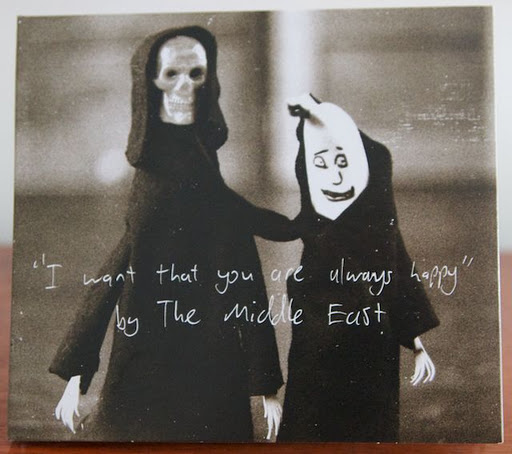 |
| The Middle East: I want that you are always happy. **** |
 |
| The Naked and Famous: Passive Me, Aggressive You. **** |
Grouplove: They play happy music and I always trust happy music. I absolutely love this album and was lucky enough to see them in a smallish Sydney venue live in mid-2011. They’re brilliant, new, original, enjoy playing together and just so enthusiastic about their music. So much energy they just make you want to jump about or thump something in time with their beat! I love the clapping, the guitars, the teeth, the hair, the vocals, the stomping, the screaming and the words. They are like crazy animals released live on stage. It is all good. The first song I heard was Colours and I knew I would love whatever they did. Then I was wild for Naked Kids and soon came Itchin’ On a Photograph and its brilliant video and I especially love Andrew Wessen’s guitar work right at the end of the song. I also love his vocals and ukelele playing on Spun. Love Will Save Your Soul is another powerful song backed by guitar work that I find addictive. Hannah Hooper painted the art work on the album cover. Her vocals are wonderful. They have it. They use it. They do it.
Dancing, California, Rock, Fun, Energy, Pace.
Gypsy & The Cat: Yeah, so they unashamedly echo the soft rock of the 80s like Boston and Toto, but I like this album more than the original tunes that might have inspired them. There are a good number of instantly likeable tunes and the hit tune Time to Wander had a fantastic music video set outside the Tate Modern staring Art Malik that just mesmerised me. I don’t really like Jona Vark, but others like The Piper’s Song, Parallel Universe and Breakaway are great.
80s, Pop, Tate Modern, Dancing.
Jinja Safari (EP): I was really into Peter Pan in late 2010, but I think that I didn’t buy this EP until 2011 and I’m including it in this list because I think the real highlight on the EP is the haunting Stepping Stones. It is a very beautiful song and entirely under-rated. Their music reminds me of Yes. MGMT and Fleet Foxes. An odd mix, I know.
Hippies, Happiness, Dancing, Jumping, Bush.
The Middle East: They are very hard to label but I think they have an alternative folk rock sound not unlike Fleet Foxes for the most part and I like them a lot. It is a pity that this is their second and last album. I was lucky enough to see and hear them perform live at the Metro soon after the release of this album and they’re even better live. Their live performance is much stronger and more energetic than the finessed studio production of this album. I really like Hunger Song and The Land of the Bloody Unknown. I still cannot believe that this band came out of Townsville. Some of their music is truly beautiful.
Bush, Australia, Country, Driving, Sadness.
The Naked and Famous: This is another electro-pop album that I love with many great and varied tracks. It deservedly scored 8/10 from an NME review. They’re from New Zealand and their music is instantly engaging. Young Blood certainly is a highlight and an obvious single, but so too are Punching in Dream, Eyes, the fascinating Jilted Lovers and All Of This. On some of those tracks you almost cannot tell it is the same band. I’d love to see them live. For most of their music you just cannot sit still. It just makes you want to get up and start stomping and jumping around.
80s, Pop, Energy, Darkness, Parties.

