
Tagged: ANZACs
For ANZAC Day 2025 (some tenuous links)
Over the Easter break, I started watching The Narrow Road to the Deep North miniseries and I ordered Richard Flanagan’s 2014 Booker Prize winning novel that inspired it for my Kindle. I usually feel a bit of a connection to this kind of thing as I am named after my father’s older brother Malcolm who died as a PoW of the Japanese. He had been captured during the fall of Singapore and had served time in Changi and then on the infamous Burma-Thailand Railway, before being repatriated to Japan as slave labour on the Japanese cargo ship Rakuyō Maru. It was torpedoed in September 1944 by a US submarine in the South China Sea and my uncle lost his life along with 1,158 other Australian and British PoWs from that “hellship”.
On Easter Monday I normally try to catch the famous Stawell Gift handicapped pro footrace and after watching that I started to think about what to post for ANZAC Day, something I usually do for the people I swim with regularly in Sydney. After a great deal of thinking and a quick skim of Dr Peter Pedersen’s excellent book The Anzacs: Gallipoli to the Western Front I thought that maybe I could try to come up with a post linking Gallipoli (Day 1), the Stawell Gift (or at least Stawell, the city), PoWs of the Japanese and my family at war. So here we go, mind the step …
It all starts with Captain Joseph Peter “Puss-in-Boots” Lalor who landed at Gallipoli with the 12th Battalion in the second wave on 25 April 1915. A grandson of Peter Lalor of Eureka Stockade fame he had also served in the Royal Navy, the French Foreign Legion and had helped out in a South American revolution before joining the Australian Military. After wading ashore with the family sword, he and his men had dug in just short of the Nek. The 12th Battalion was in reserve.
Elements of the 11th and 12th Battalions had been sent to occupy Baby 700, consolidating there until resuming the advance, but under Lt. Col Mustafa Kemal the Turks who had initially fled the Anzac landing assault, reorganised and started counter-attacking. Baby 700 was regarded as strategically important by both sides and the Australians and then some New Zealand troops made several charges against it during the day, forced back by the Turks each time.
Captain Lalor eventually sent some exhausted troops to the rear and led the remaining 12th Battalion troops forward for the Nek. He came across Captain Leslie Morshead with a platoon of the 2nd Battalion and asked them to join him. Leading a charge, Captain Lalor stood up and was sniped. Captain Morshead survived the first day at Gallipoli and months later he fought at Lone Pine as a Major.

Leslie Morshead is pictured above standing on the right, in a captured Lone Pine trench after the battle in August 1915 with Private James Brown (Jim) Bryant of the 8th Battalion (also standing, facing the camera). Private Bryant from Stawell, Victoria would be awarded the Military Medal in 1918 as a Company Quartermaster Sergeant in the 60th Battalion for “conspicuous gallantry and devotion to duty”. There is another photo of Private Bryant here, on 26 April 1915, also taken with his own camera, by an unknown mate. He re-enlisted as a Lieutenant the 2nd AIF in 1941 and would then survive three years as a PoW in Changi Prison after being captured. He provides a rather tenuous link to the Stawell Gift and also to prisoners of the Japanese. Over 22,000 Australians became prisoners of the Japanese during the Second World War, including Jim Bryant and my uncle Malcolm.
After the Gallipoli campaign, Leslie Morshead was promoted to Lieutenant Colonel and commanded the 33rd Battalion in France from November 1916. He led the battalion successfully through Messines and the Passchendaele campaign of late-1917, was awarded the Distinguished Service Order, and continued to command through the battles at Villers-Bretonneux and Amiens in 1918. His service also continued in the Second World War, initially as a Major General commanding the 9th Australian Division (photo below) during the seige of Tobruk (April-November 1941) and again, as a Lieutenant General (commanding the 2nd AIF and the 9th Division) during both battles of El Alamein in 1942. He was known to his troops at “Ming the Merciless”. Later in the war he would command the Australian I and II Corps in the South West Pacific.

Leslie Morshead and veterans of the 9th Division that he commanded at Tobruk and El Alamein provide the final tenuous link to my family, this time with regard to my father … Robert John Booth (aka Dad) enlisted in the RAAF in early 1944 and served as a Flight Sergeant Navigator in the Pacific at the ripe old age of 19. He would not say much about his war service, but on the odd occasion when he did I remember him telling us of at least one of his pilots being a 9th Division veteran. This man had seen enough of the army during his service at Tobruk and El Alamein, so on return to Australia he transferred to the RAAF and retrained as a pilot. Dad said he was both fearless and as mad as a cut snake. As a young boy I remember Dad taking me to visit a couple of friends and distant relatives for whom he had enormous respect. They were Rats of Tobruk.
Anzac Day 2024
So for the last little while I’ve been putting together a bit of information about Anzac Day and who we commemorate for the people I swim with several times a week. Sometimes I read it out between sets on the day, but this year we are only swimming on the days before and after Anzac Day, so I distributed this as reading. I don’t know why I selected some Boy Anzacs and a Dame, it just came to me when browsing the Australian War Memorial’s website. There is also part of a famous poem by Rupert Brooke which I believe says it all, particularly regarding those Boy Anzacs.
Private James Charles Martin

James Martin was born on 3 January 1901 in Tocumwal, NSW. He was successful on his second enlistment attempt at 14 years and 3 months, departing from Melbourne in June 1915 with the 21st Infantry Battalion. Deployed with reinforcements for Gallipoli from Egypt, his transport ship was torpedoed by a German submarine and he spent several hours in the water before being rescued. He eventually landed on Gallipoli on 7 September.
Although battle casualties were slight in the time he was there, front-line work, short rations, sickness, flies, lice and mosquitoes took their toll on his unit. He contracted typhoid fever in late October and was evacuated to a hospital ship, having lost half his weight. He died of heart failure only two hours later, three months short of his 15th birthday. He was buried at sea and is commemorated on the Lone Pine Memorial on Gallipoli. He is thought to have been the youngest Australian to have died on active service in the First World War.
Private Kenneth Norman McNamee, M.M.

Private Kenneth McNamee, M.M. (4258, 14th Battalion) was born in Ballarat, Victoria. He was working as a printer with “The Sporting World” and not yet 16 years old when he enlisted in July 1915. Kenneth was awarded a Military Medal for his “daring and coolness” while running messages and maintaining communication between Company and Battalion headquarters during the battle of Mouquet Farm in August 1916. Kenneth was wounded on 11 April 1917 during the battle of Bullecourt and was last seen being bandaged by two German Red Cross men. This was reported after the war by a fellow prisoner of war, who said that Kenneth had been badly wounded by a bullet just above his heart and was unlikely to live long. Kenneth is commemorated on the Villers-Bretonneux Memorial, Villers-Bretonneux, France. He was 17 years 9 months of age.
Private Roy Henderson Robertson

Private Roy Robertson (1765, 20th Battalion) was a shop assistant from Scarborough, NSW. He enlisted in June 1915, claiming to be 18 years old. Roy was killed in action at Russell’s Top, Gallipoli, on 7 November. His name is recorded on a memorial at Walker’s Ridge Cemetery, Gallipoli.
After the war his brother, James L. Robertson, who served with the 45th Battalion, wrote that Roy was 16 years 4 months when he died.
Private Ernest Arthur Deane
Private Ernest Arthur Deane (NX52899, 2/2nd Machine Gun Battalion), from Campbelltown, NSW died on active service in Egypt on 19 August 1941 when his dugout collapsed on him. He is commemorated on the El Alamein War Cemetery in Egypt. His service record file shows his birthdate on enlistment as 26 January 1920 but subsequent letters from his family post-war show his real birth date as 26 January 1925. This was somewhat common with those who looked and sounded old enough to enlist. He would have been 16 years and six months when he was killed accidentally.
Private Thomas Arthur Jiggins

Private Thomas Arthur Jiggins (NX36926, 2/19th Infantry Battalion), from Barallan, NSW enlisted under his brother Frederick’s name, using his date of birth, 1 May 1920. He changed his name to his correct name in August 1941 in Malaya and did so by Statuary Declaration, without any mention of his correct birth date, 1 February 1925.
His service record shows him as missing believed wounded on 22 January 1942 and he was later officially presumed to be dead. (He was not recorded as a PoW.) The AWM Roll of Honour circular shows that he was only 16 years and 11 months when he died.
Dame Emma Maud McCarthy, GBE, RRC & Bar, DStJ

Dame Maud McCarthy was born in Paddington, Sydney in 1859 and saw service as a nursing sister and army matron-in-chief in the Boer War and the First World War. Known as the nurses’ general, she was one of the most highly decorated women’s leaders of the First World War.
She had moved from Australia to England by 1891 and began general nursing training at London Hospital, Whitechapel, becoming a sister in early 1894. She was selected by Princess Alexandra to go to the Boer War with five others as her own “military” nursing sisters and served with distinction from 1899-1902.
On return to England she was matron at a succession of military hospitals and became principal matron at the War Office in 1910. On the outbreak of war she served as Matron-in-Chief of the British Expeditionary Force in France and Flanders from 1914 to 1919, sailing on the first troop ship to leave England. By the time of Armistice there were over 6,000 in her charge and she had been responsible for the nursing of hundreds of thousands of casualties in the years 1914-1918. She retired in 1925 and died at home in Chelsea, London in 1949.
THE DEAD (IV) extract
Rupert Brooke, 1914

These hearts were woven of human joys and cares,
  Washed marvellously with sorrow, swift to mirth.
The years had given them kindness. Dawn was theirs,
  And sunset, and the colours of the earth.

These had seen movement, and heard music; known
  Slumber and waking; loved; gone proudly friended;
Felt the quick stir of wonder; sat alone;
  Touched furs and flowers and cheeks. All this is ended.
Sources:
https://www.naa.gov.au/explore-collection/defence-and-war-service-records
Other Men’s Flowers. An Anthology of Poetry Compiled by A. P. Wavell, 1981 reprint
Our Anzac Day Swim Set
On Anzac Day (or thereabouts) I usually use an Anzac theme and tell some stories between the sets. This year I used a selection of those who served as patrons of each set, so here it is, mind the step:
5*600s on Anzac Day
1. PO Ron Middleton, VC RAAF: 150fs /10R + 3*50 as fs, bk, fs /5R + 150 drill-DPS-bk /2:45 + 3*50 as fs, bk, build /60
2. Lt Col Vivian Statham (nee Bullwinkel), AO MBE AANS: 4*(2*50 (25fly+25fs)/60 + 50bk/70)
3. Ord Seaman Teddy Sheean, VC RAN: 3*(100IM/2:00 + 2*50 as Build & FE /60)
4. Capt Reg Saunders, MBE 3RAR: 4*(50 sprint/70 + 100 aerobic fs/1:45)
5. Cpl Cameron Baird, VC MG 2 Cdo Regt: 4*100s/2:00 as 75fs+25bk; 4*50s/50, 55, 60, n/t
You may not understand the swimming short-hand, but it is more important to understand the service of the patrons, so here are my notes foreach of them:

PO Ron Middleton, VC RAAF. He was awarded the VC while piloting a Stirling bomber over Turin, Italy in 1942. His aircraft was hit by heavy anti-aircraft fire over the target and he lost consciousness briefly with numerous serious wounds to his limbs, body and face. After dropping their bombs he was determined to return his crew home to England but they suffered more flak damage over France. He ordered his crew to bail out on reaching the English coast and five did so successfully. He turned back over the Channel and ordered his front gunner and flight engineer to bail out, but they did not survive in the water overnight. He soon crashed into the Channel and his body was washed ashore in Feb 1943.

Lt Col Vivian Bullwinkel, AO MBE AANS. Served as a nurse with the 2/13th AGH, Singapore, until defence of the island ended and she escaped on the SS Vyner Brooke. The ship was sunk by Japanese aircraft on 14 Feb 1941 and she made it ashore to Bangka Island with 21 other nurses, soon surrendering with others to the Japanese who killed the men and ordered the nurses to wade into the sea (probably after being sexually assaulted) before machine gunning them from behind. She was hit and feigned death until the Japanese soldiers left. She hid for 12 days with a British soldier who was also wounded (and later died of his wounds), before being captured and then spending 3.5 years in captivity as a PoW of the Japanese.
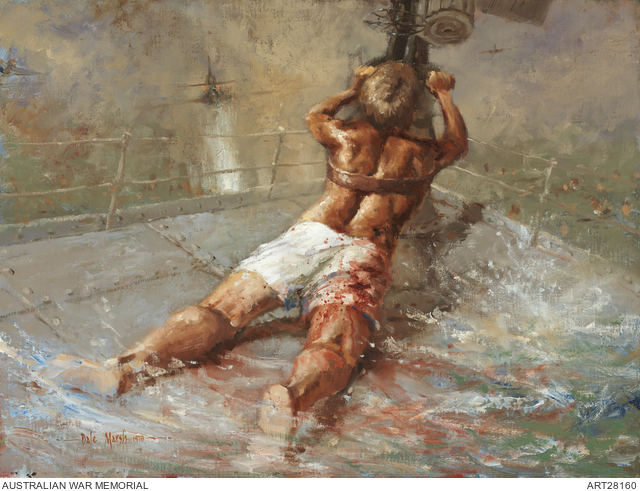
Ordinary Seaman Teddy Sheean, VC RAN. He served on the corvette HMAS Armidale, carrying out escort duties off the Australian and PNG coasts. On 1 December 1942 in waters off Timor the Armidale came under severe attack from Japanese aircraft with torpedoes hitting its port side and engineering spaces. After a bomb hit aft, the order was given to abandon ship. Survivors leapt into the sea and were machine gunned by Japanese aircraft. 18 year old Teddy helped to free a life raft then scrambled back to his Oerlikon anti-aircraft gun on the sinking ship. Although wounded in the chest and back he strapped himself to his gun and shot down one bomber and kept others away from his comrades, still firing as the Armidale sank. Only 49 of 149in the ship’s crew survived the sinking. He was awarded only a MID and had a Collins Class sub named for him in 1999, but in 2020 after a sustained campaign to have his bravery and sacrifice recognised, an expert panel recommended he be considered for a VC, which was posthumously awarded in December. This was a first for the RAN.

Capt Reg Saunders, MBE 3RAR. Reg was the first Aboriginal Australian to be made a commissioned officer in the Army. He enlisted in 1940 and served in North Africa and then the ill-fated Greek and Crete campaigns, eventually evading capture on Crete for 11 months. He was evacuated to Australia in 1942 and re-joined his battalion, fighting in the 6th Division in New Guinea as a Sergeant until recommended for officer training in mid-1944. He served in NG as a platoon commander in the Aitape-Weiwak campaign. He left the Army in October 1945, but when the Korean War started he returned to the Army serving initially as a Lt with 3RAR and later as a Captain Company Commander in the ferocious Kapyong battle (in which 3 RAR was awarded a US Presidential Citation). Reg was recommended for a decoration but turned it down. He was a much-respected soldier and leader and awarded the MBE for his community work in 1971.

Cpl Cameron Baird, VC MG 2 CDO. Originally from Tasmania, Cameron joined the Army in January 2000, serving with 4 Battalion (Commando), later 2 CDO Regt in Timor-Leste and Iraq (twice) until 2004. He re-enlisted in 2006, also with 4 Bn (Cdo). From 2007 he had four deployments to Afghanistan until 2013. He was awarded the Medal of Gallantry (MG) for a search and clearance operation on a Taliban stronghold under heavy fire and with close quarter fighting in 2007 as a LCPL. He was KIA in operations in 2013 and awarded a VC in 2014 for his bravery and self-sacrifice. After a helicopter insertion, Cameron Baird led the silencing of a number of enemy positions under heavy fire. He then assisted another team whose commander had been seriously wounded. With selfless disregard for his own safety, he drew fire from an enemy machine-gun position and his team regained the initiative. Inside the enemy compound he charged their positions three times, drawing fire away from his team, again under heavy fire. His third attempt cost him his life.
 FromMelbin