
Denver slideshow in Flickr
Denver Art Museum slideshow in Flickr
MCA Denver slideshow from Flickr
accessCeramics: digital image collection using Flickr
 Mark Dahl’s and Jeremy McWilliams‘ presentation on accessCeramics was probably the most inspirational session that I attended at Educause09. I am an unashamed fan of Flickr and its possibilities and Mark and Jeremy explained just how they used it to its full potential. Many of us should be following their brilliant example as it shows just how an institution can use a Web 2.0 service to facilitate a collaborative project. You can see all 53 slides for yourself in the presentation link above. These cover: the history of the project, how they did it, who was involved, cataloguing issues, enhancements, lessons learned, gains, costs and future plans. And they are now using Twitter (@accessCeramics) as their news feed: another great idea.
Having been involved in a more traditional (i.e. expensive, never ending, painful and frustratingly complex) DAM program in a large museum recently that used commercially sourced software, I found slide #48 particularly illuminating. Yes, they had hurdles too, but nowhere near the issues endemic in the traditional models.
Recently, we’ve started discussions about a community-based project to develop a special collection as part of the UTS Library. We will certainly be looking very closely at accessCeramics.
Disrespectful and Time-Wasting, or Engaged and Transformative? The Mile-High Twitter Debate
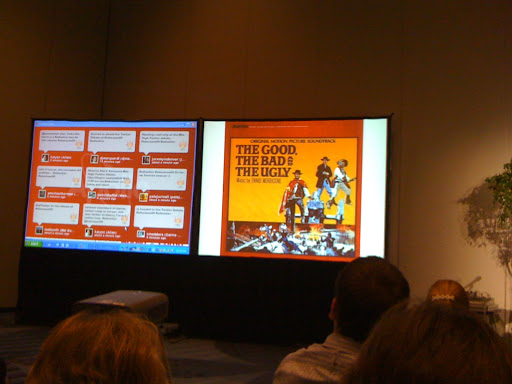
This post is “loosely based” (as they say in films) on a series of my tweets (@malbooth) from the Twitter Debate session at Educause09. I’ve cleaned up and explained a few tweets in the interests of your sanity.
(#edTwitter is the hash tag for the Twitter debate at #educause09)
- RT @jeremyindenver Standing room only at the Mile High Twitter debate (yes, the room was packed and people were standing up lining all walls)
- Mostly academic theatre so far.
- Noise, safety, security, content, distractions, spam, reality?
- Or passion, diversity, helpful, connections, real time?
- Check this video out — The Twitter Experiment – UT Dallas http://bit.ly/YlBZt
- CIOs as orange cones over potholes?
- A reference to Harvard now. The school that gave us those that gave us the GFC [sorry, that was unfair: I put it onto the jet lag]
- Is it about experimentation, innovation, making mistakes, exploring?
- “Messy creativity that leads to engagement” (I liked that)
- Do ground rules inhibit exploration & experimentation?
- Google on innovation. Comes when reflecting, not on schedule in a divisional structure. Self-organise in shared-value culture.
- Clay Shirky now: changing the world via social networks (from his recent talk at US State Dept)
- How to make best use of the media even though it means changing our ways (Shirky)
- Who cares what a CIO thinks about Twitter anyway?
- [I then noticed that:] #educause09 [was] now a trending topic – imagine what we could achieve if we really collaborated
- Twitter offers transparency, but [there are] some costs – uni reputation needs to be considered. Voices or consistency?
- Dialogue is important. can practices be integrated? Is it a distraction?
- Has tweeting become competitive in this debate? [This tweet attracted a response: “@kaiyen @malbooth no, unless you tweet faster than I do”]
- [I think it is] too early for best practice & benchmarking: read some blogs, but not [the] usual suspects: see practitioners
- Immersion is important! Follow @RWW, @mashable
- [The someone mentioned:] FRBR (groans) [actually I heard FRBR being a librarian, but maybe they said FERPA?]
- “Twitter is a basic information literacy skill” & [it is not] not in a walled garden
- “What better evidence of your engagement in learning than results when your name is Googled”: be a citizen of open web
- “Please don’t tell us what we can’t do: help us, guide us”
- Someone raised the importance of the back-channel as a toll for LISTENING!
- Back-channel can be transformative, scary, invaluable and great guidance
- Does or should twitter emulate real life communications? Trust users to do what is right with it as a tool
- Can lead to moments of authentic connection!
- We will all make mistakes and need to be tolerant of each other
- Many different ways to use it appropriately – make a judgment
- Important to be able to use all forms of media for communications!
- Thanks for this session – it made me think
This was a very lively, active and well-presented session. My thanks to the two presenters: W. Gardner Campbell, Director of the Academy of Teaching and Learning and an Associate Professor of Literature and Media from Baylor University (who played the radical academic) & Bruce Maas who played (and is) the CIO of the University of Wisconsin-Milwaukee (all universities should be so lucky).
Visit to Denver University
 Before Educause09 started a generous man called Joe Schuch (from Thorburn Associates Inc.) organised a campus tour of some new learning spaces for those of us who were interested at the University of Denver (DU). I took a lot of photos as the tour was really interesting and useful. Here are some quick observations that I noted on my iPhone. The images can all be found on this Flickr set. Educause09 is way too busy for me to clean this up any further (and my brain is still suffering from jet lag).
- Reconfigure of classrooms may be possible but it won’t happen without ease of use (wheels).
- Webcasting is possible in most classes at DU.
- Hubs can be found in most floors for data/power (see images of a variety of types).
- Wireless access is still problematic so they usually provide cable data too.
- The importance of mobile technology is growing as is BYO computing.
- “Idea paint” is used on some walls to allow writing space (see an image).
- It can be hard for buildings to keep up with technology, so they must be designed to be flexible and adaptable as needs change. It is critical to allow for flexible movable furniture and non-defined learning spaces. Non-traditional models of teaching are being facilitated at DU. They find that they still need to allow for some managed restoration of spaces unless you have mature, responsible students.
- Security devices are used on projectors to prevent theft.
- Technology (& software) that you don’t need to teach people about is their aim: the users can just figure it out.
- The space with high projectors is an experiment with a (previously) poorly used space that is mow well used, for many different purposes. DU staff said it was best if faculties can see and play with something first before deciding what they want!
- Ports are provided in floors that can be walked over & wheeled over (see image).
- DU Library is digitizing teaching materials for faculty but there are some rights issues.
- Permaculture gardens are being put in around the DU campus as it is a dry environment. This is a long term plan.
- They have a professor teaching students all over world on International Futures and have set up a special teaching space for him to hookup real time with students on campus and remotely (overseas) using a large-screen web cam system. His program needed a single port of access for all while waiting for a full web solution (see image).
- Construction projects are being used to leverage the steps of technological progress. Idea paint is used on some walls in big classroom (see the image with the cool desks).
- The Center for Teaching & Learning (CTL) program is in the university library. Julanna V. Gilbert is the Director of CTL and she accompanied us for our entire tour along with Jane Loefgren from the office of the University Architect. Julanna also gave us a presentation on their web-based tools that support learning at DU.
- CTL have their own developers for Cold Fusion and developed the DU Portfolio Community (before Facebook was developed). It supports many communities, but content is not exportable to other platforms or systems. It is now a huge system that has evolved over eight years. 400 communities are using it and some departments use it as internal space as it has configurable privacy settings. It is written in Java uses an Oracle database (with the DBAs coming from the central university technology support department). It is not a course management program. It offers academic program assessment (not course assessment) as well as the community side. It is capable of collecting all forms of media that can be uploaded. It seems to be more popular with faculty, staff and communities but some students use it too. They can take their portfolio with them after graduating by keeping the space and they can add to it. The system started before online spaces were developed. A lot of research communities use it. It is much easier to use than blackboard and there is no need to teach people how to use it. (Blackboard is used at DU for course support.)
- DU CTL also built DU CourseMedia – a media management system for multimedia including video, sound, images, etc. It was designed to be “no harder than buying a book at Amazon”. Anyone who wants to use these applications can use the system (but not the DU content). The DU Library helps with digitizing media, negotiating the ownership landmine and by adding (consistent, standard, necessary) metadata as “they know all that stuff”. The library thought that they should offer that service. They even hired an art historian at first when digitising images and then moved into film. The Library felt a need to provide content. (This is not part of the Colorado Digitisation Project.)
- Lecture capture at DU is done through client via laptops, mostly to Blackboard. I think their system can encode up to six simultaneous streams. It is mostly used by the Business faculty academics. They went for an economical solution.
I am really grateful for the time and generosity of the staff and students of the University of Denver for providing us with this tour of their learning spaces. My images and words probably do not do them the credit they deserve.
Visit to Thinkspace (Powerhouse Museum)
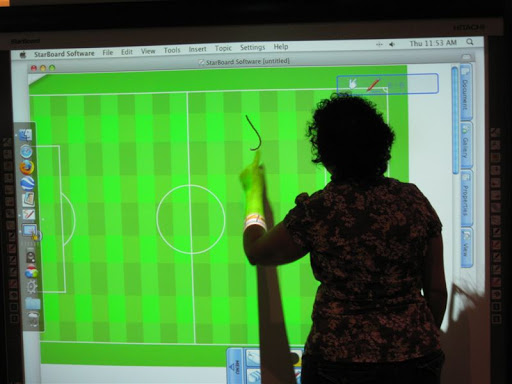 These are some images of a recent visit that I made with some colleagues from the UTS Library to the Powerhouse Museum’s Thinkspace. The super staff there, Joy Suliman and Peter Mahony, gave us a great workshop to introduce us to some of the possibilities for collaborative digital learning and creativity in such a space. We played around with Garage Band, Google Earth, Inspiration (a mind-mapping tool, see below) and some other programs.
 Peter and a blurry Joy answering some of our questions.
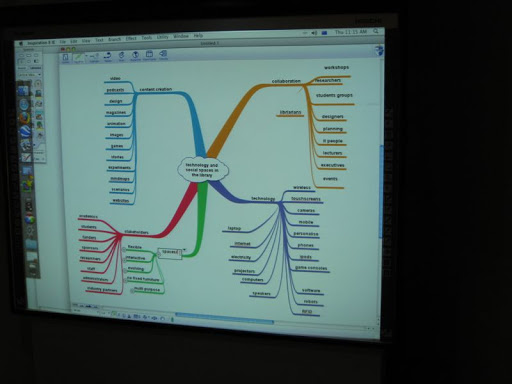
 The two shots above show the results of some quick mind-mapping about technology and social spaces in libraries.


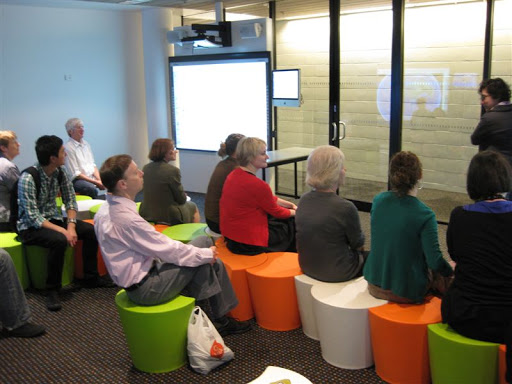 I’d been to this space for a quick tour once before but I wanted to go back and take our entire management team along with a few younger colleagues to help us out. We’re probably going to experiment with a similar space in our library very soon.
Peter and Joy said their space had three key features: it could be personalized (made relevant to me); it was connected (to the web and therefore elsewhere); and it could be situated (made even more relevant with maps, GPS, etc.). It also had durable and flexible furnishings as you can see above. Their room contained four workstations and it works well that way. I think at one stage Peter said something like collaboration in such a space is “augmented by technology that is configurable to different levels”. The whole environment seems very conducive to creativity.
For us I think it could assist in facilitating collaboration and even cross faculty interaction. The technology does has a shelf life, but as it is already in many NSW schools our future students will be expecting access to it when they get to university too.
Thanks again to Joy and Peter for a great workshop!
Watch this space . . .
FromMelbin Wordle

Image from http://www.wordle.net/
Peter Murray-Rust’s 12 point action plan for libraries
Peter Murray-Rust Keynote at ILI 2009 from Jaap van de Geer on Vimeo.
Peter is seeing no fire in our collective bellies and not enough passion coming from librarians about our own future. He puts forward an interesting action plan calling for librarians to be less passive and far more proactive on issues such as Copyright in academic publishing, open everything (publishing & data), community collaboration and action, and taking more steps to make the library a growing and addictive organism.
In this talk he delivers a pretty good 12 point action plan that most of us working in academic libraries should at least consider very seriously. The whole video is well worth watching, but I know most people won’t bother so here again is my summary of the key points along with a few of my own comments thrown in for good measure.
Before introducing his action plan he mentions a few other interesting ideas:
- He grounds his presentation by referring to Ranganathan’s Five Laws of Library Science, although he dislikes the term “user” preferring “reader”.
- Copyright as we know it must be destroyed for the sake of academic publishing and in order to facilitate the sharing of knowledge (as distinct from the business of making money from restricting the sharing of knowledge). He claims by example that Copyright is currently preventing the sharing of knowledge that could help to save the planet and that we as librarians should be agitating, displaying our “raw anger” and protesting for legislative change.
- He laments the situation in academic publishing where academics create works for free, but are expected to pay in order to see the work of their colleagues. It is a situation that must be changed.
The 12 Point Plan (in no particular order):
1. We should act as citizen librarians towards a common or shared goal. (See some examples below of communities collaborating towards shared goals.)
2. Post all academic output publicly: ignore Copyright. For this, we need to display our passion and one of probably has to volunteer to go to gaol. I like this one, but I can’t be the one going to gaol. Sorry. (Beth & Belinda: step forward please. Don’t worry, I’ll look after the shop.)
3. Text mine everything. Currently this isn’t allowed by the publishers who own nearly everything. It stops researchers trying to find stuff. As he says: “when violating a publisher’s terms of use, you are guilty until proven innocent”.
4. Put 2nd year students in charge of developing educational technology resources. They use it all the time and will know whether to go mobile or to use Xbox or Play Station. There is some truth in this.
5. Actively participate in obtaining science grants. Because scientists find it all too repetitious and cumbersome. They need our help.
6. Actively participate in the scientific publishing process. Again, they need our help. Maybe we can help them to publish their work more openly and also to facilitate better management of their IP.
7. Close the science library and move it all to the departments. He says this is a no-brainer. (We don’t have a science library at UTS.)
8. Handover all purchasing to national Rottweiler publishing officers. Apparently they deal with the publishers centrally in Brazil. We could not do it in Australia. Getting any form of agreement with so many egos and so much self-interest in the room would prove far too complicated. Besides, we have less important issues to worry about. It is actually something we should at least try to do, very seriously. It may well be one of the big issues on this list, along with taking action on Copyright and open access publishing where we really could have a very beneficial effect and demonstrate our worth.
9. Set up a new type of university press. The traditional presses have all been failures. We have been handed an opportunity with the Internet, but our presses have been less innovative than other publishers. I think we are taking steps in this direction now and UTSePress is a good example, publishing journals, books and conference proceedings online.
10. We should develop our own metrics system. Publishers manipulate the metrics system in order to get us to buy what they think we want.
11. We should publicly campaign for openness. He gave a few examples like the Open Knowledge Foundation and the Open Rights Group. We should be actively involved.
12. We should make the library an addictive “game”. He used the example of building “reputation points” through involvement and participation in something like stackoverflow.com After a while it becomes a bit addictive, like ebay.
We should be asking ourselves “what can we do to change the world and keep the library a growing organism”? His list seems like a decent start, even if it is a tad biased towards science.
He wound up his presentation with a few examples of the contributions made by online communities, including: Galaxy Zoo where 150,000 members world-wide have assisted professional astronomers to classify over one million galaxies; and OpenStreetMap, a free editable map of the world that is up-to-date within minutes thanks to the contributions made by over 250,000 members.
One of the most important pleas he makes is for the democratisation of knowledge. This should be possible on the web. For it to happen, democratisation must win over commoditisation for commercial purposes (i.e. the protection of business empires).
I am surprised that there has not been more debate about his address.
 FromMelbin