
Category: Uncategorized
Discussions and exhibition viewing
I missed a couple of presentations and talked at length to W.F. Pascoes re digitisation – recent trends in equipment and new software and correction techniques for OCR work (done in India!).
Caught up with Shirley Foster from Altarama. They are very grateful for all the promotional support the AWM has given them and the company is now going strongly, especially in the ACT. There was keen interest in RefTracker at the conference, including the NLA.
Discussed RFID with two providers, including 3M. They’ll ask me to go and see them for a demo in Sydney in April around the time I am giving a digitisation master-class.
Over lunch I caught up with Paulie and Carmel from NLA and they agreed that Andy Powell’s plenary address was the most stimulating thing from the morning session. The rest of the Library 2.0 stuff that I missed was useless, at least for us.
Library 2.0
Lynette Lewis from Yarra Plenty Regional Library –
Library 2.0
(a written paper was provided on CD – let me know if you want the pdf file)
She related 2.0 developments and initiatives to other physical improvements such as wifi and RFID – aiming at 100% self-serve.
Referred to Helene Blowers’ Learning 2.0 program. Self-paced and online to encourage play and exploration. 12 week program – 23 things. Exercises set out on blogs. A good model for us and ECM learning exercises.
YPRL are also using a wiki internally as a training resource for staff.
LibraryThing for Libraries is also used through their catalogue – tagging.
It was worth the trip just to hear this bloke
Repositories Through the Looking Glass
(Keynote)
Andy Powell, from Eduserv Foundation (an educational charity based in Bath)
This presentation had a lot of useful views for us as we approach the new philosophy of our whole ECM environment.
So far (and at this conference) digital repositories seem mostly on the academic agenda in university libraries. Not much seems to be recognised regarding the challenges facing cultural institutions, so maybe we can learn something from the academic experience?
Powell has some cynical views re repositories.
He started by giving us his background with Dublin Core – he has been involved from early days, esp re web based metadata generation tool development. (The Abstract Model was discussed zzzzzzzzz.)
Then he moved on to JISC Info Environment – again aimed largely at the tertiary and further education environment. Most UK digital repositories are based in this environment. They use all the expected standards, but the environment has missed or ignored the Web and this is missing from most digital library spaces, particularly web architecture.
Eduserve has worked with the UK Science Museum and they started by modeling the infrastructure behind the repository (similar to what we have done with ECM). They have built (i.e. developed) a repository for them that they called a Web Content Management (WCM) system.
Serving stuff on the web still missing from JISC Road Maps. He was very positive about open access and what it will do to scholarly publishing – it isn’t an “if”, but a “when” – it will happen!
Repositories (to date) are mostly focussed on deposit, not servicing the web. WCMs are essential if they are to be used. Concepts such as search engine optimization are essential (not just having federated search within the environment).
He briefly touched on the “REST” architectural style – it focusses on resources and global identifiers.
Is the focus just to be on the institutional repositories or a global environment?
Web 2.0 means: the new “prosumer”, remote applications, social-ness & exposed APIs; plus diffusion (eg. blogs, etc.) and “concentration” (via Lorcan Demsey’s recent writings at OCLC) – hosting services that are global in scale, eg. Flickr, Technorati and maybe del.icio.us? He mentioned those using Amazon S3 hosting. Social networks are critical, particularly for research purposes and this needs global services.
Future – what would a web 2.0 repository look like? He said it would look like Slideshare Not many in the audience seemed to be using it. You can share, embed, tag, favourite, etc. Other attributes he suggested: a high quality web based document viewer; tagging; visible to Google; RSS; Amazon S3 (infra-structural services); social groups ability; global in scale. BUT – it doesn’t support preservation, complex workflows and doesn’t expose rich metadata – so what? Are they really needed (in this system)? How can these needs be met without destroying everything? I think that is the problem we have made for ourselves with some of our CMS – wanting them to be all things to all users and forgetting their most critical tasks.
One way forward may well be using SWAP – scholarly works application profile. Used to described eprints – scholarly works/publications held in repositories. They used FRBR – functional requirements for bibliographic records. (See also this Demsey blog post.)Simple Dublin Core (the metadata standard/protocol) doesn’t do this – it is all about relationships, not just a flat structure description. But it may all be too complex in the end. Can we just encourage users to tag, vice deep formal cataloguing that nobody ever sees and few outside the institution ever use? This has effectively distorted much of our work (in the AWM) that seems lost to any users, even on our own site. Rich cataloguing records are locked away inside some of our CMS and NEVER exposed on the web. THIS IS FUNDAMENTALLY WRONG!
We need to learn more from Web 2.0 about what works on the web as most repositories are not working (particularly re sharing on the web). They are not marrying up with the social networks that researchers actually use. Slideshare gets by with almost no formal metadata, just by using tags and links between resources.
Open access is important – making content available on the web. Policy needs to reflect this. We still focus on deposit, not putting resources on the web.
Andy’s clossing message was for us to think about resource orientation, not services – digital libraries ignore this at their peril.
Questions & further discussions:
Warwick Cathro (NLA) suggested that institutional repositories can account for needs such as preservation and richer identification (which is what we are aiming at to some extent), but Powell said that that world has not yet been built, at least not in the UK. Building the social layer is beyond that model.
Physicists seem to be sharing their knowledge and research in arXiv.org and they maintain their affiliations.
Why do we still publish as PDF – it is like still working on paper, why not XHTML – embedded links and micro-formats. It runs counter to the mainstream web. Citation is another huge area and is still at odds with how it works on the web yet even WordPress allows for this with an app.
Stuart Weibel from OCLC suggested that researchers are too lazy and won’t do what is needed re deposit and identification of resources. But Powell remains optimistic that the low cost of sharing a presentation on slideshare brings massive benefits in terms of knowledge sharing. It is intuitive and obvious and can work with little encouragement. It is a second best to say “you must do this”. Systems must be more intuitive than that! (I think this is a key message for us and the new practices and protocols we will be setting up and using within our ECM.)
Re future of scholarly publishing, Powell said that Open Access is just an inevitable change. We see it in the music industry already. Researchers can make their stuff free on the web. Yes, people will still want to buy and want to publish in journals. Maybe they’ll be different, but something will change. National funding bodies seem unable to fund global networks for researchers, so publishers are starting to step into that space, building “Facebooks” for researchers. What impact will blogging have on this – probably an increasing one.
[My apologies for this long post, but this is the one paper not yet provided to us online or via the CD we received at Rego. I had to take these rough notes during his presentation. I thought it was pretty relevant to us as we approach ECM implementation.]
SLV – podcasts
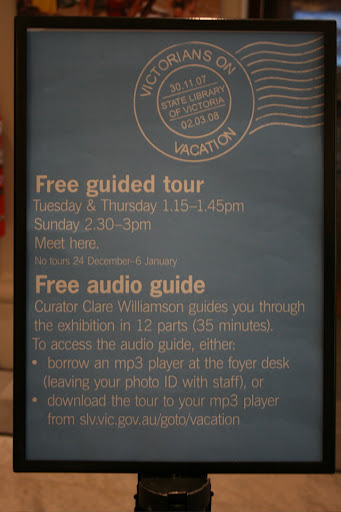
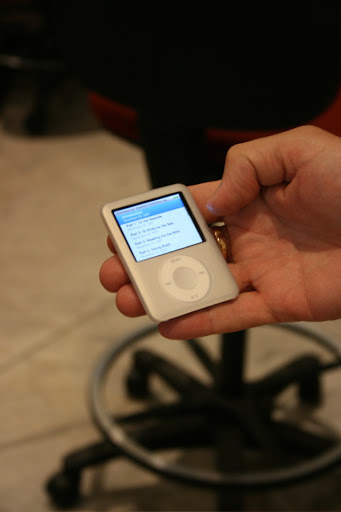
After looking over their digitisation facilities, I had a look at the Victorians on Vacation temporary exhibition. It is an interesting exhibition with some very evocative images, but I found their online audio guide to be a good model for us. There is clear signage about it as you enter the exhibition and I asked the staff about their free to hire MP3 players. They are iPod Nanos (about $199 each I think) and visitors can borrow them for a photo ID. They’ve had only one stolen and for that one no photo ID was left – just stolen credit cards. They’re pretty well used, especially on the weekends, but they only had a few to lend out. They say the use of the guides varies depending on the exhibition content, but they are expecting them to be popular for their next exhibition, The Medieval Imagination, opening in late March.
State Library of Victoria
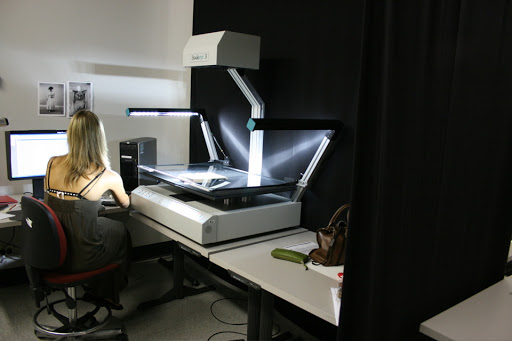
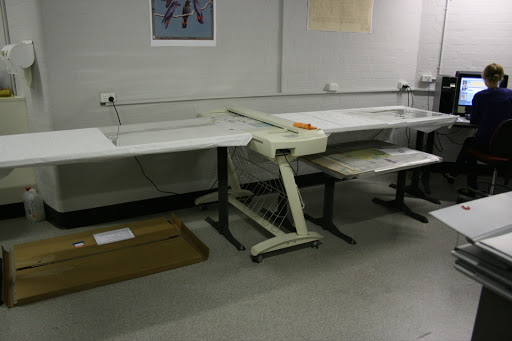
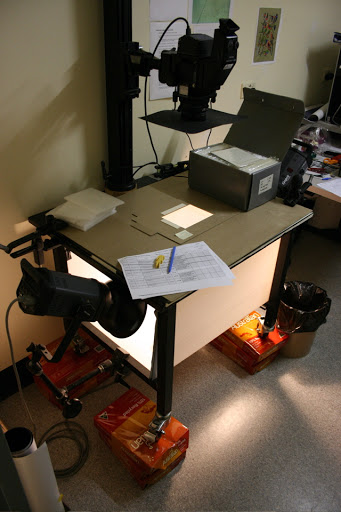
The people who visited us to look at our digitisation facilities last week returned the favour and showed me theirs this week. They have three (yes 3!) Bookeye scanners. They are not perfect for everything, but I think they are needed for many bound formats. The SLV are just scanning in grey scale for access at this stage and have not bothered with OCR for printed text.
Above you can also see an image of their map scanner with decent layout tables each side of it.
The last image is a light box that they fashioned themselves for their own glass plate negative program.
NGV

I went to the NGV, but didn’t have the time to see everything, so just looked in a couple of exhibitions and galleries. I like the way they clearly notify visitors of all talks being done during the life of an exhibition (including who is giving them), on the walls as you enter. I think we should do this with all of our special exhibitions.
Role Play was small enough to view with limited time and there were a couple of great photos that interested me.
All of Us
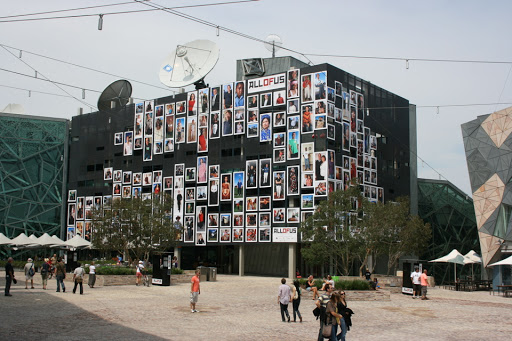
I liked this. It is installed in Federation Square on the external walls of the Crossbar building. You can read more about it on the All of Us website.
The long drive down
WARNING: This is not work-related, but I drove down on Sunday and there was not much of anything that was relevant to work.
It was pretty uneventful, even a bit dull, but less dull in NSW where they were doing roadworks every 10 km. And for those who haven’t done this trip in a while, the new Albury bypass is now open, so you just breeze through the border towns at 110 km/h. This was later to cause the only interesting part of the second half because I missed the usual Caltex petrol station in Albury and there are no big service centres yet on the bypass.
So, I charged on to Melbourne confident that the range remaining indicator which said over 340 km to go in Albury would get me to the outskirts of Melbourne where I knew there was another Caltex. Of course I could have just bought some petrol at another station (but who wants to use money when they have a Caltex card?) and I could also have turned off and gone to a side town or even turned around and crossed the highway for a Caltex on the other side, but really?
Even though the Victorian Police can pick you up for thinking about going over the speed limit (whilst you can gun down a few former friends in Carlton and freely get away with it), backing off the throttle and using the cruise control religiously didn’t seem to extend my range to the point at which I could relax. In fact, as I got closer to Melbourne I found myself doing things like reducing my cruise speed even more (which enabled old Kelvinators with wheels to overtake) and shouting out “Its touch and go! Touch and go!” (because I found that scene in the recent movie Death at a Funeral particularly amusing. I began to regret some minor throttle adjustments I that had made between the endless NSW roadworks to keep up my average speed.
Soon the range indicator just told me that the range was limited and then the patrol gauge started to flash regular warnings about the same matter, as if I’d been ignoring it!
The needle barely registered any life at all and I decided to pull into any establishment selling petrol as soon as I saw one, but as I cruised down the hill into somewhere near Wallan, less than 40 km from Melbourne city, a huge Caltex station magically appeared and I was able to drive all the way to the pump without phoning either the RACV or Alfa Road Assist. The 60 litre tank took just on 58 litres, so obviously I’d been panicking for nothing and needn’t have worried.
I filled up, consulted the Melways and charged onwards towards the maze of tollways, freeways and bridges that surround the city. I skillfully managed to take the correct turn off from the Westgate Freeway after the Bolte bridge, but then paid the ultimate price for making one unplanned turn in Southbank (within a block of my accommodation) and immediately found myself heading north east, out of the city, on something called the Monash Freeway. The first exit was somewhere near Burnley and then I had to circumnavigate Richmond and South Yarra to get back to Southbank.
It didn’t matter, I was now in Melbourne: the most civilised city in Oz.
 FromMelbin