
Category: Uncategorized
Vote now for ArtShare at mw2008 People’s Choice Awards!
PLEASE!!!! Go now to http://conference.archimuse.com/best_web/innovative and vote for ArtShare (Brooklyn Museum) – because they developed an application that all museums can use to share their images on Facebook. You need to register to vote – hurry, as there isn’t much time left! They deserve to win.
New rules for media or online museum communications?
I read these new rules for media first on Tony Walker’s fantastic blog ABC Digital Futures and then went straight to the original source – Mark Glaser at Mediashift.
Mark’s rules might at first seem only relevant to journalists and such, but the mere fact that museums are now engaged in online communications using their websites means that the rules also apply to us in a general sense. So, what I’ll do is take Mark’s rules and offer a museum perspective on what they mean for us more specifically. (Apologies to both original sources for a tad of borrowing.)
1. The Audience Knows More Than the Journalist: Rather than being a one-to-many broadcast, museums now must understand that they are just part of a much larger conversation that is networked and constantly evolving. So, replace “Journalist” with “Curator” (or historian, etc.) and you get the message. Our audience probably also has something valuable to contribute. A great topical example is the post we put up regarding HMAS Sydney’s recent discovery and the community’s contribution to that story. It has proved very popular and offered a perspective that we simply could not provide alone.
2. People Are in Control of Their Media Experience: The people are taking control and watching, and listening to what they want when they want. Making sure that we, in museums, provide content that is suitable for multiple platforms and entry points is critical. Increasingly, we will need to provide an option for content suitable for consumption on mobile devices.
3. Anyone Can Be a Media Creator or Remixer: But it still takes skills to use those tools and stand out from the millions of others who are doing the same thing. In a way, museums already do stand out as trusted sources of high quality content, but we need to balance what we do with regard to Rule #1 to ensure our position is not compromised here. As I’ve said here before, the big advantage we have is the content we can generate and provide online, particularly through our digitisation programs. Just facilitating conversations using fancy new technologies probably isn’t going to be enough for us to sustain an audience.
4. Traditional Media Must Evolve or Die: The evolution that traditional museums must make online is not just in adding new features; we must change our mindset, ideas and methods to new ways. Many of our old processes are now completely irrelevant or redundant in this environment and hanging onto them has seen others bypassing us and finding new ways to search our content and collections, describe it, promote it, provide access to it, etc. Many traditional research journals are now either dead or dying and in Australian we’ve seen the death of the formerly popular Bulletin magazine. Maybe we need to look at some of our more traditional publications and move them online too. We also need to think up and use different methods for commerce in the online environment if we need to charge for services provided.
5. Despite Censorship, The Story Will Get Out: This isn’t just about censoring news stories; it also applies to new technologies like peer-to-peer file-sharing. Maybe we need to see these new technologies more as potential friends, than enemies. A good example is LOCKSS which uses peer-to-peer technology (as I understand) to safely share and store digital assets.
6. Amateur and Professional Journalists Should Work Together: The reality now is that professional curators/historians and amateur collectors, enthusiasts and historians can learn from each other and the new social media platforms not only allow this to happen, they facilitate the conversations much more readily.
7. Journalists Need to Be Multi-Platform: Museum professionals need to learn how to make best use of a host of skills to reach different audiences. I think most of us need to be familiar with digital cameras, scanners, digital recording equipment, and online technologies such as wikis, blogs, social bookmarks, RSS, tagging, mashups, social networks & collaborative technologies. We can’t just expect to engage with physical visitors nor those who come directly to our web front page.
I reserve the right to add more examples and thoughts to this post as they arise.
Digitisation masterclass slides now online
 I’ve now uploaded the slides for the recent masterclass that I gave to Slideshare. It took several uploads because in order to re-present these slides on their site Slideshare does a bit of manipulating that changes some of the features I had used in PowerPoint. So, I needed to take two presentations down, rework them and upload them again.
Keep in mind that there are 38 slides, but they were used over an entire day, so there is a lot of discussion you are missing. The slides are best read in concert with the Slideshow Transcript that appears at the bottom of the Slideshare screen – a feature often missed by new users. Also, Slideshare appears not to have been able to pick up all of the embedded hyperlinks used in some slides. Again, they are included in the Slideshow Transcript at the bottom of the screen.
Happy viewing!
No post = no audience; no content = shallow conversation?
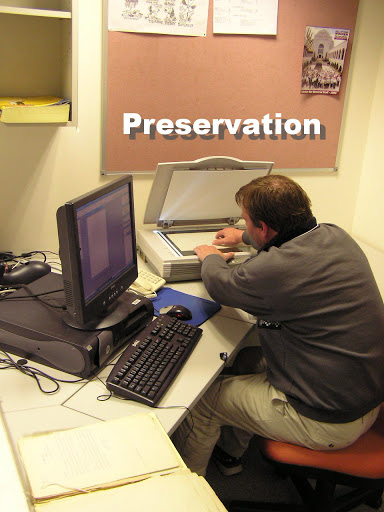 Hmmm, no posts here recently, but it is because I’ve been pretty busy preparing a “masterclass” on digitisation for the ARK Group as half of a two day workshop earlier this week called “Revolutionising Library Management”. My half was all about digitisation from a library manager’s perspective – not so much the technical side and stuff like colour management, the explanation of vector images and the mechanics of various metadata schemas.
- DYNAMISM: digitisation is a dynamic field and there are no set or concrete answers. While I was researching new research papers emerged on the use of JPEG 2000 and the digital curation cycle and I had to touch on both of those.
- PRESERVATION: There are some who don’t believe or understand the essential link between any digitisation program and preservation. But it is there and it is there in two forms. Firstly because we do digitise as a preservation strategy. In our institution we have preserved documents and images that could only have been saved using digital techniques. Thermal papers meant historic documents were disappearing before our eyes and acetate syndrome was destroying rare photos. There is also an often disregarded preservation benefit in giving access to digital surrogates which prevents or minimises the risk involved in allowing physical access to rare, fragile or unique collection items. Secondly, whatever you create through digitisation programs or projects needs to be preserved: through a curatorial life cycle, just like other collections do, but with different requirements as applicable to digital objects and collections.
- Learning by PLAYING: Adults learn best by doing (at least in my experience) – sorry, but I think it is true and this is my blog. I’ve also been involved in digitising archival and museum materials for a long time now and I reckon we’ve learned more through our projects than any courses any of us have ever undertaken. So my motto would be “start now and learn by doing”. The chances are the authorities will probably go for hardened criminals like mass murderers before they come after you, so you’ve got a bit of time up your sleeve.
- MANAGEMENT & PLANNING: A lot of useful material of late about digitisation has been indicating the importance of abiding by sound project management principles and using appropriate planning methodologies in your initiatives. This greatly assists us when the authorities (decision makers and purse holders) come after us or don’t understand what it is we are doing and why we are doing it.
- COMPROMISE: This comes up continually in our projects and you won’t see it in any of the theories emanating from academia and various standards organisations. The fact is that hardly anyone I know in this field meets all the criteria and principles that are mapped out for them or even mapped out by them. All the practitioners have made compromises somewhere, whether it be in metadata, file formats, digital preservation, QA, storage, evaluation, reports or many other critical elements of digitisation.
That’s all for now, but you can check out my del.icio.us bookmarks (see the tags on the right of this post) for some new an other really useful sites on the same subject.
Digitisation, Web 2.0 and chamber orchestras
I subscribe to the concert series the Australian Chamber Orchestra (ACO) gives in Canberra (& many other cities) each year. I have done so for many years and each year one or two concerts inspire the most amazing creative thoughts in my tiny brain while I am sitting listening and watching them perform. Some of the concepts and design features that I used in our current Lawrence of Arabia & the Light Horse exhibition came to me at their concerts.
Last Friday I saw and heard “Sublime“, a concert that featured music that was written very recently and that which was written as much as 500 years ago. Some of the vocal pieces by Holst, Nick Drake, Sting, Radiohead and Britten were performed and interpreted anew by Katie Noonan. Unlike the online review, I don’t think the combination of music was at all awkward, but that is another issue.
So how is all this relevant? Well, currently a lot of IT-based and web-based museum staff are talking about Web 2.0 and museums. Some curators are also talking about it, but mostly the debate is led by the more geekish and web-aware people who are not that attached to or involved in more traditional museum or gallery practices, like curating exhibitions or developing collections. Perhaps I’m generalising unfairly, but in my experience, that is mostly the case. With regard to the digitisation of museum or library or archival collections, those endeavours are also being led by either technologists or imaging experts or others from conservation or preservation backgrounds. Again, the interpretation of such efforts seems removed from the more traditional curatorial processes. So that is where the musical performance comes in. Sorry for the long and uncertain root to this point.
What dawned on me is that for those of us in museums who are responsible (like I am) for large digitisation programs, just scanning the material and then shovelling huge amounts of it up on the web one way or another is a bit like writing music and leaving it somewhere without performing it. Last Friday, the ACO brought a lot of music to life giving it fantastic new interpretations, like that of Leonard Cohen’s Hallelujah which Katie sang beautifully and completely unlike other recent interpretations by K.D. Lang or Jeff Buckley. So, what I think this means for us is that all of our efforts on the web re “Web 2.0” and digitisation need to be accompanied by some appropriate curatorial interpretation. It may not need to be that extensive as that certainly wouldn’t be possible with mass programs, but we can’t simply rely on links to hard-to-find catalogue entries, exposure Google search or public tagging.
As I said above, I have an exhibition running here at our museum for a few more months and we know that visitors don’t read much of the carefully written wall text (or storyline) and object or image captions. They will, however, happily come along and listen to me drone on and on about both Lawrence and the Light Horse, perhaps in much the same way that I go along to live music performances in preference to or perhaps in advance of buying a CD or downloading some music from iTunes. (I’m sure some of my “performances” are better than others.)
Museum curators need to be out there interpreting our online content by playing “our own instruments”. And that interpretation needs to be delivered in many different ways. Online means such as blogs, You Tube videos, podcasts or downloadable audio guides are just a few examples. Maybe there are more parallels between our institutions and orchestras and it might be instructive for some senior curators, for instance, to look at the role of orchestra principals and leaders?
More to follow as I think this through completely, but to me the way museums use Web 2.0, social networking applications and services and the provision of online access digitised collections goes well beyond the intersection of web strategy, IT strategy, marketing and a social media strategy. That only tells a very shallow layer of the story or the game, there is more to it than that: the museum or institution itself and its collection.
(A recent relevant newspaper article from the NYT touches on some of the points above. You can read it here.)
Wikipedia and "produsers"

A while back at work I suggested we look at moving our entire Encyclopedia to Wikipedia.org. My position has not changed. I still think we should do just that.
Putting the content up on Wikipedia.org gives it MUCH wider exposure than our website ever can and it therefore has the potential to bring new users to our website that may not even know we exist (via links in to our own web content). With a wikipedia.org user account, we can maintain an appropriate amount of control over the content (more than we have at present over wikipedia content that started as ours, already put up there by others).
Another point is that putting it up on Wikipedia allows us to engage the assistance of various volunteers who’d like to help us, but don’t live locally. I’ve been approached by a few keen volunteers who don’t live locally only recently and I think they’d do a good job for us in both maintaining content and generating new content (which we could edit when needed).
It isn’t urgent, but I think we could make some progress on at least a trial.
Adam our web developer has suggested a few things that we need to do before we start using wikipedia.org:
- learn the wiki markup (common sense guide here; markup guide here)
- understand the wikipedia templates (style guide here)
- understand the community structures and the relevant wiki-projects (general wikipedia projects, military history projects, etc)
- individual staff create user profiles and identify themselves as AWM professionals (some may eventually become coordinators)
- participate in the community, firstly by proposing to the community what AWM intends, and participate in existing relevant discussion within the projects
- THEN start importing articles from our Encyclopedia
Some colleagues here said they liked the idea of hosting our own wiki like The (UK) National Archives Your Archives wiki, but they are also supportive of moving our encyclopedia to Wikipedia. One person has started working through existing entries and tidying them up to make sure links are up to date and the sources and references are included for the entries. The motivation to do was that Wikipedians can challenge and/or remove unsourced material.
In a lot of cases we don’t currently list the sources for entries so we are going back to the background material we have for the entry and if that doesn’t exist we may recreate the research. This has made the process slower than we had expected.
As we look further into this and begin to examine some of the issues of “ownership”, reliability and “endorsed” wikipedia entries, a read of a very recent post about such matters via the ABC Digital Futures blog would seem advisable. At first glance one might think that this is a bit of a long bow to draw, because it is focused on the digital future of the national broadcaster and it discusses a model of participation regarding travel advisory websites, but when you think about it, many of the principles apply in a much broader sense and to us us as we look at moving our encyclopedia to a more open and participatory environment.
The whole Lonely Planet model is very similar to our situation. Indeed, our existing top-down model of the publication (in various forms) of Australian military history guides, magazines and books could well be undermined in much the same way as the environment in our own small world shifts from military history for the people to one of military history by the people.
The author/presenter is Alex Bruns and you can read his full text online here.
- In recognising that everybody has a valuable contribution to make, and as he encourages us not to be afraid of it, Alex says there are four preconditions that are needed:
the replacement of a hierarchy with a more open participatory structure; - recognising the power of the COMMUNITY to distinguish between constructive and destructive contributions;
- allowing for random (granular, simple) acts of participation (like ratings); and
- the development of shared rather than owned content that is able to be re-used, re-mixed or mashed up.
So, throughout his article he uses the term “produser” to describe the participants in such a community. It is all about true collaboration, engagement, and the shared development of content.
Finally, he suggests these four principles for anyone seeking to successful and sustainable participatory environments (mind the big words):
- Open Participation, Communal Evaluation – inclusive, not exclusive
- Fluid Heterarchy, Ad Hoc Meritocracy – from a hierarchy to leadership based on accumulated merit that is recognised by the whole community
- Unfinished Artefacts, Continuing Process – evolutionary development of articles; nothing is ever truly “finished”
- Common Property, Individual Rewards – tangible outcomes for individual contributors.
The reasons we need to get involved in the broader wikipedia community are basically two: firstly it is inevitable that it will grow as a community and if we are to have any influence at all we need to be involved; and secondly, we do not have the resources to be involved in two communities by managing one on our own site as well. Wikipedia is the pick (at least in my mind) because it has much more potential reach and exposure than we ever will. I think it is overly pessimistic to look at the worst possible case scenario (of extensive and malicious damage to entries) in this instance. Moving our encyclopedia to wikipedia should not be looked at as a surrender.
Recently in D-Lib there was a good example of an institution (University of Washington Libraries) using wikipedia to promote digital collections by using deep links back into their site. See Using Wikipedia to Extend Digital Collections.
Not all new ideas are good ideas . . .
And IMHO, this initiative from ICOM is a truly awful idea. Here is an excerpt from an email that I saw this morning. It starts like this:
ICOM cordially invites all members of the global museum community to participate in IMD on 18 May 2008 with activities in their museums based on our theme “Museums as agents of social change and development”.
Sounds good so far. IMD is International Museum Day. They invite us all to participate in both the real and virtual worlds with activities consistent with their theme. And here is where they lose the plot completely:
The highlight of the suggested online activities on http://icom.museum is hosted by The Tech Museum of Innovation on 18 May in the replica of its Silicon Valley museum of technology on SECOND LIFE, the virtual 3-D platform created by Linden Lab. From real-world museums, museum professionals and the public will be able to communicate with colleagues, artists and “residents” in the virtual world. They will therefore be able to participate in the collective development of exhibits in The Tech in SECOND LIFE.
I am not at all sorry to say that this is simply one of the worst ideas I’ve heard of recently.
What will people pay for online?
As a former economist, I have long been interested in the new economic or commercial models that are emerging on the web. Many of us will be familiar with Chris Anderson’s “Long Tail” description of the niche marketing of online stores like Amazon. Well, here is another theory. It comes from another respected web pioneer: Kevin Kelly (who helped launch Wired Magazine and is still a board member of the Long Now Foundation).
Kelly has recently written up a post called Better Than Free and in it he offers us “eight generatives” that people will still be willing to pay for in the new web environment (”a copy machine”) where so many copies of everything are now available somewhere for free (eg. peer-to-peer networks, not that I’d have any idea what they are for!).
What he says is that even when some product or service is available for free, we are probably still willing to pay for it elsewhere when it is surrounded by or within an environment characterised by these qualities (which can’t be copied, cloned, faked, replicated, counterfeited, or reproduced). Here is a quick and dirty summary of Kelly’s article with my comments about how each one might apply in the museum world, in italics:
- Immediacy – Eventually you will be able to find a free version of just about everything somewhere, but it could take sometime. People still pay a premium for special air delivery import magazines, so in much the same way we value getting a copy immediately delivered to our inbox as soon as it is released, requested or created. Digital downloads by subscription where applicable and possible.
- Personalization — Generic versions may well be free, but getting something bespoke will always be something that some people want. Offering products like hand-crafted digital prints, very high resolution objects, or rare special copies/facsimile editions may be well received.
- Interpretation — “As the old joke goes: software, free. The manual, $10,000. But it’s no joke.” I’m not sure how this applies to us because for many museums, particularly in Australia, although we have bucket loads of interpretation, the general expectation is that we provide it, as well as most quick reference services, for free online. Perhaps we need to look at paid subscriptions for well-written online publications?
- Authenticity — “You’ll pay for authenticity.” Again, we can offer very authentic material and already have this advantage. More, better branding?
- Accessibility – “Ownership often sucks. You have to keep your things tidy, up-to-date, and in the case of digital material, backed up. Many people, me included, will be happy to have others tend our “possessions” by subscribing to them.” I’m still not so sure about this generative: in some ways, we can get web services like del.icio.us and Google Reader to do such things for us, like looking after our bookmarks/favourites and blogs (respectively) for free. It also doesn’t seem to be named that well.
- Embodiment — “At its core the digital copy is without a body. . . . The music is free; the bodily performance expensive.” For museums I think this is about what else we can offer in terms of paid programs or experiences. Generally, major museums and galleries in Oz, charge only for special/imported exhibitions or “blockbusters” (except us). Perhaps it means selling or charging curatorial talks on the talks circuit. I do a few of those in relation to our Lawrence exhibition and a few other things, and so far they are all free!
- Patronage — Audiences probably want or at least don’t mind paying creators. “But they will only pay if it is very easy to do, a reasonable amount, and they feel certain the money will directly benefit the creators.” This applies universally for creators, including us, but we probably need to pay more attention to making payment easier and reasonable.
- Findability — “No matter what its price, a work has no value unless it is seen; unfound masterpieces are worthless.” I like this one a lot and it is probably one of the most relevant to our cultural world where such a large percentage of our collections is not on permanent display. It should not be too hard to highlight, find and get our products and services – not too many gates or complicated registration.
Some of these eight qualities apply to us more than others and a few could be better described or have a different descriptor applied to them (like accessibility?). To the list I’d probably add trust and, like one of his comments says, usability. Most cultural institutions are trusted and we can take advantage of that, but usability isn’t really a major focus – think of most of our unfriendly catalogues and systems.
OK, so I might occasionally use a peer-to-peer network for some music and films that are either impossible hard to get or far too expensive in Oz, but I also download a lot of material for a fee from iTunes and I’d agree that the reasons I do this are pretty well mapped out above. If we are to come up with a decent model to make money or even recover costs for certain products and services on our museum websites, we need to very carefully look at this article.
Shift happens: how the network effect, two-sided markets, and the wisdom of crowds are impacting libraries and scholarly communication
 Bruce Heterick, JSTOR, New York, USA
Abstract: This session will discuss the changing nature of library services and scholarly research in the networked world. Our affiliated group of not-for-profit digital initiatives – JSTOR, ARTstor, Portico, and Aluka – has a unique perspective on this shifting environment. There is ongoing discussion about the evolving Web (or Web 2.0): the migration of the Internet from a platform to a service; the network effect that encourages (and values) contributions and collaborations; and a shift in software and services to a participatory model. This evolution is changing libraries, publishing, and scholarship. In particular, it is fundamentally changing the paradigm of scholarly communication, and this presentation will examine this change.
I thought this was yet another good paper from the final day. Bruce knew his stuff and was an engaging and stimulating speaker. Fabulously, you can download the slides he used from this link: http://www.jstor.org/about/forum/ShiftHappens.pdf (1.1. Mb pdf file)
Bruce opened up by quoting Neil Postman “Technology doesn’t add or subtract something. It changes everything.” It does, however have a short half life. He then argued that Apples introduction of the iPod (bringing us portable media) in 2001 was as important an advance as Tim Berners-Lee’s World Wide Web in 1989.
Next he told us of John Seely Brown’s “Four exponentials” (regarding the pace of change as it applies to working together):
- Moore’s Law: the power of computing doubles every 18 months.
- The Law of Fibre: the capacity of the bandwidth of fibre doubles every 9 months.
- The Law of Storage: digital storage doubles for the same cost every 12 months.
- The Law of Community (Metcalf’s Law): the power of the network increases with the square of the networked people interacting with it (more people = more power).
This increasing pace of change becomes unsettling for some, but he said that when things are in control, you are probably moving too slowly.
The Transition from the Information Age to the Age of Participation
- Active, not passive
- Multilateral, not unilateral (If your federated search has a problem, who do you call? It could be with any one of 12 repositories.)
- Communities, not silos
- Contribution as well as consumption.
An Environment with New Dynamics
- The network effect. It increases in value the more people use it, eg. Open Source software (Linux, Open Office), Communication (email, SMS), Social Networking software (MySpace, Facebook), Scholarly Resources (arXiv.org, JSTOR). Its growth can be extraordinarily fast (“viral”) and without control. Eventually the power of the network moves down.
- Two-sided markets. In Web 2.0 people can contribute as easily as they consume. These new networks have two groups that provide benefits to each other and enjoy intermediary platforms that balance their interests, eg. Flickr, eBay and OCLC’s WorldCat.
- The “Wisdom of Crowds”. In the right circumstances groups are often smarter than the best people in them. Their decisions work best when the crowd is: diverse, decentralized, has a mechanism for summarising the answer and acts independently, eg. Wikipedia (this applies particularly to our situation and our Encyclopedia!), Google’s page ranking algorithm.
So, what does this mean for us?
- Libraries (and we may read here “museums” or “cultural institutions” I think) have to manage access and preservation for system wide and local resources (wikis, blogs, repositories).
- We need to take advantage of economies of scale (OMG, I think I’ve said this meself before and nobody believed me!) so that we can reduce costs by sharing core services.
- We must reconfigure our services for the networked environment (which means they aren’t actually configured that way now).
- We need to learn how to engage proactively with our constituents – see the OCLC report Sharing, Privacy and Trust in Our Networked World.
- Free-standing publishers will need to share the commodity layers of their activities, eg. HighWire Press. There is tremendous pressure to move from print to electronic publishing.
- Publishers that harness the network effects and which are able to build self-sustaining communities will grow faster than others, eg. arXiv.org
- (There are also implications for the academic world, but I’m not going into those here. Sorry, call me selfish and self-centred.)
Conclusion
Libraries (and other cultural institutions) are small systems in a much larger one and we must learn to move with it! Bruce then briefly touched on the “Gorbachev Syndrome” in which change agents are swept aside by the tide of change they initiated because of their continued commitment to legacy systems/products/services. And I’m afraid that in my view, most libraries and archives that I know about are still well anchored in their old ways and processes. The world has changed around us and we need to move on. Some of our much loved standards and ways need to be left behind, not continually patched up and brought with us.
Key messages from VALA 2008
Some people don’t have the time to plough through all this text, so I’ve been asked to put together some of the main messages that I picked up at VALA. I reserve the right to adjust these as I complete posting all of my notes. So, to date, I think the key messages that come to mind are as follows:
- The importance of pro-active engagement and interaction with the relatively new social networks that have emerged on Web 2.0. That is where the future will evolve from (very rapidly) and we need to be aware and involved to stay up. It is relatively risk and cost free. We should start making more use of engagement/interactive tools like wikis to develop and grow our own community (utilising the wisdom of crowds).
- Systems (on the web) need to be engaging and intuitive (not “must do”) or they’ll be avoided by users.
- We need to look at the ways we catalogue and who we are cataloguing for (ourselves). If you think of the Collection-Cataloguing continua it is something like Acquisition>Arrangement>Store>Keep – we are good at all of that, but we are not so good when it comes to the “providing public access via the web” (assisting our users to find and get) part. Our catalogues need to be fully optimised for search engines like Google, Yahoo and MSN. If we are maintaining systems that do not get the data out to the web because of some facility or capability that only we need, we should consider using a mash-up to account for those needs and simpler more open web standards for the essential needs of the public users. The use of persistent identifiers (particularly “canonical” URLs that in many ways are brief catalogue entries themselves) was a plenary topic that attracted much interest.
- Web services are increasingly being used and can provide almost anything. Slideshare is a good online example of an online repository in the Web 2.0 world. Much of the useful cataloguing (or tagging) is done by the extended community or network. Library Thing for Libraries was also mentioned quite a bit as being used by many libraries around our size (mainly to augment their conventional cataloguing systems).
- We must stay in touch with developments in Copyright and we should consider making use of the Exceptions in the Act to ensure they stay with us (this will be relevant to the WW1 non-OR digitisation project that we are just beginning – many orphaned and unpublished works).
- Regarding digital repositories – much of the experience so far has been in the universities storing research material. From them we learn that a one-size-fits-all approach (from the outset) should not be applied too rigorously. Needs and different requirements will evolve as the repositories are used and certain assets may have vastly different needs to others (eg. storage, metadata, etc.) Otherwise, the ECM itself may become a victim of “Gorbachev Syndrome” – swept away by a tide of change that it started and could not keep up with through its own inflexibility and resistence to changing with the times and new technological trends.
 FromMelbin