
Category: Uncategorized
Disrespectful and Time-Wasting, or Engaged and Transformative? The Mile-High Twitter Debate
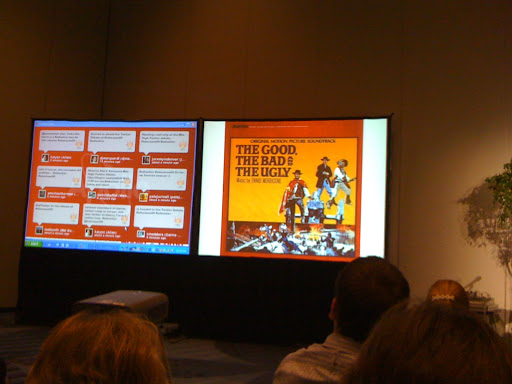
This post is “loosely based” (as they say in films) on a series of my tweets (@malbooth) from the Twitter Debate session at Educause09. I’ve cleaned up and explained a few tweets in the interests of your sanity.
(#edTwitter is the hash tag for the Twitter debate at #educause09)
- RT @jeremyindenver Standing room only at the Mile High Twitter debate (yes, the room was packed and people were standing up lining all walls)
- Mostly academic theatre so far.
- Noise, safety, security, content, distractions, spam, reality?
- Or passion, diversity, helpful, connections, real time?
- Check this video out — The Twitter Experiment – UT Dallas http://bit.ly/YlBZt
- CIOs as orange cones over potholes?
- A reference to Harvard now. The school that gave us those that gave us the GFC [sorry, that was unfair: I put it onto the jet lag]
- Is it about experimentation, innovation, making mistakes, exploring?
- “Messy creativity that leads to engagement” (I liked that)
- Do ground rules inhibit exploration & experimentation?
- Google on innovation. Comes when reflecting, not on schedule in a divisional structure. Self-organise in shared-value culture.
- Clay Shirky now: changing the world via social networks (from his recent talk at US State Dept)
- How to make best use of the media even though it means changing our ways (Shirky)
- Who cares what a CIO thinks about Twitter anyway?
- [I then noticed that:] #educause09 [was] now a trending topic – imagine what we could achieve if we really collaborated
- Twitter offers transparency, but [there are] some costs – uni reputation needs to be considered. Voices or consistency?
- Dialogue is important. can practices be integrated? Is it a distraction?
- Has tweeting become competitive in this debate? [This tweet attracted a response: “@kaiyen @malbooth no, unless you tweet faster than I do”]
- [I think it is] too early for best practice & benchmarking: read some blogs, but not [the] usual suspects: see practitioners
- Immersion is important! Follow @RWW, @mashable
- [The someone mentioned:] FRBR (groans) [actually I heard FRBR being a librarian, but maybe they said FERPA?]
- “Twitter is a basic information literacy skill” & [it is not] not in a walled garden
- “What better evidence of your engagement in learning than results when your name is Googled”: be a citizen of open web
- “Please don’t tell us what we can’t do: help us, guide us”
- Someone raised the importance of the back-channel as a toll for LISTENING!
- Back-channel can be transformative, scary, invaluable and great guidance
- Does or should twitter emulate real life communications? Trust users to do what is right with it as a tool
- Can lead to moments of authentic connection!
- We will all make mistakes and need to be tolerant of each other
- Many different ways to use it appropriately – make a judgment
- Important to be able to use all forms of media for communications!
- Thanks for this session – it made me think
This was a very lively, active and well-presented session. My thanks to the two presenters: W. Gardner Campbell, Director of the Academy of Teaching and Learning and an Associate Professor of Literature and Media from Baylor University (who played the radical academic) & Bruce Maas who played (and is) the CIO of the University of Wisconsin-Milwaukee (all universities should be so lucky).
Visit to Denver University
 Before Educause09 started a generous man called Joe Schuch (from Thorburn Associates Inc.) organised a campus tour of some new learning spaces for those of us who were interested at the University of Denver (DU). I took a lot of photos as the tour was really interesting and useful. Here are some quick observations that I noted on my iPhone. The images can all be found on this Flickr set. Educause09 is way too busy for me to clean this up any further (and my brain is still suffering from jet lag).
- Reconfigure of classrooms may be possible but it won’t happen without ease of use (wheels).
- Webcasting is possible in most classes at DU.
- Hubs can be found in most floors for data/power (see images of a variety of types).
- Wireless access is still problematic so they usually provide cable data too.
- The importance of mobile technology is growing as is BYO computing.
- “Idea paint” is used on some walls to allow writing space (see an image).
- It can be hard for buildings to keep up with technology, so they must be designed to be flexible and adaptable as needs change. It is critical to allow for flexible movable furniture and non-defined learning spaces. Non-traditional models of teaching are being facilitated at DU. They find that they still need to allow for some managed restoration of spaces unless you have mature, responsible students.
- Security devices are used on projectors to prevent theft.
- Technology (& software) that you don’t need to teach people about is their aim: the users can just figure it out.
- The space with high projectors is an experiment with a (previously) poorly used space that is mow well used, for many different purposes. DU staff said it was best if faculties can see and play with something first before deciding what they want!
- Ports are provided in floors that can be walked over & wheeled over (see image).
- DU Library is digitizing teaching materials for faculty but there are some rights issues.
- Permaculture gardens are being put in around the DU campus as it is a dry environment. This is a long term plan.
- They have a professor teaching students all over world on International Futures and have set up a special teaching space for him to hookup real time with students on campus and remotely (overseas) using a large-screen web cam system. His program needed a single port of access for all while waiting for a full web solution (see image).
- Construction projects are being used to leverage the steps of technological progress. Idea paint is used on some walls in big classroom (see the image with the cool desks).
- The Center for Teaching & Learning (CTL) program is in the university library. Julanna V. Gilbert is the Director of CTL and she accompanied us for our entire tour along with Jane Loefgren from the office of the University Architect. Julanna also gave us a presentation on their web-based tools that support learning at DU.
- CTL have their own developers for Cold Fusion and developed the DU Portfolio Community (before Facebook was developed). It supports many communities, but content is not exportable to other platforms or systems. It is now a huge system that has evolved over eight years. 400 communities are using it and some departments use it as internal space as it has configurable privacy settings. It is written in Java uses an Oracle database (with the DBAs coming from the central university technology support department). It is not a course management program. It offers academic program assessment (not course assessment) as well as the community side. It is capable of collecting all forms of media that can be uploaded. It seems to be more popular with faculty, staff and communities but some students use it too. They can take their portfolio with them after graduating by keeping the space and they can add to it. The system started before online spaces were developed. A lot of research communities use it. It is much easier to use than blackboard and there is no need to teach people how to use it. (Blackboard is used at DU for course support.)
- DU CTL also built DU CourseMedia – a media management system for multimedia including video, sound, images, etc. It was designed to be “no harder than buying a book at Amazon”. Anyone who wants to use these applications can use the system (but not the DU content). The DU Library helps with digitizing media, negotiating the ownership landmine and by adding (consistent, standard, necessary) metadata as “they know all that stuff”. The library thought that they should offer that service. They even hired an art historian at first when digitising images and then moved into film. The Library felt a need to provide content. (This is not part of the Colorado Digitisation Project.)
- Lecture capture at DU is done through client via laptops, mostly to Blackboard. I think their system can encode up to six simultaneous streams. It is mostly used by the Business faculty academics. They went for an economical solution.
I am really grateful for the time and generosity of the staff and students of the University of Denver for providing us with this tour of their learning spaces. My images and words probably do not do them the credit they deserve.
Visit to Thinkspace (Powerhouse Museum)
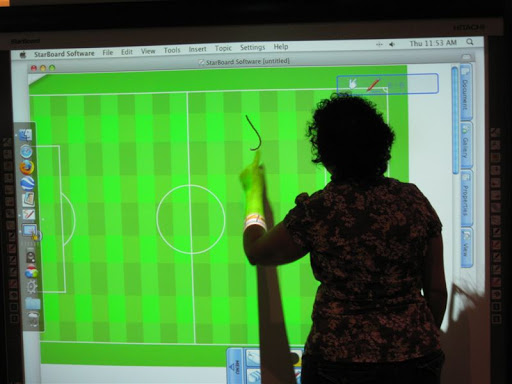 These are some images of a recent visit that I made with some colleagues from the UTS Library to the Powerhouse Museum’s Thinkspace. The super staff there, Joy Suliman and Peter Mahony, gave us a great workshop to introduce us to some of the possibilities for collaborative digital learning and creativity in such a space. We played around with Garage Band, Google Earth, Inspiration (a mind-mapping tool, see below) and some other programs.
 Peter and a blurry Joy answering some of our questions.
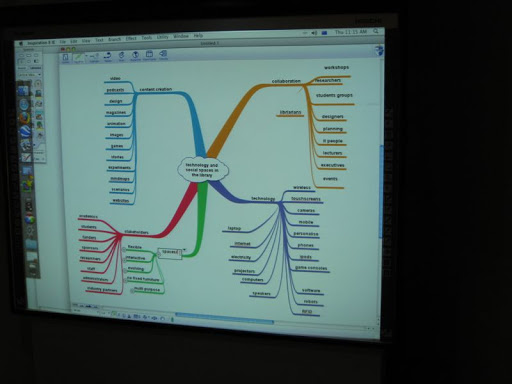
 The two shots above show the results of some quick mind-mapping about technology and social spaces in libraries.


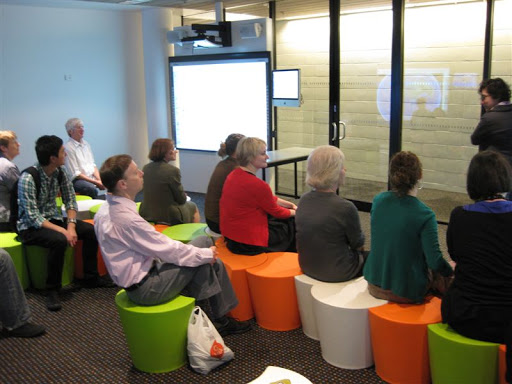 I’d been to this space for a quick tour once before but I wanted to go back and take our entire management team along with a few younger colleagues to help us out. We’re probably going to experiment with a similar space in our library very soon.
FromMelbin Wordle

Image from http://www.wordle.net/
Peter Murray-Rust’s 12 point action plan for libraries
Peter Murray-Rust Keynote at ILI 2009 from Jaap van de Geer on Vimeo.
Peter is seeing no fire in our collective bellies and not enough passion coming from librarians about our own future. He puts forward an interesting action plan calling for librarians to be less passive and far more proactive on issues such as Copyright in academic publishing, open everything (publishing & data), community collaboration and action, and taking more steps to make the library a growing and addictive organism.
In this talk he delivers a pretty good 12 point action plan that most of us working in academic libraries should at least consider very seriously. The whole video is well worth watching, but I know most people won’t bother so here again is my summary of the key points along with a few of my own comments thrown in for good measure.
Before introducing his action plan he mentions a few other interesting ideas:
- He grounds his presentation by referring to Ranganathan’s Five Laws of Library Science, although he dislikes the term “user” preferring “reader”.
- Copyright as we know it must be destroyed for the sake of academic publishing and in order to facilitate the sharing of knowledge (as distinct from the business of making money from restricting the sharing of knowledge). He claims by example that Copyright is currently preventing the sharing of knowledge that could help to save the planet and that we as librarians should be agitating, displaying our “raw anger” and protesting for legislative change.
- He laments the situation in academic publishing where academics create works for free, but are expected to pay in order to see the work of their colleagues. It is a situation that must be changed.
The 12 Point Plan (in no particular order):
1. We should act as citizen librarians towards a common or shared goal. (See some examples below of communities collaborating towards shared goals.)
2. Post all academic output publicly: ignore Copyright. For this, we need to display our passion and one of probably has to volunteer to go to gaol. I like this one, but I can’t be the one going to gaol. Sorry. (Beth & Belinda: step forward please. Don’t worry, I’ll look after the shop.)
3. Text mine everything. Currently this isn’t allowed by the publishers who own nearly everything. It stops researchers trying to find stuff. As he says: “when violating a publisher’s terms of use, you are guilty until proven innocent”.
4. Put 2nd year students in charge of developing educational technology resources. They use it all the time and will know whether to go mobile or to use Xbox or Play Station. There is some truth in this.
5. Actively participate in obtaining science grants. Because scientists find it all too repetitious and cumbersome. They need our help.
6. Actively participate in the scientific publishing process. Again, they need our help. Maybe we can help them to publish their work more openly and also to facilitate better management of their IP.
7. Close the science library and move it all to the departments. He says this is a no-brainer. (We don’t have a science library at UTS.)
8. Handover all purchasing to national Rottweiler publishing officers. Apparently they deal with the publishers centrally in Brazil. We could not do it in Australia. Getting any form of agreement with so many egos and so much self-interest in the room would prove far too complicated. Besides, we have less important issues to worry about. It is actually something we should at least try to do, very seriously. It may well be one of the big issues on this list, along with taking action on Copyright and open access publishing where we really could have a very beneficial effect and demonstrate our worth.
9. Set up a new type of university press. The traditional presses have all been failures. We have been handed an opportunity with the Internet, but our presses have been less innovative than other publishers. I think we are taking steps in this direction now and UTSePress is a good example, publishing journals, books and conference proceedings online.
10. We should develop our own metrics system. Publishers manipulate the metrics system in order to get us to buy what they think we want.
11. We should publicly campaign for openness. He gave a few examples like the Open Knowledge Foundation and the Open Rights Group. We should be actively involved.
12. We should make the library an addictive “game”. He used the example of building “reputation points” through involvement and participation in something like stackoverflow.com After a while it becomes a bit addictive, like ebay.
We should be asking ourselves “what can we do to change the world and keep the library a growing organism”? His list seems like a decent start, even if it is a tad biased towards science.
He wound up his presentation with a few examples of the contributions made by online communities, including: Galaxy Zoo where 150,000 members world-wide have assisted professional astronomers to classify over one million galaxies; and OpenStreetMap, a free editable map of the world that is up-to-date within minutes thanks to the contributions made by over 250,000 members.
One of the most important pleas he makes is for the democratisation of knowledge. This should be possible on the web. For it to happen, democratisation must win over commoditisation for commercial purposes (i.e. the protection of business empires).
I am surprised that there has not been more debate about his address.
Miscellaneous connections
I gave this presentation late last week to the ANZ Society of Indexers for their annual conference. It was meant to stimulate some thought about recent developments on the web and also within institutions. Maybe the following guide will help to interpret some of these slides.
SLIDES 2 & 3 (Connection)
I used these slides to draw a connection between myself and Hazel Bell, the other plenary speaker (by video from the UK). She indexed the first publication of T.E. Lawrence’s Seven Pillars of Wisdom (1992 text) when it was first published by Jeremy Wilson in 1997. That text is over 80,000 words longer than the 1926 text that most people would be more familiar with and the index was invaluable to me when I curated a museum exhibition on Lawrence in 2006-08.
SLIDE 4 (Collaborators)
I am really grateful to those named on that slide as they raised my awareness and gave me new perspectives on a number of issues. We mostly used Google Docs to share comments and observations.
SLIDES 6-8 (“Indexing” the web)
Here you can see the influence of David Weinberger (Everything is Miscellaneous) and Cory Doctorow regarding the application of non-web protocols, classifications and restrictions to the web. We cannot attempt to index or classify the web in the same way we would for a book or a collection of physical objects. It isn’t going to work and it isn’t necessary.
SLIDES 9-11 (Connect, share & collaborate!)
Yes, connect and integrate our existing taxonomies and indexes with those available on the web. I’m not suggesting that we throw the baby out with the bath water. Folksonomies work best with taxonomies. We need to realise that what works best in web systems like iTunes, Flickr, LibraryThing and Delicious is their ease of use. You are not forced to spend days laboriously adding metadata to fields that you don’t even understand. LibraryThing and iTunes draw or harvest open metadata for us from other sources. We can then add our own tags, and in some cases even comments, links and reviews.
SLIDES 12-15 (The power of sharing)
Social media allows us to share everything quickly and easily. Gary Hayes’ Social Media Count brilliantly displays the amazing dynamics of social media as you watch. In 2008 I was able to share images from a world championships being run in Hawaii to the world while the race was still being conducted. Our collection management systems in cultural institutions are not that adept. So maybe we use them in conjunction with image sharing platforms like Flickr or Picasa, or maybe we just chuck out these cottage industry systems and start again, realising the importance and scope of digital media, and going with systems that are intuitive, easy to use and much less cumbersome? Even software is now being shared and users are collaborating with each other to improve it. People are also still busy having their say in blogs and using clever RSS readers to help them to read what they choose to read and not what newspaper editors think they should read or what TV news rooms want to sell them.
SLIDE 16 (Authenticity)
The web is often criticised for being unreliable. But just because something is published in a magazine, a newspaper or in a book does not make it always reliable or authentic. Even peer review is not completely reliable. So we’ve come up with new ways to measure how much to trust each other and judge authenticity online. eBay and craigslist are great examples of this and they’ve been so popular that they’ve effectively robbed newspapers of much of their classifieds revenue.
SLIDES 17-25 (Institutions & sharing)
Cultural institutions are realising that they need to get out there and connect with their users on the web. They cannot wait for people to come to them. The clever institutions are making their web data easily findable and easily used. Mashups are growing. These are just a few examples.
SLIDES 26-27 (UTS Library – now)
Open everything seems to be the way of the future, so with UTSeScholarship we are heading in that direction. We are also using social media to connect with our clients where they might begin their searches and to engage with them.
SLIDES 28-35 (UTS Library of the Future)
These slides present a quick tour of some of the plans we have for our future Library. We are going to put approximately 66% of our physical collection in an underground Automated Storage & Retrieval System adjacent to our new Library building and that will allow us to do much more with our physical spaces in the Library itself. (The rough dates are only indicative.) Some of the elements we are looking at will be stimulated by developments well outside traditional library and academic environments.
Fines

A quick presentation on using Twitter
I gave this quick presentation on using Twitter to my university’s Teach & Learning Committee yesterday. Our Deputy Vice Chancellor (for Teaching, Learning and Equity), Shirley Alexander thought it was worth giving Twitter a try as a way of extending our reach and exposing the work of the committee. So here it is on SlideShare, below.
Oh, and one tool I used yesterday that isn’t linked in the presentation is TwitBlock – a great help in ridding your followers of spammers.
Of course hyperlinks still don’t upload that well on SlideShare, so here they are, slide-by-slide:
SLIDE #1 https://twitter.com/signup http://delicious.com/malbooth/twitter www.slideshare.net/malbooth
SLIDE #3 http://twitter.com/ http://twitter.com/stephenfry http://search.twitter.com/
SLIDE #4 http://en.wikipedia.org/wiki/Dunbar’s_number
SLIDE #5 http://tweetdeck.com/beta/download/ http://echofon.com/ http://www.atebits.com/tweetie-iphone/ http://bit.ly/ http://cotweet.com/
SLIDE #7 http://twitter.com/KevinRuddPM http://twitter.com/BarackObama http://twitter.com/SAlexander_UTS http://twitter.com/AnneBB http://twitter.com/search/users?q=UTS&category=people&source=find_on_twitter http://twitter.com/Twitter_Tips http://twitter.com/timoreilly
Cory Doctorow on Copyright & Open Access
I just watched a great presentation by Cory Doctorow from Access 2009 (Canada’s Premier Library Technology Conference). Cory gives a bit of a history of the web to date as a massive copying machine and then criticises various attempts to regulate it. Towards the end there are some really important statements and answers to questions about Copyright and open access publication. These ideas struck a chord with me:
- allowing free trade of electronic editions sells more print editions
- librarians under-appreciate the extent to which they are unimpeachable sources of moral authority on liberal info access
- creative people, such as authors and artists, are not the most astute people on (rights) policy questions (he doesn’t agree that we librarians are the moral equivalent of car thieves!)
- authors who give up copyright to publishers lose negotiating power
- authors’ relationships with publishers are best described as Stockholm Syndrome
- the difference between purchasing a book and buying the right to read one on Amazon’s Kindle
- libraries should spend [part of their] research subscriptions budgets on peer review fees for an open access journal
- citation is a function of access and you get cited more in open access journals
- there is a duty to release publicly funded research to the public
You can watch all 57 mins of his address below. More slides and videos of other presentations are available on the UPEI presentation portal.
Breathing new life into collections
George Oates is at it again. This presentation covers her brilliant work at Flickr Commons and her recent work on openlibrary.org. The themes that run through this presentation are: increasing access to collections; exploiting the power of (larger) networks; and institutional knowledge as substrate (through deconstruction, opening up and sharing).
Flickr Commons now boasts the shared collections of about 30 participating institutions, greatly increasing access to the shared photos (through the power and reach of Flickr) and perhaps more importantly, allowing the active participation of the viewing audience in adding to the institutional descriptions of those images. Now George has a similar vision for openlibrary.org.
She recognises that the catalogue records of libraries often do not make much sense to many intelligent people and in many cases they can actually be improved if we release our authoritative control over them and share them amongst our readers. A retired friend of mine has a massive personal library of well over 20,000 books. A while back we encouraged him to start cataloguing his books on Library Thing and he has already made a major contribution to the improvement of the descriptive records of those books in his collection, many of which he says were poorly catalogued by many great libraries or Amazon. His cataloguing is also less about the strictures of institutional taxonomies and more about the emotional and intellectual discoveries he has made through reading those books. Surely that helps if we think that our catalogues are primarily to be read by people and not machines?
Oh, you can follow her latest project on Twitter too @openlibrary
 FromMelbin