
Category: Uncategorized
Knit In @ UTS Library

Yesterday we had our first Knit In at our Library. It was very well attended and enjoyed by all participants.
- development of a full risk register (accounting for all OHS hazards – needle injuries, woolen trip wires, people knitting disguises for terrorists, sheep dogs, excess knitting noise, etc.);
- development & printing of new permissions forms (Entry to Library with Needles; Permission to Knit; Intellectual Property; Public Liability; No Fault Disclosure; Damage to Third Party; Personal Insurance Declaration; etc.);
- appointment of a fully certified Quantity Surveyor and independent auditor for the club’s budget;
- cleaning of knitting areas (for lost needles, dye stains, stray shearers, wool, fur balls, patterns, wounded knitters, etc.);
- a security plan for the knitting area (I believe these cost at least US$90 million); and
- quality control & assurance (we do not want to ruin our reputation by having people wandering around in garments that do not fit well or are not stylish).
That should be easy enough.
Recovery via Belvoir, the ACO & At The Movies

I think I’m slowly starting to improve in spirit and mind after the unexpected death of my brother Murray in early May. For a while it was all surreal, unsettling and confusing. I could not really concentrate on much at all. I could not read or even watch movies. One night I left a live concert at the Enmore Theatre (see image left) in a complete state of confused anxiety.
So, I think I’ll try and post something each day on this blog as part of my recovery and in line with the #blogeverydayofjune hashtag on Twitter. Maybe someone will notice whether the posts become more or less coherent over the month. This first post is probably going to be a bit of a mess but I did warn you that my emotions are still in over-drive. Mind the step . . .
I don’t think the kind of management theory that emanates from Harvard Business School that, along with a culture of sheer greed, gambling and competition, has almost destroyed the finance industry can be applied neatly to rescue or to keep afloat libraries and other cultural institutions. This is especially the case given the kind of second rate management “experts” (who didn’t make it to the finance industry) who tend to regard it so highly in such institutions. We don’t simply have clients and stakeholders and we don’t need to worry about bottom lines and shareholder returns in exactly the the same way as a merchant bank does. Our outputs are different and we should be able to focus on more specific qualitative indicators that are much harder to measure.
Bertrand’s directing consists mostly in the confidence and freedom he gave us. He never imposes anything. He hates marks on the ground. He just can’t stand them. He’s so cheerful when he’s shooting, so happy. His obsession is that energy flows, that every moment, every second is fresh. He communicates so well. He is so positive, so cheerful. He jumps around all day long, getting excited about every scene, rubbing his hands and muttering, “This is fantastic! I love my actors! I’m crazy about them.” And just that gives you so much confidence that you’ll do anything. And that’s an important aspect of directing.
What a fantastic way to direct.
Murray Stuart Booth, 1963-2010

I want to thank all those who came to my brother’s funeral on Monday 10 May to farewell him and also to those who came to support his family who will miss him so much. In particular, I would like to thank those like Nick Osborne from the London, UK who travelled so far to be with us on Monday. I would also like to thank our dear family friend Jeanne Lange who sang the Irish Blessing for us during a period for reflection after the eulogies and Richard Westmoreland from Randwick Botany Cycling Club who delivered a very touching eulogy. Murray (Muz to us) was a very modest man who never liked a fuss made of himself and I think he would have been quite shocked by the turn out, but I can assure everyone that his whole family has already drawn much strength from all the support shown and kind words said on the day.
These words are based on the eulogy that I struggled to deliver on Monday. I have not been able to tell everyone I know about his death because the day I spent informing my whole family about his death on 2 May was too difficult to believe and not something anyone should ever have to do.
Muz was born in Sydney, but really he grew up in Melbourne as a boy and young man. Most of his high school years were spent at a selective boys school in inner Melbourne and there he played water polo and did well at subjects like Mathematics.
He gained a university entry score, but decided not to continue with formal education, starting work with the AMP in Melbourne after matriculating. He soon started to pursue some of his passions: cars, his dog Tim and bikes. Murray bought a Mini Cooper and started enjoying driving with his close friend Richard. (We were not able to contact Richard before the funeral.) They made some long trips away together in that car including one to deepest Queensland. Soon he acquired a wonderful Newfoundland dog that he called Tim. People say that dogs resemble their owners and I think Tim was a reflection of Murray’s personality. Tim was always puppy-like and one enormous dog who could stand with his paws on my shoulders and lick me fair in the face. He was gentle like Muz but his slobber had all the qualities of Tarzan’s Grip and it made interesting sounds when it hit the walls of the house as he shook it off his snout. They were wonderful to see together and Tim would do anything Muz asked of him. Dad had retired by then, so Tim amused his house colleague while Muz was away at work by eating all of Dad’s pot plants, some of his trees and then made a decent start on the terra-cotta pots. Tim thought he was a person, so soon became Muz’s driving companion in the Mini Cooper. He always sat in the front passenger seat and if I was ever lucky enough to be taken for a drive, I had to squeeze into the small back bench seat around Tim who also got himself in first. Tim became accomplished at rallying on country roads and whilst he never quite made it as a navigator, he did once make it into the driver’s seat indicating to Muz, that he thought it was about his turn to drive.
It was in Melbourne that Muz began his passion for bicycles. He rode with the hard vets of the eastern suburbs in the days of leather soled shoes and road bikes with toe clips. There he learned his road bike skills and eventually saved enough for his first serious bike, having it made by Cecil Walker in Melbourne city. He still loved that bike and it hangs with pride of place in the fleet that fills his garage at home. (I conducted several guided tours of his bike collection during the wake for various family members who did not understand the depth of his passion for bikes.)
I guess what our family also remembers about Muz in Melbourne was his love of the Goodies and the latter Monty Python productions, particularly The Life of Brian and Fawlty Towers. He had a very funny sense of the ridiculous that his sister Mez and I always found very amusing. We will miss his cheeky grin and dimples terribly.
After a while Muz and Tim took a transfer to Tasmania to work in Hobart. He bought himself a home and seemed to enjoy life there for several years. Muz eventually sold up and moved back to the mainland, but Tim would not have handled another shift of climate and he retired to a farm in Tassie.
Muz worked for a time in the AMP in Sydney, but he really hated it and decided to chuck it all in and go to university to study to become an accountant. He enrolled in a Commerce degree at the University of Wollongong and it was there that he met and started dating his wife Jenny. That was over 17 years ago. Over his time in Sydney he continued his passion for cars and first acquired an awful looking Holden HSV Walkinshaw that Mum and Mez called the Spearmint Machine or Ralph because of the sound it made when it roared away. That was eventually replaced by an older Brock HSV The Black Beauty which he still owns. I think Jenny used to call it the brothel car and did not like to be taken anywhere in it. We have a lot in common! He raced both HSVs in club races on tracks around the Sydney region.
About 13 years ago, he married Jenny and I was honored to be their best man at the wedding. I remember the day well because I had never seen my brother so happy. I think that day would only have been matched by the birth of his son Ben and his daughter Alexis. He was completely devoted to his family as a husband and as a father. His family was really his number one passion in life. My sister Mez loved to watch Muz with his kids: their little hands in his big hands was such a sight to behold. Sometimes he just loved to sit and watch them play. I think his wife and children completed him as a person.
I now want to illustrate several of Muz’s traits and characteristics that I’ve not yet mentioned.
Most people who knew him would acknowledge his generosity, with his support and assistance for others and also with his empathy for others. He enjoyed helping many of his friends to purchase the right bike and gear for their needs, often referring to himself as “muz.con” because “.com” was taken. He had helped both his sister Mez and I with moving house several times, providing both heavy lifting and many silly observations to keep us all entertained during those long hard days. Recently, he and Mum helped me unpack a whole house after my move to Sydney in early 2009. He was really glad to see his sister happy (after marrying Phil recently) and me back in Sydney where we could do much more together.
He was gregarious, though he’d not have said that of himself. Whenever we were in bike shops anywhere, someone would say hello to him. And he could work a crowd socially, not as the centre of attention, but because of his genuine openness and warmth. It was his suggestion to buy a dog for Mum and Dad over 11 years ago despite my reservations at the time. It was probably the best gift we ever gave them at Xmas time. Of course, I later claimed all of the credit, but Mum knew all along it was Muz’s idea.
Muz was a very decent man and I think he admired those qualities in our father. He was forgiving, not judgmental, considerate and respectful of others, particularly his Dad, his father-in-law, and many of his friends from cycling. He had long admired two friends from school who became Olympians: John Fox in water polo and Shaun Panayi in diving.
Later in his life he remained passionate about his cars and bikes. He loved Top Gear and would often message or call me while watching the show. He had tickets to take his son Ben to the live show in Sydney. I think he enjoyed everything about cycling: the drama; the sound of a pack spinning together; the colour and scenery; the degree of difficulty; the devotion of the participants; the traditions and legends; the machinery; and the artistry of the bikes. He had learned much from the veterans of the road in Melbourne and in Sydney he rode and raced with the Randwick Botany Cycling Club. He followed that passion most recently by setting up his own business in bike insurance assessment. I think he relished the opportunity to work on something he enjoyed so much. I greatly admired his initiative and his independence.
Muz was my wise counsel for just about everything in life: jobs, houses, superannuation, bikes, and cars. I asked him before making decisions on all of these matters. For the last 10 years or so I think he rated me somewhere between a four year old child and a helpless village idiot. It was a family joke that he would never trust me with important tasks like our BBQs even though he hated doing it himself. 25 years ago I decided to do my first Ironman and it was very very early in the sport’s history in Australia. I sought his advice about getting a proper bike to race it on and he arranged for me to get one built to his specifications by Gordon Hill at Hillman in Melbourne. A year earlier, Gordon had built the frames for the Australian Olympic team in L.A. so when I found that out I really felt unworthy to ride it well enough. Only the best was good enough for his brother. I had given him the old bike after he helped unpack my house in 2009, but I will now restore that bike myself. He sourced or approved all of my racing bikes. I can even remember phoning Muz from a bike store in Honolulu in late 2008 before I purchased a new pair of bike shoes. Recently, he and I converted the bike I last raced in Hawaii into a single-speed bike for inner Sydney streets at Deus in Camperdown. He realised what that bike meant to me and again had to approve all of the changes. It got to the stage where Pierro at Deus would suggest something to me and before I could say anything he would tell me to just ask my brother about it and then get back to him the next day.
Muz was always there for me when I needed him as a friend and a brother. I loved him and I will miss him more than anyone can imagine.
UTS Library Planning Day #2
UTS on future academic libraries
On 9 February 2010 Dr Belinda Tiffen, Sophie McDonald and me from the UTS Library presented some ideas for our future Library to a national library conference in Melbourne (VALA2010).
As part of the UTS City Campus Master Plan, we have begun the early stages of planning for a new library building or “learning commons” on Broadway that will set new standards for online and physical services to our clients (students, researchers, academics and staff), green culture and operations, and our own work environment. About 60% of our current collection will be buried in a robotically-served retrieval system under Alumni Green (adjacent to the new library building), freeing up the library space for things other than book storage. That facility will be designed and built in the near future.
Our ideas for the future library were presented in three short but entertaining video clips outlining scenarios for:
- students (by UTS students James Shepherd, Dan Miller and friends),
- researchers and
- our staff (in homage the the well-known CommonCraft videos).
Some observations about VALA 2010
I made a few flippant and some serious observations about VALA 2010 on Twitter over the last week or so. Well, OK then, quite a lot really. I’ll try and be less flippant and a little bit deeper in this post. Promise.
Firstly, I’d like to acknowledge the huge effort put in by all of those involved in putting this conference together. It really is an immense task and far too much to arrange for anyone wanting to keep their original hair colour. We should all be grateful to those who volunteered their time and energy to make the conference run so well.
From a content perspective, I think it had something for everyone and I know that the Program Committee made every formal and informal effort to consult with people about who to ask to give keynotes. I was also aware that people like David Feighan (the Program Chair) made an effort to encourage people to take some risks with what they said and to present it in an entertaining way. His opening address and welcome featuring the short video by Abbey the Digiberal Native was a brilliant example for us to follow. (If only David was wearing a tie.)
So, I came away satisfied that the conference pushed the buttons I wanted to have pushed:
- stimulating content and ideas that challenged some of my views or reminded me of reality (from RFID to networked books);
- the opportunity to swap ideas with colleagues from all over Australasia (& beyond!);
- the chance to let others know what we are up to;
- the opportunity to have some fun (away) with some of my colleagues and some new friends;
- stimulus to write a paper and prepare a presentation on a topic of some importance to us;
- connecting with old colleagues;
- watching and listening to some up-and-coming rock stars of the library world who are so passionate and enthusiastic about what they do; and
- sometimes I just needed a laugh (thanks to many of my Twitter friends and especially John Garraway from the University of Auckland who has a real gift for timing and delivery).
I don’t think the real value, in terms of connections, content, conversations and encouragement, that such conferences give to their attendees can be discounted.
So, to some brief observations from my perspective:
SUSTAINABILITY: I was pretty surprised that this issue did not come up much apart from our (UTS) presentation. It is a major priority for us and was one of the main conference themes at Educause09.
TWITTER: It provided a very valuable back-channel for this conference and I think that, like Educause09 in Denver, if you didn’t at least lurk, you missed a vital and really useful dimension of VALA2010. As @flexnib tweeted: “all of us are smarter than any of us”. In a way, it provided a cloud for the crowd.
CLOUD COMPUTING: This issue emerged and was debated in several sessions, but again, I was surprised that it didn’t feature on as many agendas as it might have.
ROCK STARS: I am glad that some new young Australian library “rock stars” are starting to emerge. I’m thinking of people like Paul Hagon, Kat Clancy and our own Sophie McDonald to name just a few of them. They need to be encouraged as examples for others to follow. Their essential role in connecting us to our clients or just the broader public cannot be underestimated.
INSPIRATION & LEARNING FROM OUTSIDE THE SECTOR: I really enjoyed two of the keynotes as they made me think . . . about everything. Firstly there was the wonderful Stephanie Orlic from Museum Lab, Musée du Louvre and finally we had McKenzie Wark from the New School for Social Research in New York. Both were brilliant. You could also argue that Paul Hagon’s “cataloguing by faces and colours” session on 10 February was along the same lines – thinking outside the box.
FROM LITTLE THINGS . . . : One thing that disappointed me was hearing, I think from a panellist, that what some public and state libraries are doing in digitising their own historical collections and other popular and/or rare collection material is insignificant or really doesn’t matter much. Well, I’m sorry, but it does. It matters big time. As Paul Kelly said “From little things, big things grow”. It is an important start and if our public institutions don’t make a start then someone else will start pulling the rug from under us. We should be encouraging any digitisation of cultural materials, not just endlessly debating which metadata schema to use or how to moderate user-created data, should we ever decide to allow it. What NLA is doing with Trove , what the Australian War Memorial has done with war diaries and more recently C.E.W. Bean’s First World war records and what the State libraries and some public libraries are doing to provide online access to and digital preservation of our cultural and historical heritage is very important and a great example for others to follow. If we were really a clever nation, by now we’d have a national cultural digitisation strategy.
That’s all!
Deus bike swap meet #4
Happy Holidays!
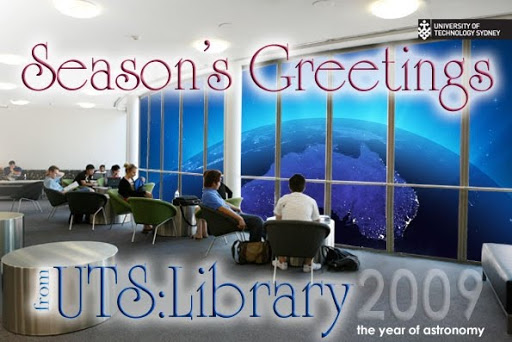 I’ve lost your address!
2009 was another hectic year for me as I took a job offered to me in December 2008 at the University of Technology Sydney. That meant quickly selling my house in Canberra and moving everything to Sydney while still looking for a new home.
I found a near new unit in Camperdown and it is really handy to work, Newtown, Glebe and Annandale. I usually walk or run everywhere now and love living in Sydney so close to the city.
Work started (for me) in early March at the University Library and I’m enjoying the job and my new colleagues there. Apart from looking after the services we provide to students, researchers and staff I’m leading a project to build an underground repository for our little-used books (about 60% of our collection) and then the design of a new library for the University on Broadway that is currently scheduled for 2015.
Most of the year was spent settling into the University and life in Sydney, but in November I had the chance to travel to the US for a higher education conference and to visit several academic libraries that have done what we are planning to do. This meant seeing new places like Denver, Salt Lake City, Las Vegas, Reno, Santa Clara and San José and returning to San Francisco for the first time in over 20 years. It was hectic but really interesting and enjoyable.
That’s all. I hope you are all well and happy!
Lost in Space
This is just a photo essay on two lakes in Canberra. Words by Aimee Mann: Lost in Space and images taken by me while playing around with different cameras. I think you need to view it in Flickr as a slideshow to see the captions. (Select Show info once onto the slideshow.)
Universities & the cloud: services, economics & impacts

A style of computing where massively scalable IT-related capabilities are provided “as a service” using Internet technologies to multiple external customers.
(Gartner, 6/08).. . . massive aggregation of a wide variety of IT services delivered via fast digital networks – much like power generation and the electrical grid of a public utility.
(Brad Wheeler & Shelton Waggener, EDUCAUSE review 2009)The services themselves have long been referred to as Software as a Service (SaaS). The datacenter hardware and software is what we will call a Cloud. When a Cloud is made available in a pay-as-you-go manner to the general public, we call it a Public Cloud; the service being sold is Utility Computing.
We use the term Private Cloud to refer to internal datacenters of a business or other organization, not made available to the general public.”
(Armbrust, et al., Above the Clouds)
What is different, and how is it different, when you compare cloud computing to traditional out-sourcing or software as a service?
- Cloud computing needs integration so it looks like extension of the campus.
- It also needs strong identity management and a federation system.
- It differs from out sourcing as it is usually more flexible, elastic and it is more configurable to meet changed demands.
- Also, cloud computing makes universities it think differently about running everything themselves.
- The comfort factor is different too for off-campus services: If Google goes down people seem to understand; there is a different end-user experience in cloud.
- Users don’t care about content being hosted in a “ .edu” domain as long as it works.
- Easy-to-use interfaces from huge investments in the cloud if the services are mass consumerised but if not, it could cause trouble.
- One panelist saw IT as advocates for best service and therefore the cloud had to be on their radar.
What is the compelling case for cloud computing?
- There are very obvious economic benefits from shared data centres alone. Regional computing centres are growing rapidly in California – as the cheapest available solution.
- We need to decouple the concept of “computer labs” from the location of software and digital storage so they (i.e. users) don’t need to come to the service (it comes to them).
- We may be in a “perfect storm” for case-building right now: the GFC; carbon neutral pressure; limited expansion space; etc.
- The total cost of ownership is less.
- Services are provided to locations all over with limited space investment.
- The time to market and deliver is much quicker.
There may be opportunities for scaling infrastructure. Does the collaborative nature of higher ed support cloud activities across university systems or consortia?
- One panelist cited the example of the Fedora Commons and Dspace consortium DuraCloud as large buying agents.
- Collaboration provides many advantages for those who don’t have the necessary storage competencies.
- Collaborative consortia may be better equipped to leverage Amazon services.
- There is already pressure for access from researchers to use the commercial cloud and they seem less concerned with oft cited disadvantages such as re privacy, security of data, down times, etc.
- It works when the new service is better than old way
How does cloud computing impact governance, the organization of our departments and the skills of our staff?
- Simple innovation isn’t a component of greatness – we need to focus on core (and not just try to be “trendy”).
- Cloud computing could be disruptive and it must be a strategic decision that is supported by whole management team (it isn’t just a tactical initiative tactical like moving student email to Google is).
- The decision needs entire institution buy-in.
- It is broader than just a CIO issue.
- Privacy issues: when dealing with offshore servers, yes there are jurisdiction issues; but Google is willing to give assurances that they will comply with national requirement as they want our business; the problem is solvable.
- One issue is the possibility of going to the cloud and then the company who is providing the service goes bankrupt, but that can also happen with traditional IT services. A risk management plan is needed.
- Universities may need to reset different levels of service.
How does cloud computing impact governance, the organization of our departments and the skills of our staff?
- We cannot grow as quickly, even in regional collaboration projects as the large commercial companies can.
- What changes needed in IT staff? More expertise in contract management.
- Someone needs to make a sensible decision about which records to turn over.
- Most (IT) jobs and roles are changing anyway.
What should campuses be thinking about today and including in our planning for tomorrow?
- Changing capital $ into those devoted to the provision of services (power costs need to be considered too).
- In general, some services seem appropriate for the cloud, some should be provided on the campus & and some should be shared.
 FromMelbin