
Category: Libraries
Library Chat » Episode 8 – Mal Booth – Culture, Creativity, Play, Meetings
Library Chat » Episode 8 – Mal Booth – Culture, Creativity, Play, Meetings.
This a podcast of an interview that I did with Corin the Librarian (@corinh) in Auckland. It was done a while back and I’ve only just had a listen to it. I’m amazed at how coherent it is. Maybe it is all due to Corin’s editing, or maybe it was someone else impersonating me!
Libraries and the digital future
This is the presentation I gave to a City of Sydney Libraries seminar on 27 June 2013. It was only a short presentation so it isn’t comprehensive. Presenter’s notes are included in the pdf file.
Some thoughts about MONA (Part 2)
I promise this is the last in the series of hand-written posts about Tasmania. It just seems appropriate to wrap it all up the same way.


Some thoughts about MONA (Part 1)
Here is Part 1 of my reflective thoughts on MONA in Tasmania. Part 2 is here.


Theatre of the World (past exhibition) http://www.mona.net.au/past-exhibitions
Smith Journal http://www.smithjournal.com.au/
The Onion http://www.theonion.com/
Fender Katsilidis Architects http://www.fkaustralia.com/
My images of MONA on Flickr http://www.flickr.com/photos/malbooth/sets/72157633236587086
#THETA13 Search to Discovery (Part 2)


From Search to Discovery at UTS:LIBRARY #THETA2013


This is Part 1 of a few. We only have 25 minutes to present, so I’ll cram in some extras via this blog.
What would Andy Warhol do?

Sketched on my iPad whilst watching the documentary.
Last week I found the time to watch all four hours of Ric Burns’: Andy Warhol a documentary film (it is in our library collection). It is divided into two parts – his earlier period and his later period. I watched the second part first. I don’t know why. I had recorded them from ABC TV ages ago and I guess I found them in that order.
In NYC last year I saw Regarding Warhol, Sixty Artists, Fifty Years at The Met and enjoyed it, but now I wish I had seen this doco or read more about him beforehand. I had some awareness of the popular Warhol images, but not enough to fully appreciate his impact on art in the last century, nor how and why he went about it. He wasn’t one of my favourite American artists of the post-war period. I’m more of an abstract expressionist fan, so for me it is always a hunt for Clyfford Still, Mark Rothko, Lee Krasner, Franz Kline, Joan MItchell, Philip Guston, Pollock, de Kooning, etc. As for pop art, I guess I liked Jasper Johns, Robert Rauschenberg and Roy Lichtenstein more than Andy. I had not appreciated his background, nor the influence he had on modern art and pop culture; not fully. Maybe not at all really. I have always wondered whether the artistic work itself is more important than the influence of the artist, but as one curator says in the documentary, you could say the most influential artist of the first half of the C20th was Picasso and it was Warhol in the second half.
The earlier part went into his childhood and his experience of art school. He was a good draftsman and could draw in his own fluid style really well, even though he did not think so. He seems to have had an enormous inferiority complex his whole life, but that is another story I guess. When he moved to NYC he first worked and became very successful as a commercial artist and illustrator for magazines. This is where he made a buck and financed his first explorations into the much poorer art world. In this period I think he produced some really beautiful images that they showed in the doco including his shoe illustrations, the “Progressive Piano” (1957) and the beautiful coloured birds in “Female Head” (also 1957). Despite this, he apparently he sold very little as an “artist” in several of his unsuccessful small shows. As I think the collector and gallery manager/owner Irving Blum said: Americans bought big cars and boats but they did not buy art in the 50s and 60s. It is worth noting that the clever Blum purchased the Campbell’s Soup exhibition set (after its display in his California gallery) for $1,000. He sold it many years later to the MoMA for $15 million.
As a successful commercial artist he tried to attract the attention of other successful artists like the writer Truman Capote (with an entire exhibition devoted to him) and both Johns and Rauschenberg, visual artists like Warhol, who snobbishly refused to have anything to do with him because of his profession and his flamboyant manner (both were apparently still entrenched in their closets). Perhaps this closeting of true self is why neither were as influential with others as Warhol was? This seemed to be at a stage when he was still exploring and developing his own pop art style, but before he started his more bohemian collaborations with a vast collection of “creative” misfits from both the upper and lower echelons of contemporary society but not, according to the documentary and those interviewed, like Billy Name and various writers and artists, with anyone from the middle class. With the Factory he created an artists’ collective, a space where people could be collaboratively creative and explore new forms of artistic expression. He dabbled in film (with people like Paul Morrissey), music (like the Velvet Underground), silk screen printing, magazines (Interview), sculpture and briefly even operated a dance club in Manhattan. He found artistic merit in mass produced images (like advertisements, printed photographs in newspapers or even Most Wanted posters) and made popular culture and popular celebrities (Brando, Taylor, Monroe, Presley, etc.) into iconic images through his own obsession with them and his unique form of mass produced and vibrantly coloured portraits. Warhol seems to have been fascinated by what others disregarded as ordinary and he was gifted enough to raise the ordinary into an art form, paving the way for others to follow in this vein, like Jeff Koons I suppose.
Many curators said he was truly gifted with colour, which is a bit obvious I suppose when you think about it, but I also learned that he was a great and inventive technician too (e.g his blotted line technique and his screen prints). He dragged in potential collaborators off the street, like Jed Johnson (a one-time boyfriend and later designer to the stars). It seemed to be a very free-flowing period in which he went with the cultural flow and explored possibilities because he could. But he could not say no easily and that probably led to his shooting by the writer and crazy person Valerie Solanas.
Not surprisingly, that seems to have been a turning point in his life and the second period seems to have been more commercially successful and more business-focussed with partners who encouraged him to concentrate on producing art that sold or that was commissioned. (Even so, nobody seems to have mentioned anyone measuring his success with things like KPIs or business objectives.)
Various people who knew him were interviewed and some said he was easy to dislike and unpleasant, particularly in his later years. He is described as withdrawn and fearful of close contact and affected, but I think those who knew him best said he was magnetic and also a very complex person.
As well as inspiring me to further our efforts with our cultural programs, all of this made me think. I think it made me think more about the value of artistic collaboration and about not knowing where that might lead or even what it might deliver. I was reminded of discussions I had last year with a few colleagues about the usefulness of useless knowledge, by Warhol’s inspiration from rather ordinary images. And I was again reminded of the dangers of the mindless nature of a one-eyed pursuit of efficiency: by anyone really, but certainly by a cultural institution, and even in a university, a library must recognise that it is a cultural institution. I think libraries have a lot more to learn from Warhol than they do from Jack Welch and sundry successful business theorists, but it is worth noting that Warhol himself always recognised that he also had a sharp business brain. That’s the bit that confuses me, but I guess it is also where the folk from our Design School come in because the art they produce seems grounded in all kinds of practical reality. Warhol seems to have started as a successful visual communicator in the 1950s and whilst he dabbled in so many other things a continuing thread in his artistic output seems to me at least to have been his gift for communicating through the visual image. I know that I’ll view the next Warhol exhibition that I see with different eyes.
I’ve recently been asked by a few people about how I measured the effectiveness of our arts and cultural programs. I gave some rational answers that I don’t intend to go into here. In future I intend to say “by shoe size”.
Researchers & social media
In early February I was asked to participate in a discussion on the use of social media by researchers for our 2013 Research Week. I was joined by @jennaprice and we mostly agreed with each other. Mostly …
I based my talking points on the content of two presentations that I have uploaded to SlideShare. They are among the most popular of my 30 or so uploads and here is the most recent version: Make me famous with social media
For those who prefer the most recent discussion, here are a few words based on the rough notes that I used.
I started by saying that I recognise the ephemeral nature of almost all social media posts. I am not really sure that any institutions needs to try to record all of it. A lot of it is complete rubbish and quite meaningless without the context of time, place and others participating in the same conversation or open discussion. As Clay Shirky has said though, it does represent a connective tissue that fuses both public and personal media and that is what makes it so significant, at least in our time. For researchers it can assist in connections, communication, the provision of sometimes instant feedback or responses, increased reach and in finding your own “voice”. One of social media’s key and perhaps most valuable characteristics is that it allows and encourages us to share; it helps facilitate altruism and that is a real benefit (as long as it lasts).
So, if we take a quick look at three key platforms as an example for researchers and what they can do with them:
- TWITTER – helps with connections, asking for help, news, “voice”, sharing and searching.
- ACADEMIA.EDU – basically Facebook for academics (without the ads). It is not as well used here as it seems to be in the US, but has huge potential to facilitate better academic social networks. (Jenna didn’t agree with me on this one.)
- BLOGS – allow you to test ideas and to share, practice, ideate and form or contribute tio various communities of research practice.
My tips and advice for researchers who want to use social media:
- Start with your own community
- Keep it in perspective (see the note above re the ephemeral nature of social media and social networks)
- Listen (it is a two way street, not simply a public broadcast media)
- Engage – I doubt you’ll fully realise the potential benefits by just lurking
- Play, fail, learn – most social networks are very forgiving
- Respect others and their acknowledge their generosity
- Be real – I’m not at all a fan of anonymity on the social web
- Be careful how much you reveal about yourself and your long term research (Jenna reminded us that most researchers, like journalists like to be the first to publish)
- Don’t feed the trolls!
- Be patient – it isn’t always instantaneous and not everyone is always connected and always paying attention
Finally I said that for some researchers in a highly competitive market for research funding that social media can lead to the creation of a higher public profile (which then needs some management). This might be combined with sharing (via Open Acces publication), clever use of social networks and altmetrics to deliver crowd-funding for your research.
Sketch-notes – Pirate Party
 |
| Anna Troberg keynote ALIA Information Online 2013 |
Anna Troberg leads the Swedish Pirate Party and she gave us very strong encouragement to raise hell about quite a few issues. We are “too passive and too nice!”. She sees information and culture as wealth and reminded us that we have a key role in preserving access to them. Anna said that culture always finds a way forward, but outdated Copyright law needed reform as it now served to block cultural flow and even to hide cultural assets.
So what are we all waiting for? Let’s raise some hell!
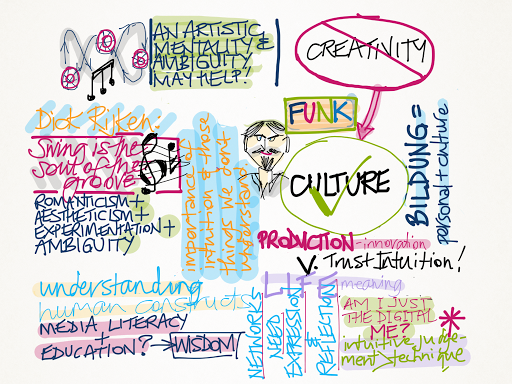
Sketch-notes – Swing is the Soul of the Groove
 |
| Dick Rijken keynote ALIA Information Online 2013 |
Dick Rijken’s keynote Swing is the Soul of the Groove was one that I arranged, so again, maybe I am biased here, but I loved it. It seemed to me at least that the whole week flowed into his final keynote and he nicely wrapped up many of the main themes. He stressed culture over the vogue words: creativity and innovation. He illustrated his points with visual and musical storytelling and I was in two minds as to whether I should just watch or try to record some thoughts and reminders.
It was fantastic to hear someone of his standing reminding us of the importance of things like ambiguity, not knowing or understanding, romanticism, aestheticism, experimentation and trusting our intuition. All are hard to tie down, to justify or to measure quantitatively, but in the end are they not some of the things that distinguish us from robots or automatons? And certainly I think they are critical to our sector. For too long I think we’ve been obsessed with making things more efficient, more specialised, less connected and easily measured. We need to rediscover the underlying meaning in what we do. As Dick said, an artistic mentality can be very helpful to us in finding that meaning and in truly understanding what we are supposed to be doing.
I was fortunate enough to spend a lot of time with Dick last week and to present a workshop with him last Friday. Not only did I learn a great deal from him, I was stimulated and energised by the many discussions we had.
 FromMelbin