
Category: Internet
Sketch-notes – Open Linked Data
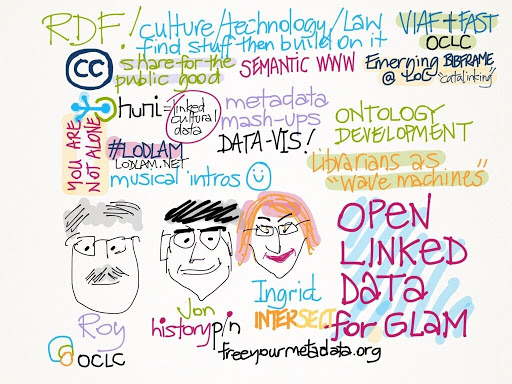 |
| Roy Tennant, Jon Voss and Ingrid Mason Keynote for ALIA Information Online 2013 |
This was one presentation that I felt I should attend, but I was also fearing because it is a serios and technical subject that might be hard to present in an entertaining and lively manner. Well that certainly was not the case with these three presenters. They grabbed our attention after lunch with well selected personal musical introductions for each.Then they managed to pass on some key messages about the benefits of open linked data along with some powerful examples of what data can do when it is shared, open and then linked. A very memorable presentation!
Ebooks, the future of research & cultural preservation by libraries

I read this post from O’Reilly TOC this morning and I was glad that someone finally raised these issues that have been bothering me for some time. I almost posted about the same issues a few weeks ago, but was distracted. The post raises some real concerns about the preservation of knowledge for future research. For me it is wider than that and goes to cultural preservation for our communities. Is it right that for our e-content we should just rely on someone else to have a copy (like Apple or Amazon as the article suggests)?
I had been worried about this, because like many other libraries we have been e-preferred for some time now. Is it also right that cultural material we collected and provided for our own communities could be unavailable for them in the future because the e-content is no longer available via our library? I don’t think it is and I don’t think we should simply hope for the best, divest ourselves of this responsibility and rely on others doing it for us, like say the National or State Libraries and certainly not the publishers because it isn’t really their role and it really never has been. Don’t we have an obligation along these lines (i.e. cultural preservation) for those in our communities? I think the rush to e-preferred has possibly led us to a focus on the now, the most convenient, the most efficient, and the least expensive alternatives, but quite probably at the expense of our obligation to preserve knowledge and culture for future generations.
I had been running around asking everyone who was involved with ebooks a lot of questions about what happens when the providers go bust, when we cease subscribing, or in the case of other inconvenient but worrying events (like hacking, file corruption, etc.). I am told that it varies with different ebook providers. Some regard it as a lease of those ebooks, others allow you to download the content in their proprietary format or in xml, but this ultimately isn’t a solution. Encrypted formats offer a whole other dilemma. Many contemporary publications are in danger of disappearing, becoming untrustworthy or inaccessible in the future if we don’t seriously consider this issue now. My own view is that there is actually more to cultural preservation of publications than simply preserving the xml. Books have always had other features, like covers, layout, typography, illustration, decoration, way finding assistance, etc., that add to the reader’s experience. In our relentless hunt for efficiency and convenience I think we’ve progressively discounted the value of these features for our readers.
Perhaps this will be addressed by those talking about ebooks at the 2013 ALIA Information Online conference in Brisvegas next week.
This was originally posted here:
http://informationonline2013.wordpress.com/2013/02/07/ebooks-the-future-of-research-cultural-preservation-by-libraries/
What did I say, think and write in 2012?

Just in case you missed it, and let’s face it you probably did, here is a listing.
With colleagues from UTS Library (S Schofield, B Tiffen) I co-authored the article “Change and Our Future at UTS Library: It’s Not Just about Technology.” Australian Academic & Research Libraries 43 (1) , 32- 45.
I contributed the essay “Design as a Catalyst for UTS Library” for J. Schweitzer & J. Jakovich (eds.) Crowd-Share Innovation: Intensive Creative Collaborations, Freerange Press ( 2012) , Ch. 2: 114- 119.
For the ALIA Biennial Conference Sydney 2012 (http://conferences.alia.org.au/alia2012/), again with UTS colleagues (B Tiffen, J Vawdrey), I co-presented on Discovery for Academic Libraries.
Chapter/essay (about the future library) for forthcoming book on the 25th Anniversary of UTS edited by Paul Ashton & Debra Adelaide. (Publication title not known yet.)
Various conference, interviews, blog posts and seminar presentations including:
- Design and our Future Library: more than just spaces and technology, a practitioner’s view, by invitation, for UTS:CMOS Workshop on Organisational Spaces. http://www.slideshare.net/malbooth/uts-future-library-more-than-spaces-technology A similar presentation was also given earlier that week to Australian University IT Directors & CIOs.
- Supporting researchers and research publication: impact measured by more than just metrics, for the seminar Measuring and Improving Library Value, 2012. http://www.slideshare.net/malbooth/supporting-researchers
- Creativity and (academic) libraries, for Library 2.012, an online conference run by the School of Library and Information Science at San Jose State University. http://www.slideshare.net/malbooth/creativity-academic-libraries
- Short talk on creativity and innovation in our Library at a Talk it up! Forum with Hael Kobyashi and Chris Gaul. http://hdl.handle.net/2100/1314
- Design as Catalyst at UTS Library, a masterclass for UTS:CI Labs 2012. http://www.slideshare.net/malbooth/design-catalyst-ci-lab-notes
- Making Researchers Famous With Social Media, for UTS Research Week 2012 http://www.slideshare.net/malbooth/making-researchers-famous-with-social-media
- From Search to Discovery in our Future Library (with Josh Vawdrey) for the ITD Divisional staff meeting (similar to the presentation given for the ALIA Biennial, but no pdf available, sorry).
- Short talk (as a panel member) for ALIA Sydney event on the Future of Reading: Books Are Not Dead. http://www.frommelbin.blogspot.com.au/2012/08/books-are-not-dead.html and an earlier talk for the same group UTS Library and Sustainability http://www.slideshare.net/malbooth/uts-library-sustainability
- Interview on UTS:Newsroom: From Triathlons to Tomes http://www.newsroom.uts.edu.au/news/2012/09/tomes-to-triathlons?
- Interview with CIO Summer 2012, 58-60: “Going Underground“ (with UTS CIO, Chrissy Burns) http://www.cio.com.au/article/444300/uts_library_goes_underground_robotics/
- Various blog posts for ALIA Information Online 2013: see http://informationonline2013.wordpress.com/ (including two long posts about the implications of recent changes in online learning for libraries). Those posts and most of the items listed here can also be found on this blog.
- Interview for UTS Engage about our future library at UTS, with Ryan Diefenbach (film-maker, producer): http://youtu.be/V1n0rgyQ4YQ
- Presentations (several) for CSU students, UTS Information and KNowledge Management students, and TAFE Librarians (from both Victoria and NSW) on the Future Library.
- Presentation for QUT’s Information Studies Group (online): Becoming Extraordinary. http://www.slideshare.net/malbooth/becoming-extraordinary
The implications for libraries of recent global trends in open online education (Part 2)

The implications for libraries of recent global trends in open online education

This is really a plea for advice or debate. I’d like to read your ideas, thoughts, suggestions, questions and comments. (There hasn’t been much over the last few days, so I’m adding a bit more content now just in case you feel you need more from me up front.) I’ve also posted this here http://informationonline2013.wordpress.com/2012/11/09/the-implications-for-libraries-of-recent-global-trends-in-open-online-education/
- A useful ARL Issue Brief: Massive Open Online Courses: Legal and Policy Issues for Research Libraries by Brandon Butler http://www.arl.org/bm~doc/issuebrief-mooc-22oct12.pdf This brief encourages us to start thinking strategically about how we will support the MOOC phenomenon and highlights the following as key issues for us to come to terms with: fair use; protecting and extending open access policies; ensuring accessibility; and the continued relevance of librarians and library collections to teaching.
- What Campus Leaders Need to Know about MOOCs http://net.educause.edu/ir/library/pdf/PUB4005.pdf This highlights the following as key issues related to library responsibilities and interests: intellectual property, Copyright, licensing of content, technical challenges, resource discovery and the delivery of teaching assistance and support.
- Should we just provide directories for various relevant open online courses (like we now provide books, journals and databases)? Or is more judgement needed? Do we need new skills to do this or should we collaborate with academics to do it? Some Directories Like that of Stephen Downes (above) already exist and essentially, the nature of the MOOC beast is to be “discoverable”, so keeping directories like this is a bit like that pre-Google approach of Yahoo. I don’t think it will work.
- Access to reading and reference materials is all well and good if you are enrolled in a university with access to the required or relevant texts and learning materials, but if not, are Open Access materials the answer and if so do we need to be doing more to encourage and promote them? This probably is the key step for most libraries. Many of us are already active in this space, but we probably could and should do more.
- If courses offered on things like various MOOCs, Coursera, Udacity, etc. are basically just new open platforms for education is the real threat to our individual learning management systems like Blackboard? Will online learning platforms simply become much more open and broader in scope? To some extent this is covered already in some of the links above and we are now seeing reports of providers like Blackboard and Instructure taking the initiative.
- Is there a link to the evolving provision of complex new e-Textbooks being promoted by publishers like Pearson (in various forms – hybrid, digital, enhanced and proprietary). Do we need to understand more about this too? I think we do need to understand more and it is another issue requiring collaboration between libraries, publishers and academics.
- How are publishers getting involved in supporting this global trend? I’m sure they’ve seen it and will be considering ways to generate revenue. As Stephen points out, this is something librarians already deal with on a daily basis, so we are well positioned to engage with them.
- Similarly, some LMS providers are also looking to get involved. Dealing with LMS providers is a bit of a line ball really, as at UTS, this isn’t our responsibility. It could, however, become more complex and require our input if there is a cross-over and we end up dealing with consortiums of content providers, platform providers and publishers.
- What do our academics want us to do? And what do students expect from us – e.g. 24/7 support. Will we be required to enhance the support provided (anytime, anywhere) for online or more remote learners, along with academic staff? Can that be done in isolation or is the answer here not in competing with other providers, but collaborating with them? I think libraries understand the benefits of collaboration and collaborative referencing models have already been proven in public libraries.
- Are libraries and librarians already “flipped”? (See articles above.) If we read what Betsy Wilson says on this above, we probably are already running like more of a flipped model. We have re-engineered our collections, services and learning spaces to reflect this over the last decade or even earlier.
- How can we do more with the data we have to assist us in responding to some of these questions with proper analytics? We are working on that now and looking at collecting open data from all new systems used within the Library. We are also looking at Privacy protections.
- Is increasing gamification in libraries at least part of the answer or do real libraries now offer a unique competitive advantage to enrolled students (in the physical spaces they offer)? The advantage is probably in developing innovative learning and study spaces that meet student and researcher needs. These spaces will probably include more space devoted to non-text media and even gaming, but primarily we still need to meet the demand for spaces that facilitate collaborative group work and meet student demands for silent and individual study.
- If libraries are already “flipped” should we be concentrating on the library as a “space or place” for more inquiry based learning that is supported in person by real people? This probably is the key advantage we can offer over any form of remote learning. We are reviewing the services we offer with a view towards a new service model for academic libraries that capitalises on this advantage in our future library.
- We are already positioned for more interactivity in libraries, but should we be providing even more spaces for this and less to simply store collections? Our current Library is still dominated by books, but with the excavation of our underground Library Retrieval System now complete, we will soon have the majority of our collection stored in it and quickly accessible from it. That will prob=vide us with more space in the current and future Library to meet all of the needs already touched on above as well as a few more.
- Students still come to academic libraries in their droves, but we need to know more about why they do. Is it simply for access to clean, moderated or mediated spaces with wifi, or are they seeking our help services, access to books and journals, a better environment for reading and writing, independent and quiet study spaces that are more conducive to learning than their homes (or informal learning hubs, cafes, etc.)? Are our (managed) collaborative group work spaces really important? Stephen believes that both part-time students and overseas students have a lot in common in what they need and want from the Library in terms of access to dedicated quiet spaces to study, particularly closer to exam times.
- How do we support future learning and research needs (vice simply managing our collections)? This probably means a further extension of our hours of opening, beyond what is offered today and collaborative arrangements with others to provide 24/7 online support. There could be workload implications in this.
- What are the technical issues for libraries (i.e. the real ICT issues) in all of this? Others are better equipped than me to deal with this, but certainly those providing and supporting MOOCs will have to consider the impact of a large increase in load on the ICT systems involved.
- What does open education actually mean for libraries – should it lead to more competition or are libraries well positioned and do we have a proven history to model the benefits of increased collaboration? Interestingly, my colleague Stephen says that campus based academic libraries are not in competition with online course providers. The free online providers do not give away access to the rich library collections that we provide to our enrolled students. Their’s is a very different model to fee-based higher education. Public libraries will not be able to satisfy their needs.
- Are there major costs involved – from the new services that we will need to purchase from publishers and other learning providers and possibly for increased or new licenses that facilitate this trend/initiative? As Stephen thoughtfully points out again, the increasing use of e-texts has driven down costs to some extent, allowing libraries to build broader collections than previously possible. We are now purchasing new titles or back-titles that were not previously covered or affordable. Other newer “special” collections are being established by campus-based libraries too. These are relevant to the needs of our institution and are unlikely ever to be part of the MOOC model.
Books Are Not Dead!
 |
| From Book Spotter’s Guide |
Not for thith little black duck …
So here are some notes from a short talk I did last night for ALIA Sydney on The Future of Reading. (It is also posted here https://informationonline2013.wordpress.com/2012/08/24/books-are-not-dead/) What follows are really just some random thoughts, not a deep, definitive or comprehensive prediction. It is a bit like Anne Elk’s Theory on Brontosauruses: My theory, which belongs to me, is mine.
I started by talking about the books in my own library, many of which I’ve not yet coloured in. You can view those I think highly enough of to catalogue, here on LibraryThing.
The Web & rich media
Only this week I saw the “Howl” animation on YouTube and was amazed. I’d not yet seen the entire film nor read much of Alan Ginsberg’s writings, but I will now. In these clips James Franco reads Ginsberg’s poem and it is brought to life, illuminated by his voice, Carter Burwell’s music and Eric Drooker’s brilliant animation design. I think it is a great example of using the web at its best to encourage reading. From there I think it is easy to see how the web has restored reading and writing as central activities in our culture (vice sitcoms on TV) as Clay Shirky said in the Wall Street Journal in 2010.
Yes, parts of the web are ephemeral, but so too should be a lot of printed text. Just because it is printed on paper does make our reading material more valuable.
Aggregation & Disaggregation of content
I see and use a number of things that are all positive signs for the future: aggregators and personalised reader advisories (like Zite, Huffington Post, & FlipBoard – and sometimes I wonder how long they can survive as free services), piracy (Neil Young says it is the new radio for recorded music); and we could also talk about those authors who give away online books for free online and then sell more print books accordingly, like Cory Doctorow and Seth Godin. Then there is the wonderful Interactivity we see in Zite (an app for iPads and iPhones) which learns what you like to read via voting up and down and your ongoing selection of subject matter and creators.
Disaggregation of content comes in here too because that is how aggregators work. They select and aggregate disaggregated content. Disaggregation has already happened in music (e.g. buy a song rather than whole album on iTunes) and is happening in some publishing (buy a chapter, article etc rather than whole book or issue). Some see it as a bad thing, quoting death of the book, loss of narrative form, negative effects on literacy, etc. but it can also lead to new forms of non-linear story-telling, plus it’s also not new. The great Victorian novels like those of Dickens often were serialised. I think disaggregation is particularly important for journalism now because over the last decade we’ve become more exposed to the variety of news sources that are now available to read via the web and hardly anyone is really going to continue to be satisfied by the one subscription to a particular news publisher (IMHO).
Revenue – new streams?
I’m an optimist here too, but we might need to be patient. I don’t think we see a stable digital publishing market, particularly not for ebook lending and newspapers. As well everyone is still trying to protect and defend IP and ownership of content on a copying machine that now has global scale via outdated, unworkable and inappropriate models (e.g. Copyright law and DRM). Solutions will probably come from a range of options like micro payments, subscriptions, advertisements, application sales, premium upgrade options, renting like films, marketing associated product and memberships. Perhaps the publishing industry has a bit to learn from film and music? It does seem to be slow to react and evolve, and resistant to inevitable change
NYR12
For Librarians, every year should be the National Year of Reading (NYR), we must be more active in encouraging reading, get more involved, and should not just stop what has been happening this year after 2012 comes to an end. There are many great causes that need our support like the Indigenous Literacy Foundation. Don’t stop now!
Books are not dead & neither are bikes
Books and bikes are both great models that will survive. Just as bikes survived the motor car and aeroplanes, books too are really good at what they do. I think those of us in the reading industry (if you can actually call it that) need to understand deeply why the model and power of the printed word (and illustration!) will survive. There’s a lot more to books and reading than just efficiency of digital storage and the ability to transport 453 books with you on the tram or on holiday. Who cares that you can carry more than 400 books in your small Crumpler bag? Do we have the same experience with all ebooks? Do they form the same lasting relationships and remind us of holiday reads? Can you decorate a whole house or even one room with your Kindle? Do they capture the same attention? I’m not so sure.
Maybe some of the future for printed books will be as art and artefacts. A colleague at UTS Library Dr Belinda Tiffen says you only have to think of illuminated manuscripts or even coffee table books as art objects rather than (or as well as) just a means to convey text. So one possible future for reading could be that a lot of ‘ephemeral’ material could become purely digital (popular novels, etc.), and printed books could become more niche or specialised editions. We are also starting to see the emergence of ebooks as conveyers of design, more interesting typography, illustration, alternative endings and even interactivity with regard to story-telling, so the game isn’t up yet. (My thanks to Belinda for a few of the ideas I’ve used here!)
The future for reading is richer for the digital age. We have even more options and the old formats like books, newspapers and magazines will have to evolve to survive. That’s all!
Thinking Differently: Twitter and Zite can help
(Reblogged from something I posted here: http://informationonline2013.wordpress.com/2012/08/14/thinking-differently-twitter-and-zite-can-help/)
Here is a rag bag of different articles that you could have read and pondered over just the last 24 hours if you were a Twitter or Zite user. For those who don’t know it, Zite is a great free iPad app that functions for me as a personal newspaper or reader. It knows my interests (I told it) and it learns what I like to read and delivers me more content on a regular basis without all the rubbish that clutters other services. I wonder how long it’ll last like this so get in fast before Rupert kills it.
- The e-book lending wars: When authors attack. Fear of piracy and authors against lending on principle. It all sounds awful. What is lovely is this bit: As musician Neil Young put it recently: “Piracy is the new radio — it’s how music gets around.” So true. I heard a very experienced lawyer for US musicians recently at an ideas fest in the OPera House. He said that the problem the record companies had with Napster was not that they stole their content, but that Napster could do what they could not do: distribute music really fast (online).
- Top 10 Clever Uses for Dropbox. Normally I don’t like top 10 lists, but I do like Lifehacker and I use Dropbox, so I looked at this and saw some uses that I wasn’t familiar with like monitoring your computer for unauthorised access or managing BitTorrent downloads (not that I even know what a torrent file is!).
- Twitter and Scientists. A PhD candidate shares some of the things she finds useful with Twitter.
- Textbooks Unbound. A startup called Boundless challenges the textbook market by packaging (freely available) open access materials. This talks about moves by companies like Amazon to rent textbooks and the developing open educational resources movement (or market?). Boundless is being sued by at least three publishers. Of course it is.
- What Will Higher Education Look Like in 2020? Tanya’s maths is bad: 2020 is only eight years away, not 12. This is, however, a topic that is concentrating a lot of thought in universities at present. It is all still a bit debatable. You could look into the economics behind Massive Open Online Courses (MOOCs) in this essay Bitter Reality of MOOConomics or another article on What’s right and wrong about Coursera-style MOOCs. How do future libraries fit into all this? If you have any thoughts please send them to me. And here are Four Reasons Librarians Should Join a MOOC.
- For those keen on sport and the recent Olympics in London there is this great article Swimming Australia’s incentive model was a failure: fact. Essentially the article is about people, not sport. As a lapsed economist I agree with this sociologist’s take on it all that not everything in life should be reduced to a simple cost-benefit analysis and also that sociability shapes our motivation. We do care what others think of us. I really enjoyed reading this article and the voicing of opinions like this is long overdue.
- Putting an End to the Biggest Lie on the Internet. Those pesky Terms of Service that we all agree to! A new site aims to give more power to users by summarizing terms of service, flagging potential issues and rating apps on a scale from A (the best) to E (the worst). TwitPic gets the worst possible rating so you might want to consider future use. Thanks to @marksmithers of Swinburne Uni for that tweet!
- BrainPickings is always good for thought-provoking content, so here’s 10 Rules for Students, Teachers and Life by John Cage and Sister Corita Kent. I really like rules 4, 6 & 8. Life is short: share your passion!
- Finally, some tips for those with iPads: a how-to guide for Blogging Using Just the iPad.
All of this was collected and shared in just 24 hours using Twitter and Zite. It is that easy.
Making researchers famous with social media
These are the slides and notes for a workshop we are running for academic researchers on using social media to raise their profiles as part of our UTS Research Week 2012 program.
 FromMelbin